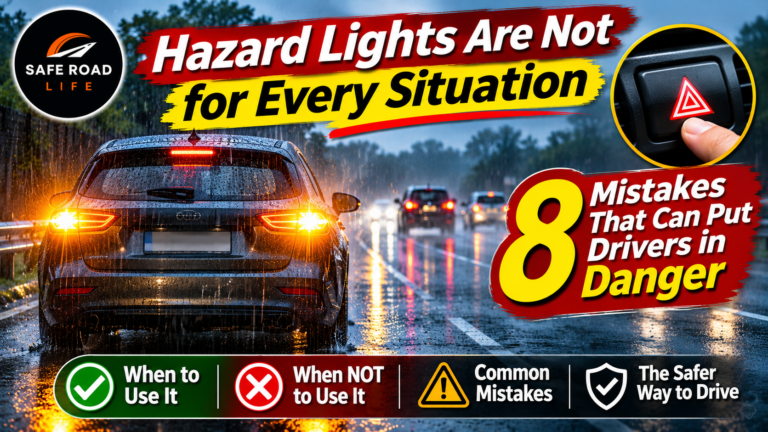
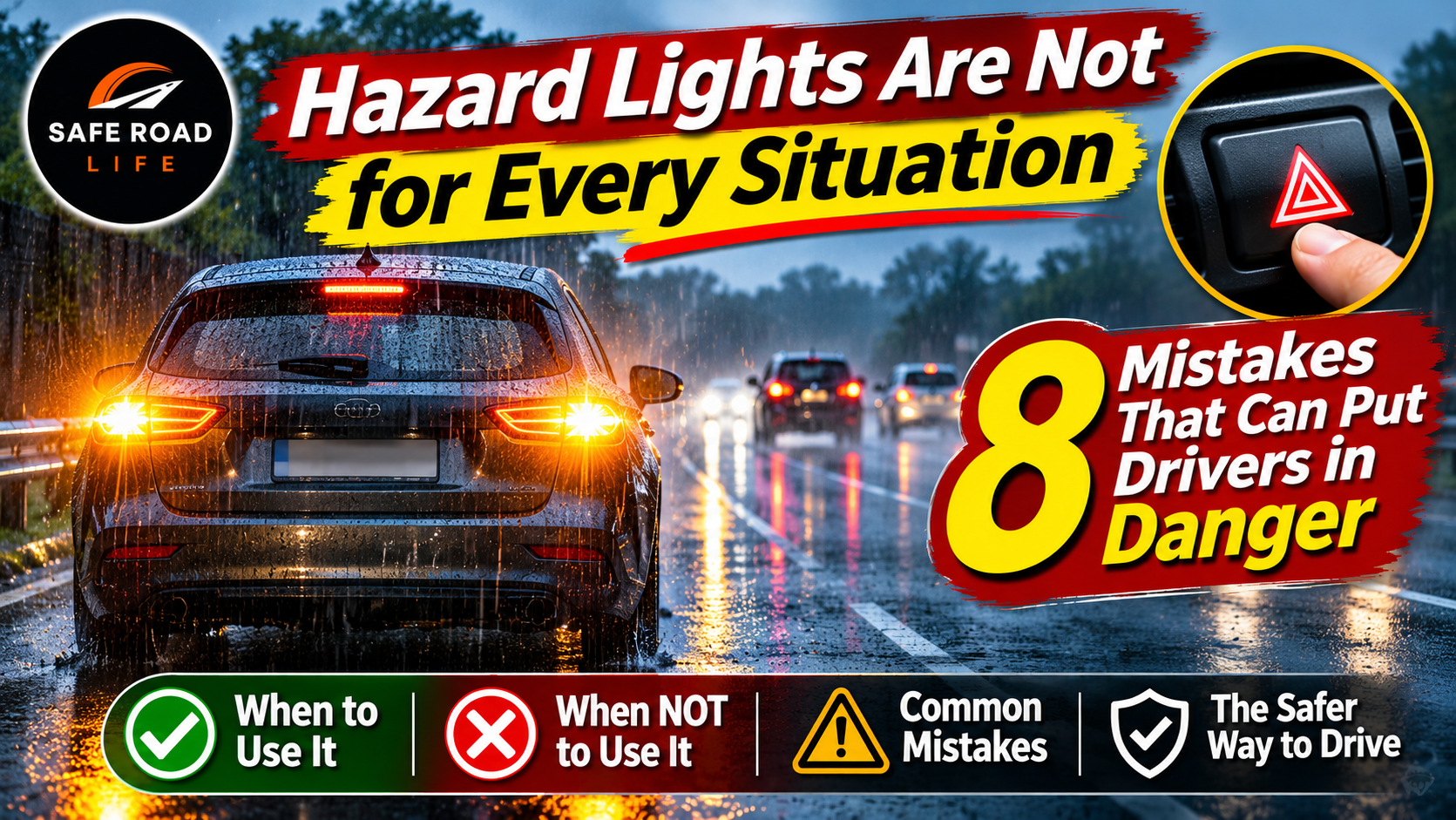
You see rain, slow traffic or a patch of fog ahead. A driver switches on the hazard lights and continues moving. Another vehicle stops suddenly with its hazards flashing. Which action is correct—and which one could confuse the drivers around them?
Hazard warning lights are an important vehicle safety feature, but they are not a substitute for safe driving, proper lighting or a warning triangle. Used at the wrong time, they can make your intentions harder to understand and may hide your turn indicators on some vehicles.
Rules differ by country and vehicle. Always follow local traffic law and your vehicle owner’s manual. This guide explains practical safety principles for drivers.
What are hazard warning lights designed to do?
Hazard warning lights usually flash the vehicle’s left and right indicators together. Their main purpose is to warn other road users that your vehicle is creating or facing an unusual hazard—for example, when it has broken down or is stopped in a dangerous position.
They do not give you permission to stop anywhere, drive faster, park illegally or ignore traffic signals. They also do not tell other drivers whether you are turning, changing lanes or continuing straight.
8 common hazard-light mistakes that can create danger
1. Driving with hazard lights on in ordinary rain
Rain reduces visibility and grip, but switching on hazards while continuing to drive can make your next move difficult for others to read. On many vehicles, the hazard system also prevents normal use of the turn indicators while it is active.
Safer action: Slow down smoothly, increase your following distance, use your headlights as required, and avoid sudden braking or lane changes. If conditions become too dangerous, find a safe legal place to stop rather than continuing with hazards flashing.
2. Treating hazard lights as fog lights
Hazard lights do not help you see through fog. Their flashing can distract other road users and make it harder to judge your vehicle’s movement.
Safer action: Use the correct headlights and fog lamps if fitted and permitted, reduce speed, leave a larger gap and avoid high-beam glare. If visibility is extremely poor, stop in a safe location away from the live carriageway.
3. Using hazards while changing lanes or turning
Flashing both indicators does not communicate which direction you intend to take. Other drivers, cyclists and pedestrians may not know where you are going.
Safer action: Switch hazards off before making a normal turn or lane change and use the correct indicator. Check mirrors and blind spots, signal in good time and move only when there is a safe gap.
4. Stopping in a live lane and assuming hazards make it safe
Hazard lights may make a stationary vehicle more visible, but they cannot protect it from a fast-moving vehicle approaching from behind. A stopped vehicle in a live lane can create a serious collision risk.
Safer action: If the vehicle is still controllable, move to a safe refuge, shoulder or designated stopping area where lawful. Switch on hazards once stopped if appropriate. Keep occupants away from traffic and follow local breakdown procedures.
5. Forgetting hazards after a breakdown or emergency stop
A vehicle that has stopped unexpectedly may be difficult to see, especially at night or on a fast road. Failing to warn approaching traffic can increase the risk of a secondary crash.
Safer action: If safe and permitted, activate hazard lights, move people to a protected place away from traffic, and call roadside assistance. Use a warning triangle only where local rules permit and only if it can be placed without putting anyone in danger.
6. Using hazards to justify illegal or unsafe parking
Stopping in a no-parking zone, across a pedestrian crossing, near a junction or in front of an emergency access does not become safe simply because the hazard lights are on.
Safer action: Choose a legal, safe stopping place. Keep junctions, crossings, bus stops, cycle lanes, emergency access and visibility zones clear.
7. Leaving hazards on when the vehicle is moving normally
Continuous flashing can become background noise to other road users. It may also conceal a genuine intention to turn or change lanes. Some drivers mistakenly use hazards to signal thanks or to travel in a group.
Safer action: Use hazard lights only for a genuine warning situation as allowed by local law and your vehicle manual. Use normal indicators for turns and lane changes, and maintain safe spacing in a convoy.
8. Relying on hazard lights instead of making yourself safe
Hazards are only one warning measure. They do not replace moving out of traffic, wearing a reflective vest where available, using a safe refuge, or calling for help.
Safer action: Prioritise people over the vehicle. If you break down, follow your local road authority’s guidance, keep passengers away from moving traffic and never stand behind or beside a vehicle in a live lane.
When should you use hazard warning lights?
Depending on local law and your vehicle instructions, hazard lights are generally appropriate when your vehicle is stopped or presents an unusual hazard to other road users, such as after a breakdown or an emergency stop. They may also be required in specific situations under local rules.
Do not assume that every country permits hazards while a vehicle is moving. Check the applicable traffic regulations. In all cases, hazards are a warning—not a licence to drive without care.
What to do if your vehicle breaks down
- Move as far out of the traffic flow as you safely can.
- Switch on hazard warning lights if appropriate.
- Stop on a firm, safe surface away from bends, junctions and narrow shoulders where possible.
- Use the passenger-side exit if that is the safer side, and move occupants behind a suitable barrier where one exists.
- Do not stand in front of or behind the vehicle in a live traffic lane.
- Call roadside assistance or the relevant emergency service if the location is dangerous or anyone is injured.
- Follow local rules for warning triangles and reflective equipment; never risk your life to place one.
Hazard-light safety: a quick driver checklist
- Am I warning others about a genuine hazard?
- Is my vehicle stopped or moving? Check local law before using hazards while moving.
- Can other drivers understand my next action? Use normal indicators for turns and lane changes.
- Am I in a safe location? Hazards do not make a dangerous stopping place safe.
- Are passengers protected? Move them away from traffic and call for help when needed.
Remember: visibility is not the same as safety
Hazard lights can warn other road users, but safe positioning, correct signals, sensible speed and clear communication matter just as much. Do not switch them on out of habit. Understand why you are using them—and make sure your actions are predictable to everyone sharing the road.
Share this guide with family members, new drivers, professional drivers and fleet teams. One misunderstood signal can create confusion; one safer decision can prevent a crash.
DRIVE SAFE. STAY SAFE.
@SafeRoadLife
Related SafeRoadLife guides
- A Breakdown on the Highway Can Turn Deadly: 9 Rules to Keep Everyone Safe
- The Road Disappears in Fog: 10 Rules for Safer Driving in India
- After a Road Crash: 8 Steps to Help Safely Without Becoming the Next Victim
Further guidance
For country-specific requirements, consult your local road authority and the vehicle owner’s manual. In India, refer to the Ministry of Road Transport and Highways for official road transport rules and guidance.
About the Author