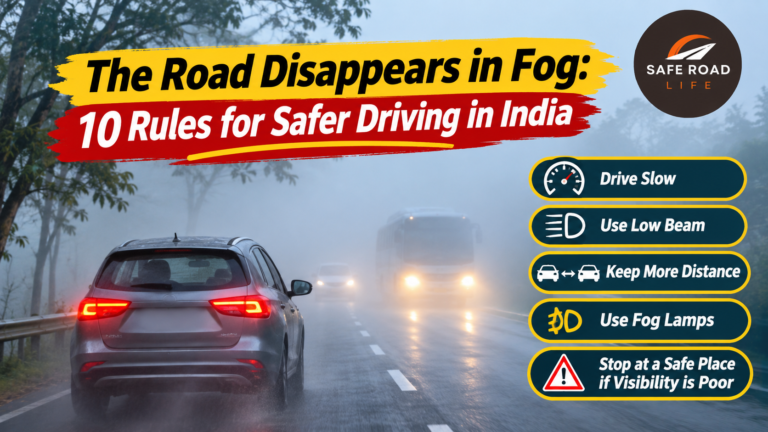
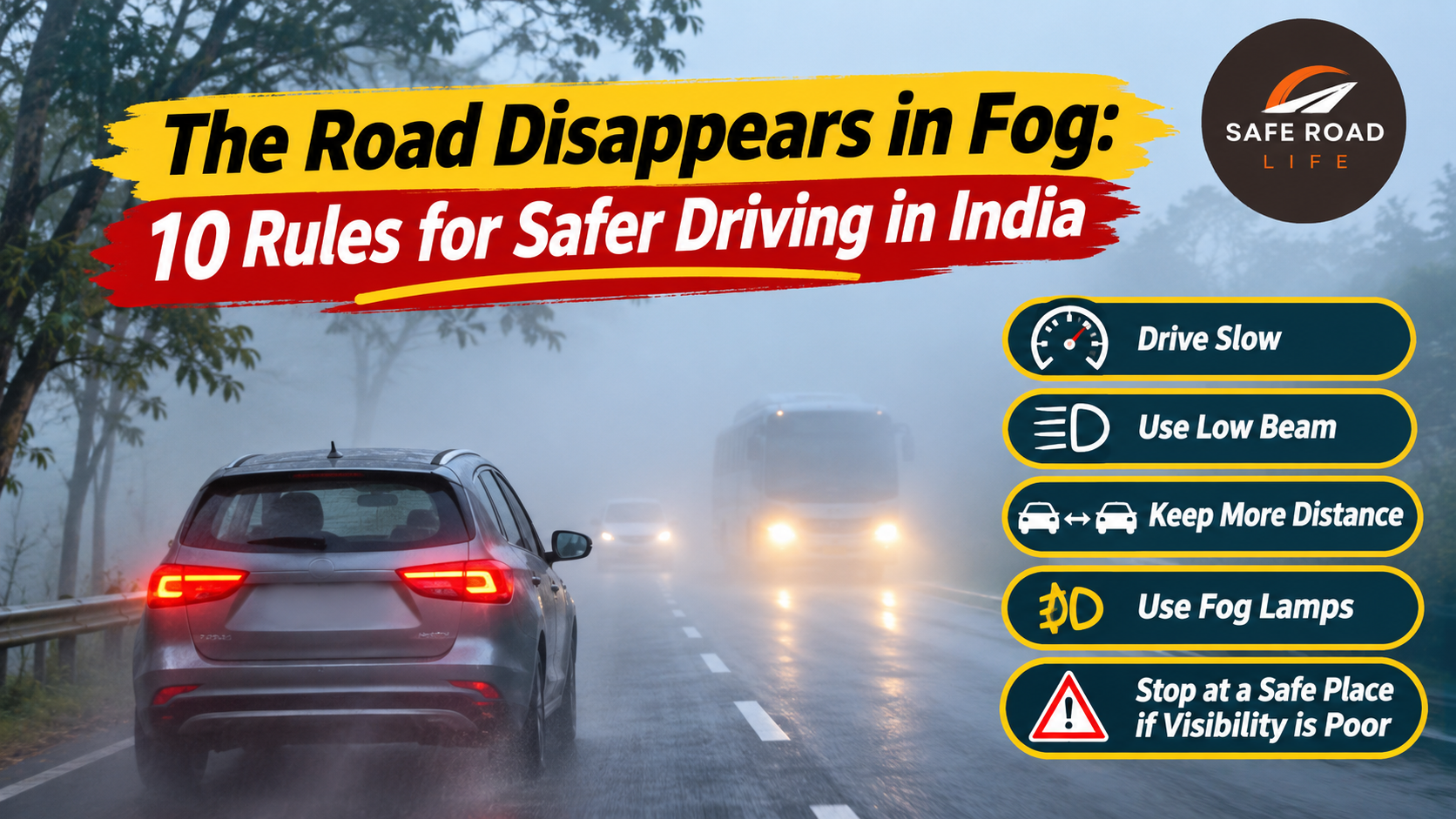
In fog, the road does not become shorter. Your safe seeing distance does. A vehicle emerging through a white wall may be much closer than it appears. Slow down, make your vehicle visible and leave room to stop.
Fog can form in patches and hide stopped vehicles, lane markings, road edges and people. These rules apply to cars, buses, trucks, motorcycles and all road users.
Why fog turns an ordinary journey into a high-risk drive
Fog sharply reduces the distance a driver can see. If speed is too high for that visible distance, there may be no time to react to a queue, bend, slow vehicle or person crossing.
The Motor Vehicles (Driving) Regulations, 2017 address this directly: Regulation 16(2) requires a lower speed during fog and other adverse conditions so the vehicle can stop within the range of forward vision. Regulation 17 also requires a sufficient following distance. The message is simple: drive to the visibility available, not to the speed you normally use on that road.
10 fog-driving safety rules every Indian road user should follow
1. Check conditions before leaving
Check the forecast and local traffic advisories before a long or early-morning trip. IMD provides a fog-warning dashboard for highways and transport routes. Delay a non-essential journey if dense fog is expected.
2. Prepare the windscreen, windows and lights
Clean the windscreen, windows and mirrors. Check washer fluid, wipers, demister, headlights, tail lamps, brake lights and indicators before moving. A small clear patch is not enough.
3. Use dipped headlights—not high beam
Switch on your headlights on low beam so your vehicle can be seen without creating unnecessary glare. High-beam light can reflect off fog droplets and make the view ahead worse. Use fog lamps only when visibility is considerably affected and with dipped headlights, as specified in Regulation 31. Parking lights alone are not a substitute for proper headlights.
4. Reduce speed to match what you can see
Ease off early and choose a speed that lets you stop within the clear distance ahead. There is no universal safe speed: visibility, road layout, traffic, tyres and load all matter. Slow further if fog thickens.
5. Increase the gap in front
Leave a larger gap than in clear weather. The vehicle ahead may brake or stop suddenly. Never make its tail lamps your only guide; keep enough room to react.
6. Avoid overtaking and unnecessary lane changes
Do not overtake when you cannot see far enough ahead to confirm that the road is clear. Stay in your lane, follow visible lane markings where they are clear and avoid weaving around slower traffic. A few minutes saved are not worth entering an unseen vehicle’s path.
7. Brake and signal progressively
Anticipate junctions, toll areas, curves and queues. Brake smoothly and signal early. Check mirrors before slowing, while keeping attention on the road ahead.
8. Stay alert for people and vehicles without lights
Watch for pedestrians, cyclists, two-wheelers, parked vehicles and animals. Slow near villages, bus stops, junctions and unlit stretches; an empty-looking road may not be clear.
9. If visibility becomes unsafe, stop only in a safe place
If you can no longer see enough road to continue safely, leave the carriageway at a suitable designated parking area or other safe location. Do not stop in a live lane, near a blind bend or where another driver may run into your vehicle. If you have to stop, make the vehicle visible with its warning lights and follow the vehicle maker’s and local authorities’ instructions. Wait until conditions improve.
10. Give two-wheelers and large vehicles extra consideration
Motorcyclists should use working dipped headlights, clean rear lights and reflectors, and visible protective clothing. Car drivers should give them room. Bus and truck drivers must allow for the effects of vehicle size and load on stopping.
Do’s and Don’ts in fog
Do
- Use dipped headlights and appropriate fog lamps when visibility is seriously reduced.
- Reduce speed and keep a larger following distance.
- Keep the windscreen, mirrors, lamps and reflectors clean.
- Follow lane markings and traffic signs without sudden changes.
- Consider postponing a non-essential journey when dense fog is forecast.
Don’t
- Do not use high beam to try to see through fog.
- Do not drive using parking lights alone.
- Do not tailgate, overtake blindly or chase another vehicle’s tail lamps.
- Do not accelerate just because a short stretch looks clearer.
- Do not stop in a traffic lane or at a place where approaching drivers cannot see you in time.
What safer fog driving achieves
Lower speed and more space give drivers time to respond. Correct lighting improves visibility without avoidable glare, while smooth braking and steady lane discipline reduce sudden conflicts. Delaying an unsafe journey avoids taking an unnecessary risk.
Your 30-second pre-drive fog checklist
- Weather and route advisories checked.
- Windscreen, windows and mirrors clear.
- Wipers, demister, headlights, tail lamps and indicators working.
- Low-beam setting selected; fog lamps used only when needed.
- Journey time adjusted—no pressure to make up lost time.
- Seat belts fastened and mobile phone put away.
Remember: if you cannot see far, do not drive fast
Experience cannot make fog transparent. Respect the limit of visibility, leave room to react and be willing to wait. Reaching late is better than not reaching at all.
Sources and further reading
- The Gazette of India – Motor Vehicles (Driving) Regulations, 2017 (Regulations 16, 17 and 31)
- Jharkhand Police – Driving under Fog
- India Meteorological Department – National Highway and Transport Fog Warning Dashboard
- Delhi Traffic Police – December 2025 Newsletter and low-visibility road-safety message
Drive Safe Stay Safe
@SafeRoadLife
About the Author