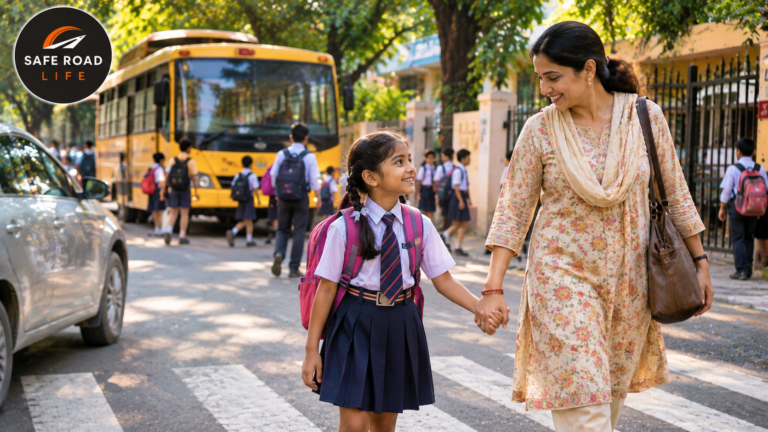
The school bell has not rung yet. A parent is late, a car stops near the gate, a child opens the door and steps towards the road. At the same moment, another vehicle is reversing out of a crowded space. In the rush of an ordinary school morning, a few metres of road can become a place of serious danger.
We often think of school-zone safety as a speed-limit sign or a painted warning on the road. But a safe school journey depends on what happens before the child reaches the gate, while vehicles arrive and leave, and when children cross the street after classes. The most important safety work happens in the space where children and traffic meet.
The danger is concentrated around the school gate
At arrival and dismissal times, the road outside a school can become crowded with cars, buses, two-wheelers, auto-rickshaws, bicycles and pedestrians. Vehicles stop in a hurry. Children may emerge from between parked cars. Drivers may reverse without a clear view. A child who is excited, distracted or still learning how traffic works may move unpredictably.
Children are smaller and harder for drivers to see, especially close to the front or rear of a vehicle. Their ability to judge speed and distance is still developing. They may assume that a driver has noticed them, even when the driver is focused on traffic or searching for a parking space.
A school entrance should not become a traffic bottleneck
When every parent tries to stop directly at the gate, the result can be double parking, blocked footpaths, sudden U-turns and children stepping into moving traffic. A school should have a planned pick-up and drop-off arrangement that keeps vehicles moving slowly and gives children a protected route from the vehicle to the entrance.
Where space permits, schools and local authorities can create designated stopping areas, separate pedestrian access, marked crossings, traffic-calming measures and supervised crossing points. Staff and volunteers should be visible and trained, with a clear system for managing buses, private vehicles and pedestrians. The design should avoid forcing children to walk between queued vehicles.
The walk from the vehicle matters as much as the ride
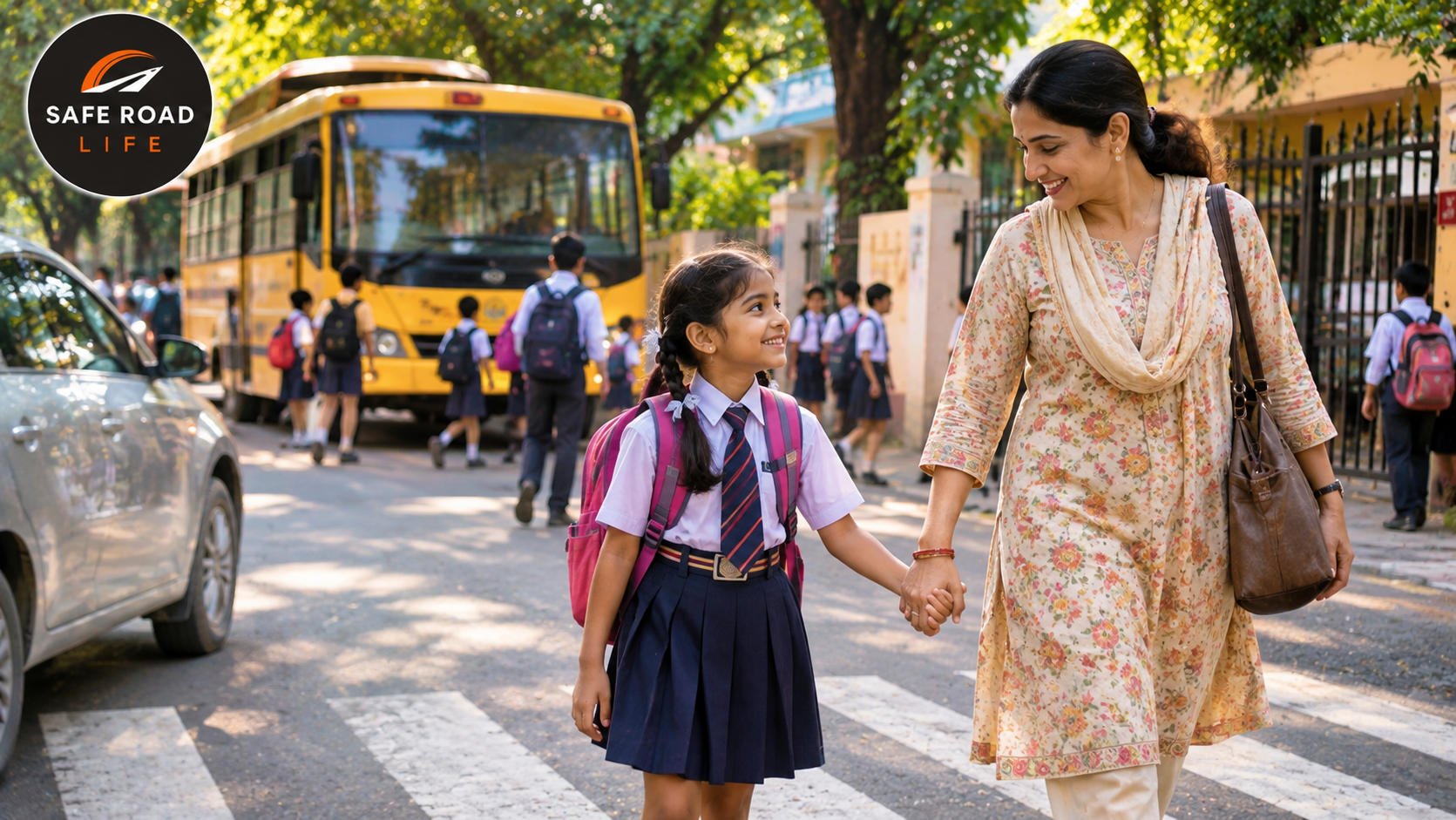
A child may travel in a properly restrained car or school bus and still face danger in the final few metres. Parents should choose a safe place to stop, help younger children exit on the footpath side where possible and make sure they reach the school entrance without crossing between moving vehicles. Never call a child across the road from the opposite side while traffic is moving.
Drivers passing a school should slow down before reaching the entrance, scan both sides of the road and expect a child to appear from behind a parked vehicle. Do not overtake a stopped school bus where local law prohibits it, and obey crossing guards and school traffic instructions. A child near a school gate should never have to compete with a driver in a hurry.
Reversing is a particular risk for small children
Children can disappear from a driver’s view behind a vehicle. Reversing cameras and sensors are useful aids, but they do not replace a careful check around the vehicle. Before moving, drivers should look for children and pedestrians, check mirrors and cameras, and reverse slowly only when the path is clear. If visibility is restricted, use a responsible guide where appropriate or choose a space that allows the vehicle to leave forwards.
Schools should discourage reversing manoeuvres in crowded pedestrian areas wherever possible. A one-way circulation plan, separate entry and exit points and a no-reversing pick-up arrangement can reduce conflicts if the site layout allows them.
School buses need safe boarding and alighting space
A school bus should stop at a designated place where children can board and get down away from moving traffic. Children should never be expected to run across the road to catch a bus or walk around its front or rear to cross. Drivers and attendants must account for every child, check the area around the vehicle and follow the applicable school transport rules.
Other drivers should slow down and follow local laws when approaching a stopped school bus. Rules differ between countries and jurisdictions, so drivers must know the requirements where they travel. The essential principle is universal: when children are boarding or leaving a school vehicle, their safety takes priority over the convenience of passing traffic.
Children need to learn safe habits—but adults must build a safe environment
Teach children to use footpaths and designated crossings, stop at the kerb, look for traffic in every direction and wait until vehicles have stopped before crossing. Explain that they should never run between parked vehicles or assume a driver has seen them. Practise the route with younger children rather than relying on a one-time instruction.
But education cannot compensate for an unsafe street. A child can follow every instruction and still be placed in danger by speeding, blocked footpaths, poor visibility or an uncontrolled vehicle queue. The responsibility for safe school access belongs to drivers, schools, transport operators, parents and road authorities together.
Make the school journey a safe part of the school day
Schools should review the road outside their gates at the actual times children arrive and leave. They should identify where vehicles reverse, where children cross, where buses stop and where sightlines are blocked. Parents should follow the agreed pick-up system rather than creating a second row of informal parking. Local authorities should address speeding, unsafe crossings and footpath obstructions around schools.
A school is a place where children learn how to build their future. The road outside it should not put that future at risk. A few minutes saved by stopping at the gate are never worth a child’s safety.
DRIVE SAFE. STAY SAFE.
@SafeRoadLife
Sources and further reading
- World Health Organization – Pedestrian Safety: A Road Safety Manual for Decision-Makers and Practitioners
- UNICEF India – Child Road Safety
- US National Highway Traffic Safety Administration – Child Safety
- International Transport Forum (OECD) – Children and Transport
Related reading: The School Bus Stop Is a Danger Zone and Every Step Matters: Pedestrian Safety.
About the Author