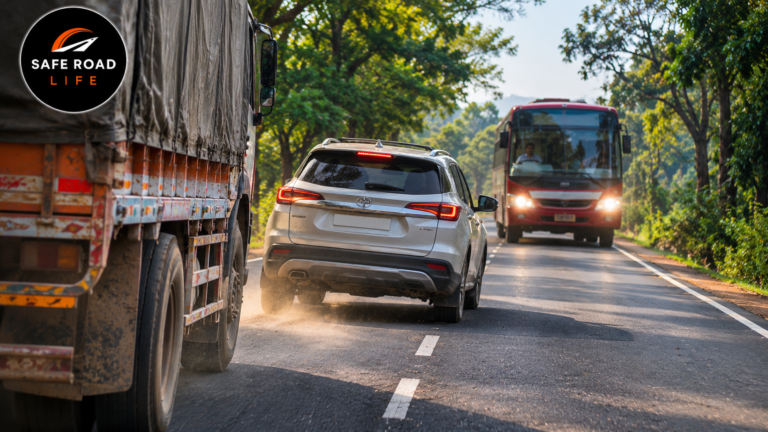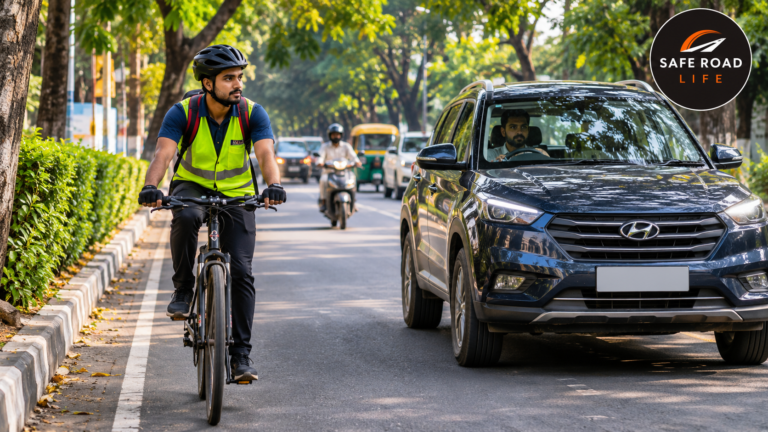
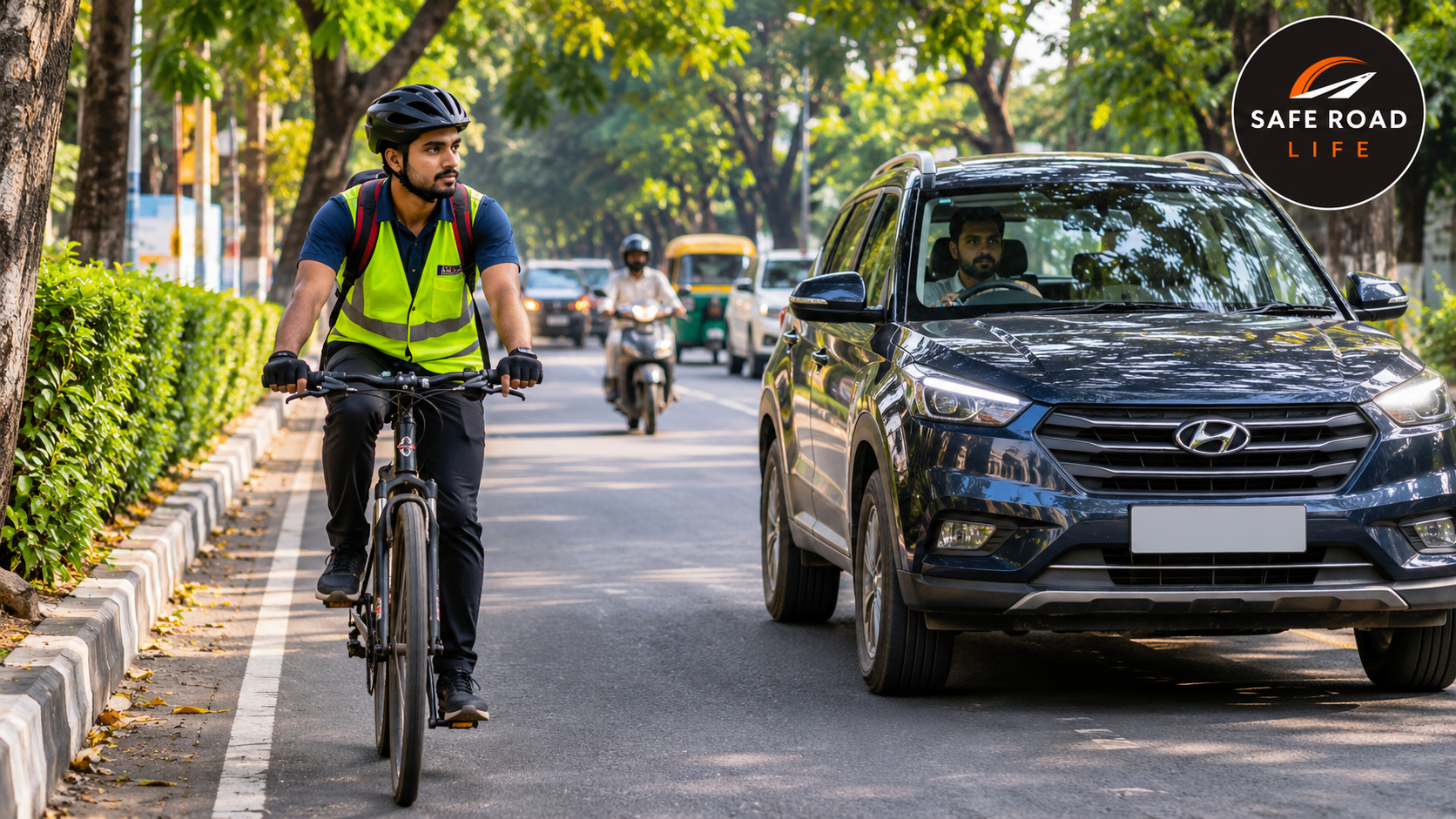
A cyclist rides close to the edge of the road. A car approaches from behind. The driver sees a narrow gap and thinks there is enough room to pass. The cyclist feels the rush of air, hears the engine and instinctively moves closer to the kerb. A parked car door opens ahead.
For a person on a bicycle, an ordinary journey can involve a series of risks created by the space other road users leave—or fail to leave. A bicycle offers little physical protection. A small mistake by a driver, a blocked cycle lane or a sudden door opening can have serious consequences.
A bicycle is traffic, not an obstacle
Cyclists use roads for work, education, exercise and daily travel. They may need to move away from the kerb to avoid potholes, drains, parked vehicles, debris or pedestrians. That movement is not necessarily unpredictable or careless; it can be a response to hazards that a driver may not notice from inside a vehicle.
When drivers treat a cyclist as an obstacle to get around quickly, the available safety margin disappears. The safer approach is to recognise the bicycle as a legitimate road user, reduce speed and wait until there is enough space to pass without forcing the rider towards the edge.
The close pass can be frightening—and dangerous
A vehicle passing too closely can destabilise a cyclist, leave no room to avoid a pothole or push the rider into the kerb. Even when there is no physical contact, the sudden pressure and noise can cause a loss of balance. A safe overtake requires more than fitting a car through a gap: it requires leaving a comfortable lateral clearance and enough room for the cyclist to continue riding predictably.
Drivers should slow down and wait behind a cyclist when the road is narrow, visibility is limited or oncoming traffic prevents a safe pass. Never squeeze through simply because the bicycle is close to the left edge. If you cannot leave adequate room, do not overtake yet.
A painted cycle lane is not safe if it is blocked
Cycle lanes can help separate bicycles from faster traffic, but only when they form a continuous and usable route. A lane occupied by parked cars, delivery vehicles, rubbish, construction material or broken surfaces may force cyclists back into moving traffic. A lane that disappears abruptly at a junction can also leave riders exposed at precisely the point where turning movements meet.
Road authorities need to maintain cycle routes, protect them from illegal parking, provide safe junction transitions and connect them to destinations. Paint alone cannot create safety if the space is not respected, maintained and designed around real movements.
The parked-car door that can enter a cyclist’s path
A person opening a vehicle door may look only for cars approaching from behind. A cyclist can be travelling in the narrow space beside the parked vehicle and may have no time to avoid the door. This is often called a “dooring” collision.
Drivers and passengers should check for bicycles and other approaching road users before opening a door, and use the hand farthest from the door where practical so the body naturally turns towards the traffic. Cyclists should remain alert around parked vehicles, but the responsibility to check before opening a door belongs to the person inside the vehicle.
Junctions are where attention matters most
Many serious conflicts happen when a vehicle turns across a cyclist’s path or a cyclist continues straight alongside a vehicle that is turning. Drivers should check mirrors and blind spots before turning, signal clearly and never assume a cyclist has stopped simply because the vehicle is larger. Cyclists should make their movements predictable, use lights when visibility is reduced and approach junctions with care.
At traffic signals, drivers should avoid stopping across cycle crossings or in designated waiting areas. Road designers can reduce conflict through protected junctions, clear markings, lower turning speeds and signal phases that reduce simultaneous crossing conflicts.
What cyclists can do to improve their visibility
Working lights, reflective details and visible clothing can help other road users detect a cyclist, especially at dawn, dusk and night. A well-maintained bicycle, correctly adjusted brakes and tyres, and a properly fitted helmet also support safer riding. Riders should obey local traffic rules, signal intentions where appropriate and avoid sudden movements where possible.
These measures help, but they do not transfer the whole burden of safety to the cyclist. A rider can be visible and predictable and still be endangered by speeding, close passing, blocked lanes or unsafe junction design.
Safer streets benefit everyone
When cycling feels safe, more people can choose a low-cost, space-efficient way to travel. Connected protected routes, lower speeds where people mix, safe crossings, secure bicycle parking and respectful driving make streets more useful for communities. They also reduce conflicts between cyclists, pedestrians and motor vehicles.
The question is not whether a cyclist deserves space. The question is whether a road system should make a person risk their life simply to travel a short distance. A safe road gives every user enough room to make ordinary movements without being punished for them.
The next time you approach a cyclist, remember: arriving a few seconds earlier is never worth passing too close. Give space. Share the road. Protect a life.
DRIVE SAFE. STAY SAFE.
@SafeRoadLife
Sources and further reading
- World Health Organization – Pedestrian Safety: A Road Safety Manual for Decision-Makers and Practitioners
- UK Department for Transport – Highway Code: Rules for cyclists
- International Transport Forum (OECD) – Cycling Safety
- US National Highway Traffic Safety Administration – Bicycle Safety
Related reading: One Door. One Second. One Serious Crash and The Quietest Vehicle on the Street May Be the One You Never Hear.
About the Author