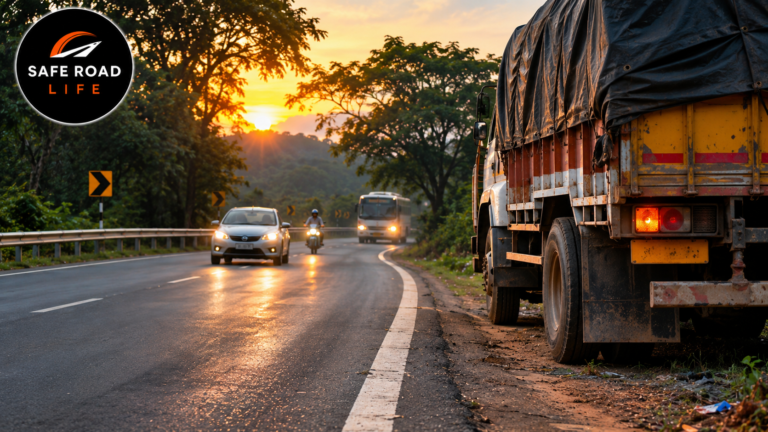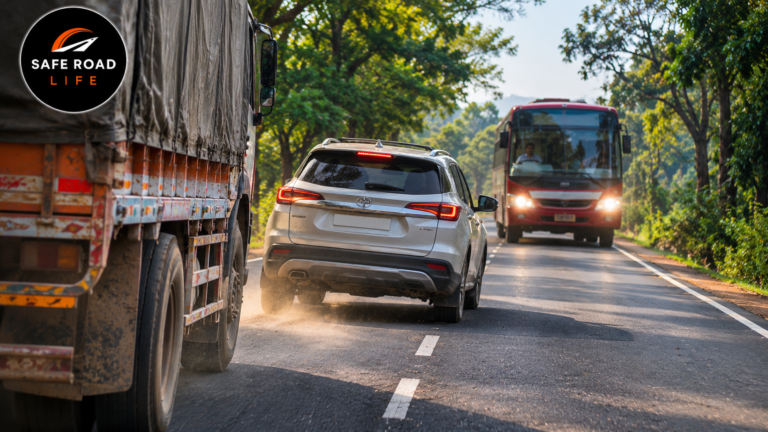
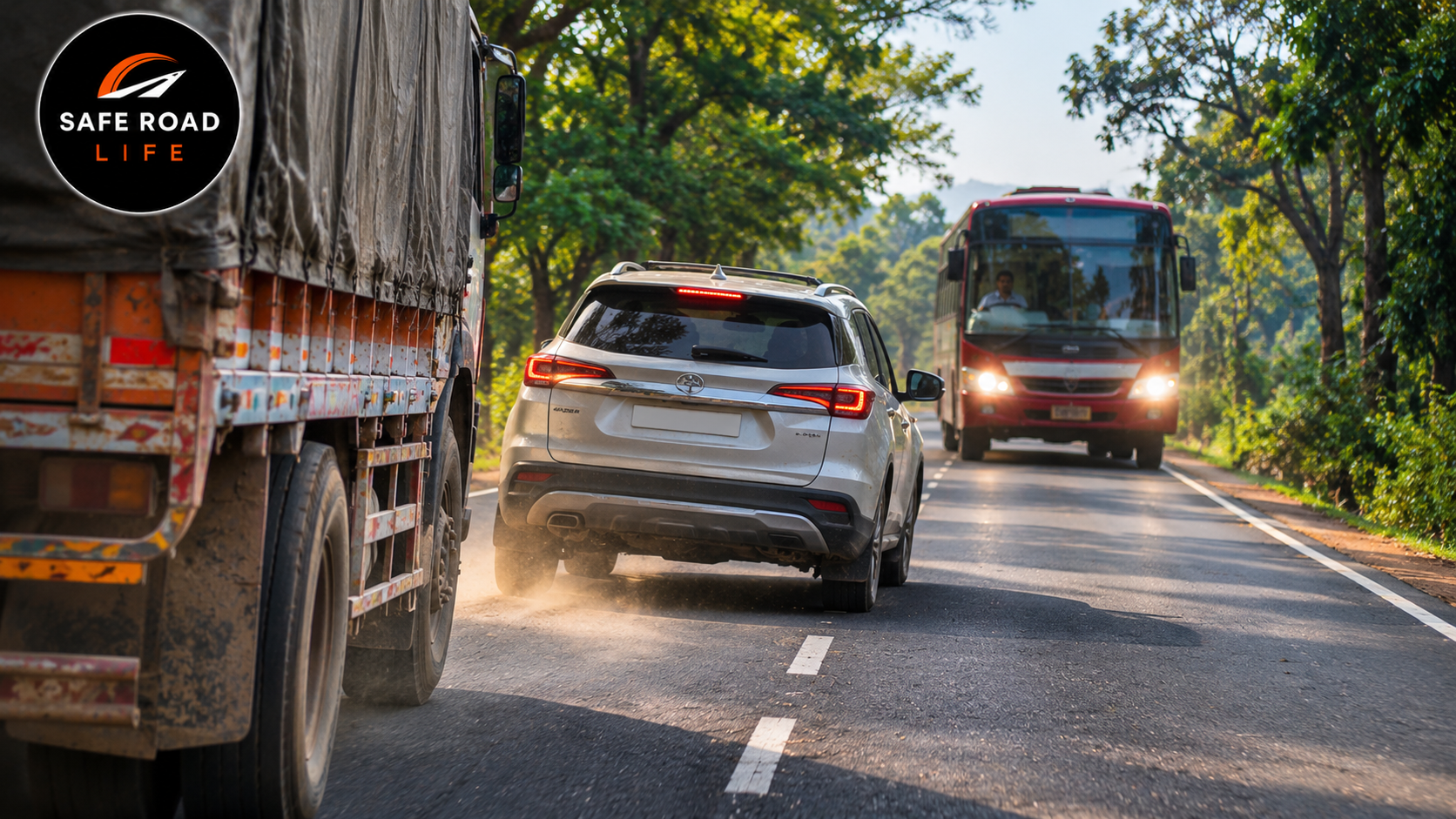
You are behind a slow-moving truck on a two-lane road. The road ahead appears open. You move right to overtake. Then a vehicle appears in the opposite lane—and suddenly the space you thought you had is disappearing.
On an undivided road, overtaking is not simply passing a slower vehicle. It means temporarily entering space used by oncoming traffic. If the gap has been misjudged, there may be nowhere safe to go. A few seconds of impatience can turn into a head-on collision.
The most dangerous part of overtaking is often the decision before it
Drivers often judge an overtaking opportunity by looking at the vehicle ahead and the visible stretch of road. But a safe manoeuvre needs much more: enough clear distance to move out, pass, and return to the correct side with a margin for error. The oncoming vehicle may be travelling faster than it appears. A small rise, bend, roadside obstruction or hidden junction can conceal another road user.
On a two-way, undivided road, both directions depend on the same carriageway. The overtaking driver is temporarily borrowing the opposing lane. If the manoeuvre takes longer than expected, the risk is transferred to everyone approaching from the other direction.
Why a familiar road can create false confidence
Knowing a route does not mean knowing what is coming around the next bend today. A tractor may enter from a field, a motorcycle may approach at speed, a bus may stop near a village or a vehicle may be hidden behind a crest. Road conditions, traffic and visibility change from one journey to the next.
Another common mistake is following the vehicle ahead into an overtake. The first driver may have enough space; the second may not. Every driver must make an independent decision and confirm that the entire manoeuvre can be completed safely.
Where overtaking becomes especially dangerous
A bend or hill crest limits the view of oncoming traffic. A junction can bring a vehicle into the road unexpectedly. A pedestrian crossing may hide someone stepping into the carriageway. A narrow bridge or culvert leaves little room for error. In rain, fog, darkness or dust, judging the speed and distance of an approaching vehicle becomes harder.
Solid centre lines, no-overtaking signs and other road markings are not suggestions. They communicate that passing is restricted or unsafe in that location. Do not cross them because the vehicle ahead is slow, because another driver has done it, or because you are running late.
What Indian road regulations say
India’s Motor Vehicles (Driving) Regulations, 2017 require overtaking to be safe and lawful. They prohibit overtaking when it is likely to impede oncoming traffic, when the traffic situation is unclear, across continuous solid lane markings, and at locations such as bends, corners, junctions, intersections, pedestrian crossings, narrow culverts and marked school, hospital or construction zones.
The regulations also require drivers to use indicators to communicate the intention to overtake and to return to the left side after completing the manoeuvre. The driver being overtaken must not increase speed or obstruct the passing vehicle’s safe return. These rules protect both directions of traffic—not just the person trying to pass.
When you are being overtaken, help keep the road safe
Do not speed up to prevent another driver from passing. Maintain a steady course, keep to the left where safe and allow room for the other vehicle to return. If an oncoming vehicle has begun an unsafe overtake, reduce speed and move left as far as safely possible. Do not swerve into pedestrians, cyclists, a ditch or roadside hazards. Your priority is to preserve control and avoid making the situation worse.
Road design can reduce the pressure to take risks
On busy undivided routes, long stretches with few safe passing opportunities can encourage impatient drivers to attempt risky overtakes. Road authorities can help through properly designed overtaking lanes, climbing lanes, safe passing sections, clear signs, centre-line markings and median separation where appropriate.
The International Road Assessment Programme (iRAP) identifies overtaking lanes and 2+1 road designs as treatments that can reduce head-on crash risk by providing safer opportunities to pass slower traffic. These facilities need suitable sight distance, safe entry and exit transitions and careful treatment of junctions.
Arriving behind schedule is better than not arriving
A slower vehicle ahead is frustrating, but it is not an emergency. Stay at a safe following distance, remain patient and wait for a legal, clearly visible passing opportunity. If the road does not provide one, continue behind it until the conditions change.
Do not let a horn, a passenger’s impatience, a queue behind you or a few lost minutes make the decision. On a two-lane road, the safest overtake is the one you can complete with a clear view, enough space and no pressure on oncoming traffic. Sometimes the best manoeuvre is not to overtake at all.
DRIVE SAFE. STAY SAFE.
@SafeRoadLife
Sources and further reading
- India – Motor Vehicles (Driving) Regulations, 2017, Regulation 14: Overtaking
- UK Department for Transport – Highway Code: Using the road and overtaking
- International Road Assessment Programme – Overtaking lanes and 2+1 roads
- UN ESCAP – Road infrastructure safety facilities and overtaking-zone design
Explore more practical advice in our SafeRoadLife Safety Guides.
About the Author