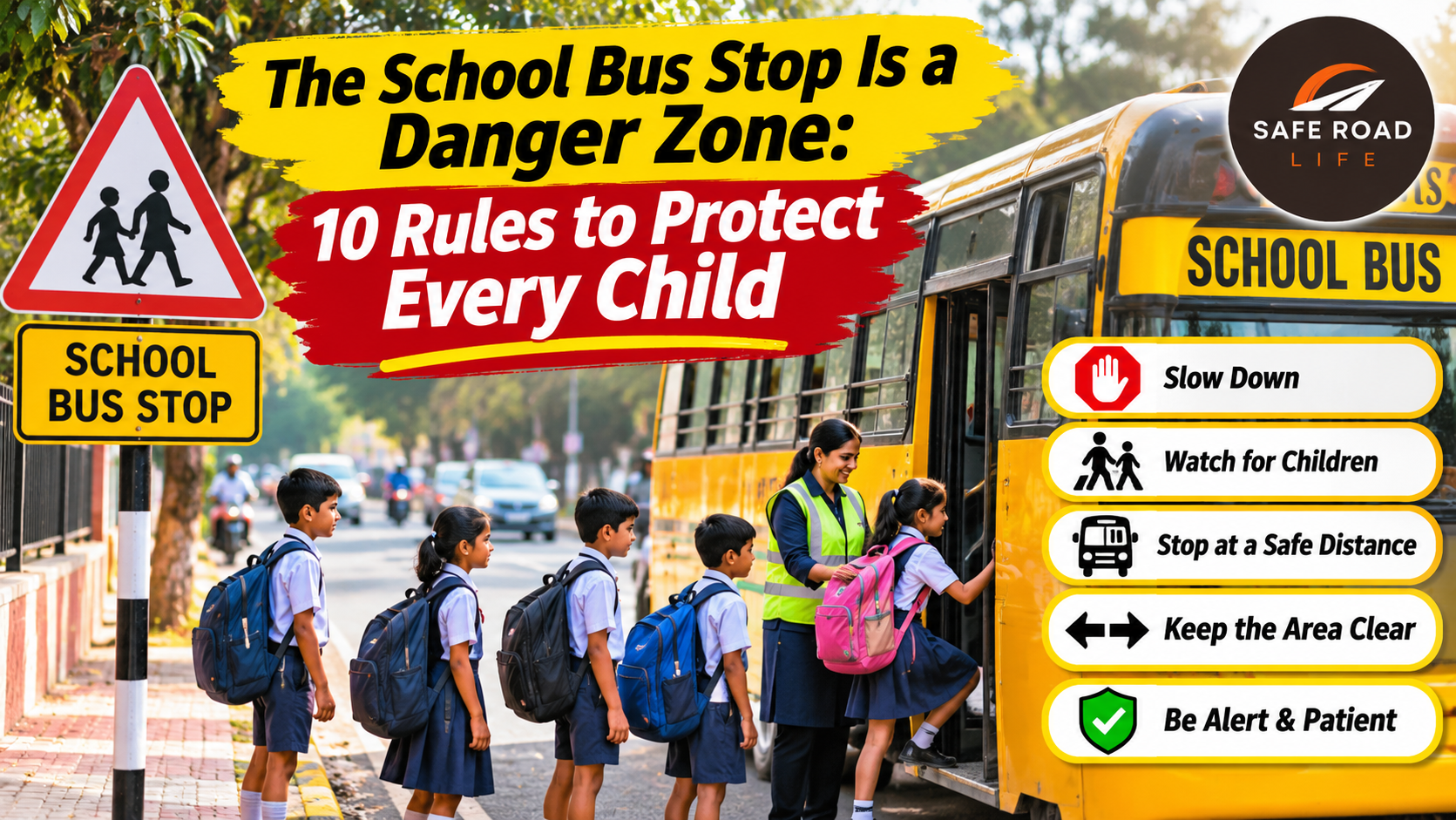
A school bus journey does not begin when the bus starts moving—and it does not end when the child steps off. The most dangerous moments can happen around the vehicle: at the pickup point, while boarding, during a hurried drop-off or when a child walks close to a moving bus.
Children are small, unpredictable and can be hidden from a driver’s view by the bus itself. Safe school transport therefore needs more than a careful driver. It needs a reliable system involving the school, transport operator, attendant, parents, children and other road users.
Why the bus stop deserves as much attention as the journey
The U.S. National Highway Traffic Safety Administration (NHTSA) notes that children face particular risks when approaching or leaving a school bus. Its guidance stresses safe waiting distances, boarding only after the bus stops, and staying clear of the area around the vehicle. India’s Ministry of Road Transport and Highways also publishes school-bus safety advice covering boarding, travel and getting off safely.
10 school-bus safety rules every family and school should follow
1. Choose a safe, visible pickup point
Stops should be selected to give the bus a safe place to pull in and leave, with good visibility and minimal conflict with fast-moving traffic. Avoid blind bends, junction corners, narrow road edges and locations where children must weave between parked vehicles. Schools and operators should review stops when road conditions or traffic patterns change.
2. Teach children to wait away from the road
Children should wait in a designated safe area, not on the carriageway or right at the kerb. NHTSA advises a waiting distance of at least 10 feet (about three metres) from the bus stop curb in its U.S. guidance. The exact arrangement should suit the local stop, but the principle is universal: keep children away from moving traffic and the bus’s path.
3. Board only after the bus has fully stopped
No pushing, running or rushing towards the door. Children should wait for the bus to stop completely and for the driver or attendant to signal that boarding is safe. They should use handrails, board in an orderly line and keep bags, straps and loose clothing clear of the doors.
4. Keep the aisle and emergency exits clear
School bags should be placed where they cannot block the aisle, steps or emergency exits. Children should sit properly, face forward and follow the attendant’s instructions. Standing on steps or travelling on the footboard is unsafe.
5. Never distract the driver
Shouting, fighting, throwing objects or moving around while the bus is in motion can distract the driver and put everyone at risk. The attendant should manage student behaviour so the driver can concentrate on traffic, speed, mirrors and the road ahead.
6. Make every drop-off a controlled activity
The bus must stop at the authorised location, secure the vehicle and allow children to alight without rushing. An attendant or responsible adult should supervise younger children. Parents should wait on the same side of the road as the drop-off whenever possible; a child excited to see family may otherwise dash across traffic.
7. Keep children out of the danger zone around the bus
Never walk behind a school bus or crawl underneath it to retrieve a dropped item. The driver may not see a child close to the front, rear or sides. If something falls near the vehicle, the child should tell the driver or attendant and wait for an adult to make it safe to retrieve.
8. Do a final passenger check before leaving
At the end of every route, the responsible staff member should physically check the entire passenger area, including rear seats and less visible spaces, and confirm that no child remains on board. A documented end-of-route check is a simple control that must never be skipped—even when the bus is late or the route is under pressure.
9. Keep the vehicle and safety equipment roadworthy
Operators should follow applicable rules and manufacturer schedules for brakes, tyres, steering, lights, doors, mirrors and emergency exits. First-aid supplies, fire extinguishers and communication equipment should be present where required, accessible and checked. Defects that affect safe operation must be reported and resolved before the vehicle is assigned to a route.
10. Have a clear emergency and breakdown plan
Drivers and attendants should know whom to contact, where to move children if the bus becomes unsafe, and how to keep students together and supervised during a breakdown or route disruption. Schools should maintain current parent and emergency contact details, and communicate delays or changes through an established channel.
What school transport operators should check every day
A short pre-trip and route-control routine helps turn safety expectations into consistent practice:
- Confirm the assigned driver and attendant are fit for duty and understand the route.
- Check vehicle condition, tyres, lights, brakes, doors, mirrors and required emergency equipment.
- Verify the passenger list, authorised stops and special assistance requirements.
- Ensure children are supervised during boarding and drop-off.
- Record delays, route deviations, complaints, defects and corrective actions.
- Complete and record the end-of-route child check before the bus is parked or released.
What parents should teach children
- Never run towards a moving bus or play near the pickup point.
- Wait for the bus to stop and an adult to allow boarding.
- Use the handrail and sit down promptly.
- Keep hands, head and belongings inside the vehicle.
- Never go behind or underneath the bus.
- If the bus stop or transport routine feels unsafe, tell a parent, teacher or school transport coordinator.
Frequently asked questions
Should a child cross the road in front of the school bus?
Only if the route and local rules require it, and only under a controlled procedure. The child should move to a point where the driver can clearly see them and follow the school’s crossing instructions. Never cross behind the bus or assume traffic has stopped.
Can a school bus drop a child at an unauthorised location?
Schools and operators should use approved stops and a documented process for any authorised change. A child should not be left at an unfamiliar or unsafe location without confirmation from the responsible parent or guardian and the school’s transport team.
Who is responsible for school-bus safety?
Responsibility is shared. The operator maintains the vehicle and operating controls; the driver drives safely; the attendant supervises children; the school manages transport arrangements; parents reinforce safe behaviour; and other road users drive carefully around school buses and children.
A safe school journey is a system, not a single person’s job
A child should never have to depend on luck to reach school and return home safely. A safe stop, a roadworthy bus, a focused driver, an attentive attendant and a properly supervised handover work together to protect every student.
DRIVE SAFE. STAY SAFE.
@SafeRoadLife
Trusted safety references
Ministry of Road Transport and Highways, India – Road Safety Book (School Bus Safety, Chapter 8)
NHTSA – Planning Safer School Bus Stops and Routes
Press Information Bureau – Guidelines on Safety and Security of Children in Schools
Transport rules and school-bus requirements differ by state and country. Schools and operators must check the latest applicable local regulations and directions from the competent transport authority.
About the Author