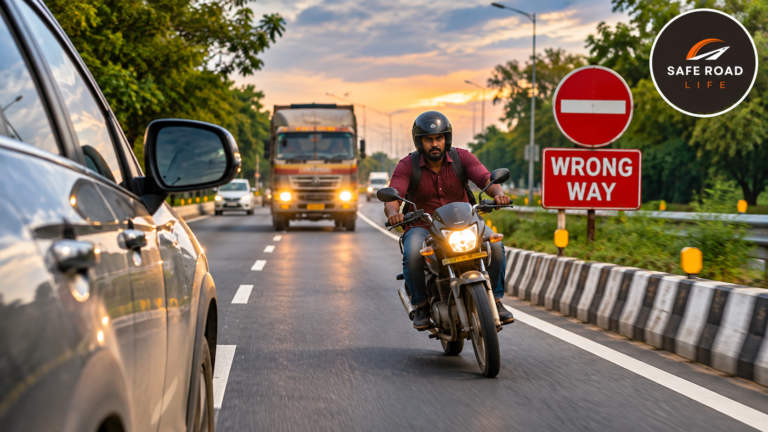
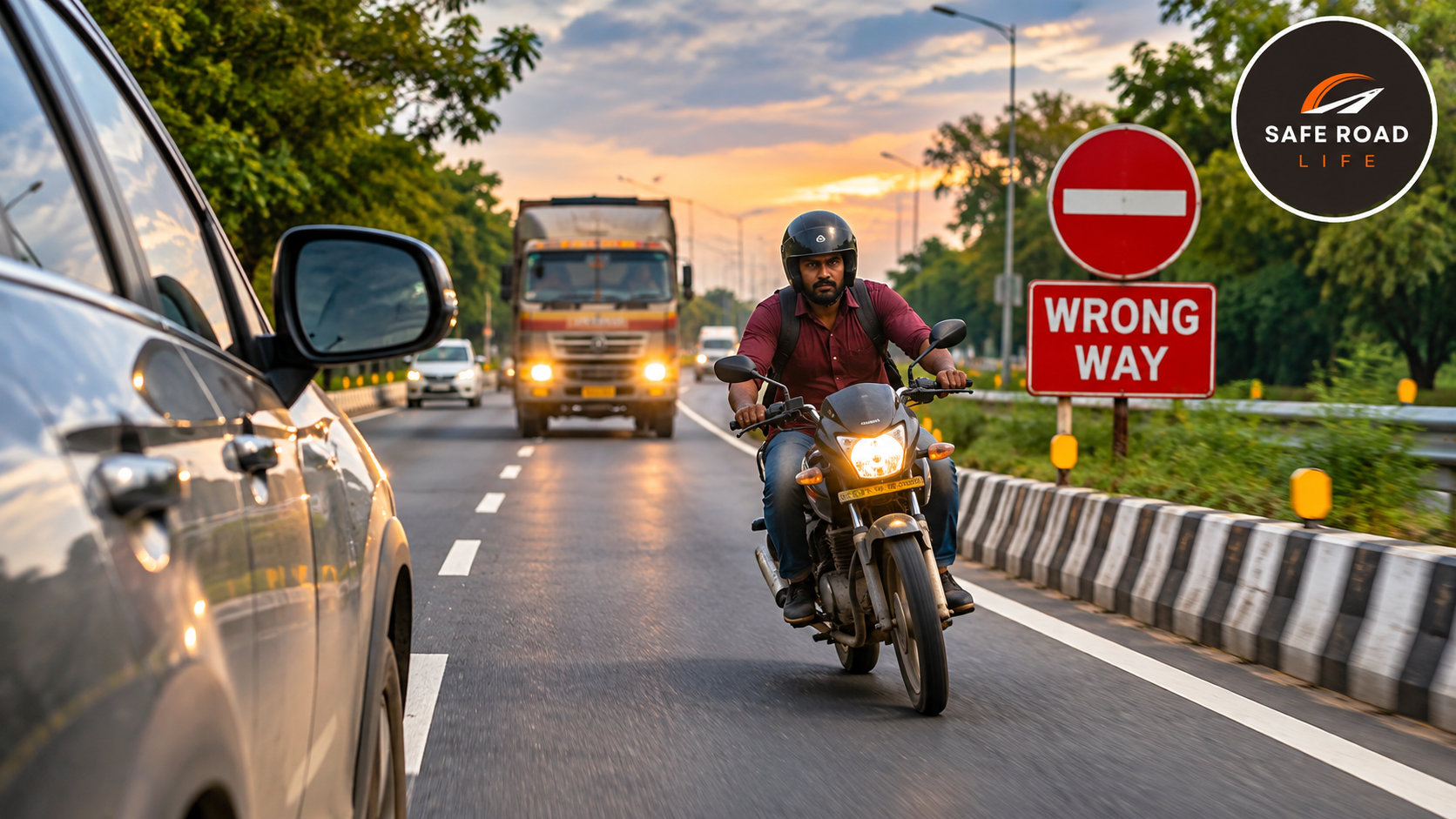
A few seconds saved can cost a lifetime. A rider enters a road from the wrong direction to avoid a U-turn. A car drives against traffic because the next opening looks far away. A delivery vehicle uses the opposite lane to bypass a queue. The road may appear clear for a moment—but an approaching vehicle may be only seconds away.
Wrong-side driving is not a harmless shortcut. It places a vehicle directly in the path of road users who are following the correct direction. The danger is especially serious on divided roads, flyovers, highways, service lanes, blind curves and poorly lit stretches.
The numbers show why this cannot be ignored
India’s Ministry of Road Transport and Highways recorded 25,242 road accidents and 9,432 deaths in 2023 under the combined category of “driving on wrong side/lane indiscipline”. The report also recorded 24,435 people injured in this category. This distinction matters: the official 2023 category combines wrong-side driving with lane indiscipline, so it should not be described as wrong-side driving alone.
More recent figures presented to Parliament show 22,530 accidents and 8,327 fatalities attributed to driving on the wrong side in 2024. The figures are a stark reminder that travelling against the permitted direction remains a serious road-safety problem. Read the Government of India’s parliamentary data for 2020–2024.
Enforcement figures also underline the scale of the problem. Delhi Traffic Police reported 42,945 wrong-side driving prosecutions in December 2025 alone, including 30,224 involving two-wheelers. A challan is a consequence; the greater danger is the crash that may happen before enforcement arrives.
Why wrong-side driving can become deadly
- Head-on impact: Two vehicles can meet with very little time or space to avoid each other.
- Unexpected movement: Drivers following the correct lane may not anticipate a vehicle approaching from the opposite direction.
- Limited escape space: A divider, parked vehicle, roadside barrier or pedestrian can leave no safe evasive path.
- Higher closing speed: When vehicles approach one another, their combined speed can make the impact extremely severe.
- Risk to everyone: Motorcyclists, pedestrians, cyclists, bus passengers and occupants of other vehicles can all be affected.
9 safety rules every road user should follow
1. Never use the opposite lane as a shortcut
Do not travel against traffic to avoid a U-turn, reach a nearby shop, skip a queue or enter a road from a convenient opening. Continue to the authorised turn or access point, even if it takes longer.
2. Follow road signs, arrows and lane markings
Check directional signs before entering a road, flyover, slip road or service lane. Follow the permitted direction and lane markings. Never assume that a gap in a divider is an authorised opening.
3. Slow down near junctions and road openings
Watch carefully for vehicles emerging from side roads, petrol pumps, parking areas and median openings. Reduce speed where visibility is restricted and be ready to brake smoothly.
4. Make yourself visible at night
Use working headlights and tail lamps, keep the windscreen and mirrors clean, and avoid high speed in poorly lit areas. Visibility helps you detect hazards, but it does not make wrong-side movement safe.
5. Motorcyclists must not ride against traffic
Never enter a one-way road from the wrong end or ride on the wrong side of a divided road. Wear a correctly fastened helmet, use indicators and make turns only where permitted.
6. Commercial and heavy-vehicle drivers must plan ahead
Bus, truck and delivery drivers should confirm the route, entry gate and authorised turning point before approaching a destination. A large vehicle travelling the wrong way can block the road and leave other road users with little room to react.
7. Do not follow another wrong-side driver
One vehicle taking an illegal route does not make it safe or permitted. Do not copy the movement. Stay in the correct lane and report a dangerous obstruction to the appropriate traffic authority when it is safe to do so.
8. If you realise you are going the wrong way, stop safely
Do not make a sudden U-turn, reverse into traffic or cut across lanes. If it is safe, move out of the live carriageway to a protected location and seek directions or assistance. Follow instructions from traffic personnel.
9. Treat temporary diversions as controlled routes
Roadworks may change normal traffic flow, but a diversion is safe only when it is officially arranged with signs, barricades, lane guidance and traffic control where required. Never create your own route through an opposing lane.
What Indian traffic rules say
Section 119 of the Motor Vehicles Act, 1988 requires drivers to follow mandatory traffic signs and the driving regulations made by the Central Government, as well as directions from traffic police. The Central Motor Vehicles Rules also refer to keeping well to the left during normal driving and using the proper side of the road. These requirements make road signs, lane directions and authorised traffic movements essential—not optional.
Where the manner of driving endangers the public, police may consider provisions dealing with dangerous driving, depending on the facts and applicable law. The exact offence and penalty depend on the circumstances and the relevant state or enforcement authority. This article is general safety information, not legal advice. Read the Motor Vehicles Act, 1988 and Central Motor Vehicles Rules.
Do’s and Don’ts
DO
- Keep to the authorised direction of travel.
- Plan your route and identify legal entry and exit points.
- Reduce speed near junctions, openings and blind spots.
- Follow police directions and properly marked diversions.
- Stay alert for unexpected vehicles without making sudden manoeuvres.
DON’T
- Drive or ride against traffic to save time or fuel.
- Enter a highway through an exit or leave through an entry ramp.
- Cross a divider except at an authorised opening.
- Reverse or turn suddenly on a live carriageway.
- Assume hazard lights make an unsafe manoeuvre acceptable.
What should you do if a vehicle approaches from the wrong direction?
Stay calm and focus on creating space. Ease off the accelerator, maintain control of your vehicle and avoid a sudden swerve into another lane or towards pedestrians. Brake progressively if needed, use your horn to alert the other driver when appropriate, and move only towards a clearly safe area. After passing the immediate danger, stop at a safe place and report the incident if it presents an ongoing risk.
Quick checklist before every journey
- Am I entering from the correct access point?
- Am I travelling in the permitted direction?
- Have I checked signs, arrows and lane markings?
- Are my lights, mirrors and indicators working?
- Have I planned a legal route instead of taking a shortcut?
Related SafeRoadLife reading
- The Blind Spot Trap: 8 Rules to Stay Safe Around Trucks and Buses
- Driver Fatigue: 9 Warning Signs Every Highway Driver Must Never Ignore
- Tyre Burst on a Highway? 7 Steps to Stay in Control
One rule can prevent a lifetime of regret
Wrong-side driving does not just break a traffic rule. It transfers the risk of one person’s impatience to everyone approaching from the opposite direction. A few extra minutes are never worth a head-on collision, a life-changing injury or a family waiting for someone who never comes home.
Choose the correct lane. Respect the direction of traffic. Reach safely—not just quickly.
Official sources and further reading
- Ministry of Road Transport and Highways – Road Accidents in India 2023
- Government of India – Parliamentary data on road accidents by traffic-rule violation, 2020–2024
- Delhi Traffic Police – January 2026 Newsletter
- India Code – Motor Vehicles Act, 1988
DRIVE SAFE. STAY SAFE.
@SafeRoadLife
About the Author