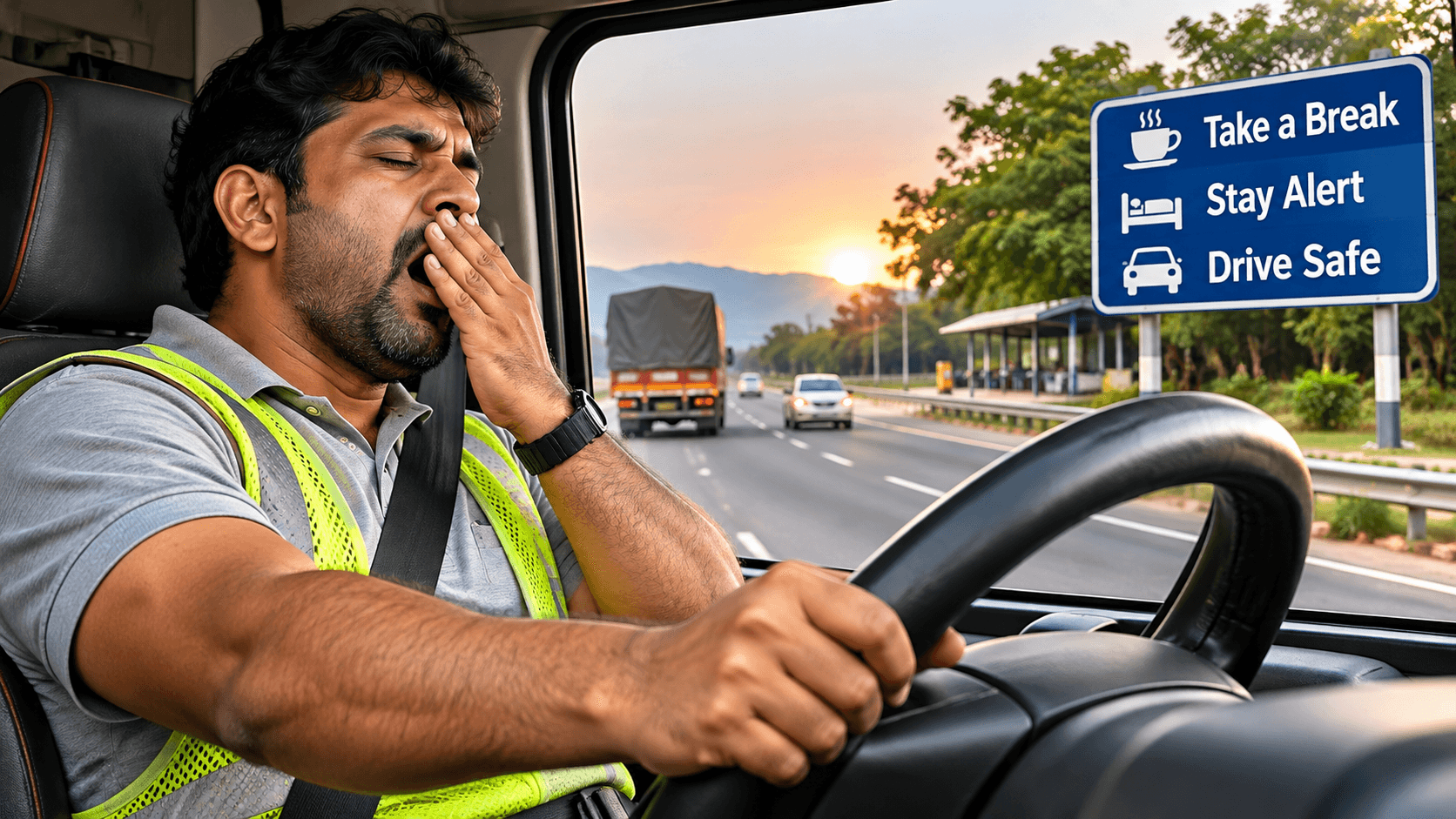
A driver does not have to close their eyes for long to lose control of a vehicle. A few seconds of microsleep, a drifting lane position or a missed warning sign can be enough to turn an ordinary highway journey into a life-changing event. Fatigue is not a weakness to hide. It is a safety risk to recognise early and manage before the vehicle moves.
For Indian motorists, the danger can build during overnight journeys, long intercity drives, back-to-back shifts and monotonous stretches of highway. Cars, buses, trucks and fleet vehicles all depend on one essential safety condition: the person at the wheel must be alert enough to observe, decide and react.
Why driver fatigue is dangerous
Sleepiness reduces attention, slows reaction time and weakens judgement. It can also cause brief, involuntary periods of sleep called microsleeps. A driver may not realise that attention has dropped until the vehicle begins to drift, a turn is missed or traffic ahead requires an immediate response.
The US National Highway Traffic Safety Administration (NHTSA) reports that 644 people died in drowsy-driving-related crashes in the United States in 2024. That figure is not an estimate for India; it illustrates that fatigue-related crashes are a serious road-safety problem. NHTSA also cautions that the true scale is difficult to measure because sleepiness is not always identifiable after a crash.
Fatigue can affect drivers at different times, but NHTSA identifies midnight to 6 a.m. and the late afternoon as periods when sleepiness is more common. Long, repetitive routes and extended work hours can add to the risk.
9 warning signs drivers must never ignore
- Repeated yawning: You keep yawning even after opening the window or changing the cabin temperature.
- Heavy or burning eyes: Your eyelids feel difficult to hold open, or you blink repeatedly.
- Frequent lane drifting: The vehicle moves toward lane markings, the road edge or rumble strips.
- Missing signs or exits: You notice road information late or pass a turn you intended to take.
- Memory gaps: You cannot clearly recall the last few kilometres of the journey.
- Delayed reactions: You respond late to braking traffic, pedestrians, curves or changing signals.
- Wandering thoughts: Your mind repeatedly disconnects from the driving task.
- Unplanned speed changes: You struggle to maintain a steady, appropriate speed.
- Head nodding or microsleeps: Your head drops, your eyes close briefly or you experience a moment you cannot account for.
Do not wait for all these signs. One clear warning is enough to stop driving and rest safely.
Before the journey: prevent fatigue instead of fighting it
- Sleep properly: Plan a full night’s rest before a long drive. NHTSA advises prioritising around seven to eight hours of sleep; individual needs vary.
- Plan the route and rest stops: Identify safe, well-lit places to stop before departure. Build breaks into the schedule rather than treating them as lost time.
- Do not start after an exhausting shift: A long workday followed by a long drive can leave too little opportunity for recovery.
- Check medicines: Read prescription and over-the-counter medicine labels for drowsiness warnings. Ask a qualified health professional or pharmacist if unsure whether a medicine affects driving.
- Avoid alcohol: Never combine driving with alcohol. It can compound impairment and sleepiness.
- Share the driving responsibly: On long journeys, arrange a second driver where possible—but only if that person is fully rested and authorised to drive the vehicle.
What to do when sleepiness starts behind the wheel
Do not try to defeat fatigue with loud music, a cold breeze, chewing gum or repeated conversation. These tricks do not replace sleep. If you are struggling to stay awake, you are already too impaired to continue safely.
- Signal and move to a safe, designated stopping place such as a service area or rest facility. Do not stop in a live traffic lane or use a narrow highway shoulder as a routine rest area.
- Park safely, secure the vehicle and take a short nap. NHTSA describes a 20-minute nap at a safe, well-lit rest stop as a short-term measure that may improve alertness.
- Caffeine may help temporarily for some drivers, but it is not a cure for sleep deprivation and must not be used as permission to continue when still sleepy.
- If you remain drowsy, sleep longer, arrange a rested replacement driver or delay the journey. Resume only when genuinely alert.
Special responsibility for bus, truck and fleet operators
Professional drivers carry responsibility for passengers, other road users and the vehicle entrusted to them. Fleet managers should make fatigue prevention part of daily operations—not just a topic in an induction presentation.
- Plan duty and rest schedules realistically, with adequate recovery time between shifts.
- Do not reward unsafe continuous driving or pressure a driver to meet a timetable at the cost of rest.
- Provide safe, practical rest locations along long routes and a clear process for reporting fatigue without fear of punishment.
- Use a relief driver for demanding long-distance operations where appropriate.
- Train supervisors to recognise fatigue indicators and review near-misses, lane-departure alerts and repeated schedule overruns.
- Check that drivers understand the route, expected duration, weather, traffic and safe stopping options before departure.
Technology can support monitoring, but no camera, alert or telematics system can replace a rested and fit driver. The US Federal Motor Carrier Safety Administration’s commercial-vehicle guidance similarly emphasises adequate sleep, safe rest stops and avoiding medicines that cause drowsiness.
Do’s and Don’ts: a simple fatigue-safety checklist
Do: sleep before a long trip; plan breaks; stop at the first sign of drowsiness; use a safe rest facility; check medicine warnings; speak honestly about fatigue; and let a rested driver take over when available.
Don’t: force yourself to continue; depend on loud music or open windows; assume coffee makes severe sleep deprivation safe; drive after an exhausting shift; ignore lane drifting; or park in a dangerous location just to take a break.
Benefits of making rest part of the journey
Fatigue management helps drivers stay attentive, improves the chance of noticing hazards early and supports smoother, more predictable vehicle control. For operators, sensible schedules and open fatigue reporting can reduce unsafe driving pressure, protect passengers and support more reliable service. Most importantly, a planned stop costs minutes; a fatigue-related crash can change lives permanently.
Make the safe decision before the warning becomes an emergency
If your eyes are heavy, your mind is wandering or your vehicle is drifting, do not negotiate with sleep. Stop somewhere safe and rest. Reaching the destination later is always better than putting yourself and others at risk.
For further reading, see our bus–truck crash safety lessons and our Mumbai–Pune Expressway route and vehicle guidance.
Sources and further guidance
- US National Highway Traffic Safety Administration (NHTSA): Drowsy Driving
- US Centers for Disease Control and Prevention (CDC/NIOSH): Risks from Not Getting Enough Sleep
- Federal Motor Carrier Safety Administration: Commercial Motor Vehicle Driver Fatigue Tips
- Hyderabad Traffic Police: Road Sense and Driving Distractions
- Government of Assam, Commissionerate of Transport: Be Road Smart
DRIVE SAFE. STAY SAFE.
@SafeRoadLife
About the Author