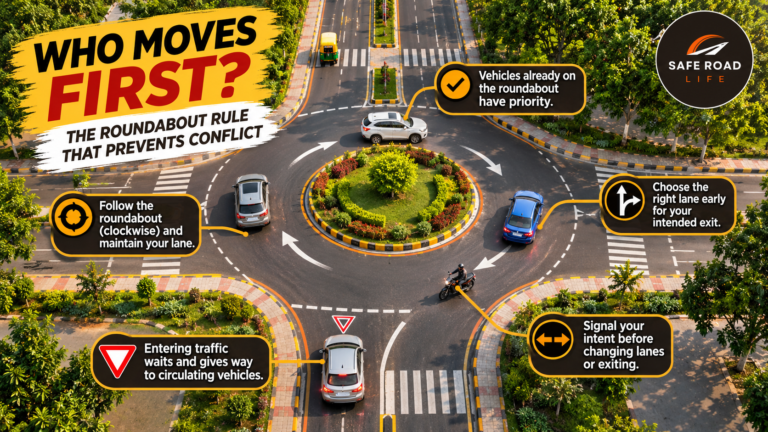
Two cars reach a roundabout at almost the same time. One is already moving around the circle. The other is waiting to enter. Who should move first?
This small moment causes confusion at busy junctions. Some drivers force their way into a gap. Others stop in the middle of the circle. A few change lanes at the last second to catch an exit. One impatient move can create a side-impact collision, force a motorcyclist to brake sharply or put a pedestrian at risk.
A roundabout is designed to keep traffic moving, but it works only when drivers understand priority, choose the correct lane early and signal their intentions. India’s Motor Vehicles (Driving) Regulations, 2017 set out specific precautions for roundabouts.
The first rule is simple: traffic already in the circle has priority
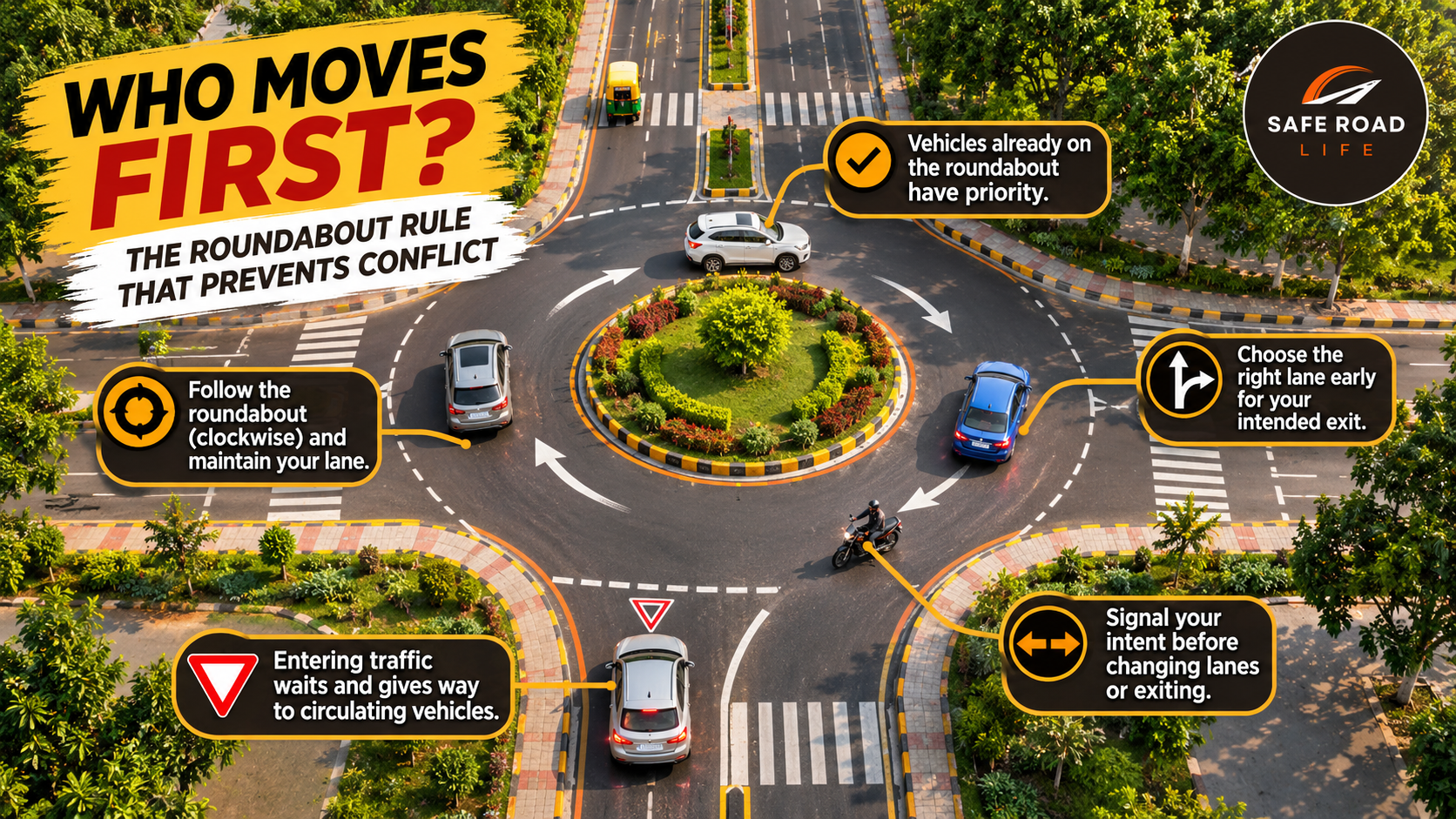
Regulation 10 of the Motor Vehicles (Driving) Regulations, 2017 states that traffic already in a roundabout has the right of way when another vehicle is entering. An approaching driver must slow down, assess the circulating traffic and enter only when there is a safe gap. Do not push into the circle and expect another driver to brake for you.
At a roundabout with a Give Way line or sign, obey the road markings and signs. If an authorised traffic officer is directing vehicles, follow those instructions. The aim is not to win a place in the queue; it is to merge without forcing another road user to react suddenly.
Before the entry: decide where you need to go
Do not wait until you reach the circle to decide your exit. Read the direction signs and lane arrows as you approach. Regulation 10 requires a driver to choose the lane relevant to the direction of further movement. The correct lane can vary with the design and markings of each junction, so follow the signs on that particular approach rather than relying on a guess.
Reduce speed early, check mirrors and blind spots, and position your vehicle smoothly. Avoid a sudden lane change across another vehicle’s path. If you are unsure which exit to take, do not make a sharp correction at the entry; continue only when you can do so safely and lawfully.
Inside the circle: hold your line, not someone else’s
Once you have entered, keep to your lane and maintain a steady, controlled speed. Do not cut across the lane beside you simply because your exit is approaching. Regulation 10 specifically requires indicators when changing lanes within a roundabout. Signal in good time, check mirrors and blind spots, and move only when there is a safe gap.
Do not stop unnecessarily inside the circulating carriageway. If traffic is blocked at your exit, do not enter the circle unless there is room to proceed without blocking other vehicles. A vehicle stopped across the circle can create congestion and unexpected braking for everyone behind it.
The exit is where many last-second mistakes happen
As your exit approaches, check the lane markings and indicate your intention to leave. Follow the prescribed left-turn procedure for exiting, and do not swing across another lane at the final moment. Watch for pedestrians at the exit crossing, cyclists travelling alongside the carriageway and two-wheelers that may be in your blind spot.
If you miss your exit, do not reverse, stop abruptly or cut across circulating traffic. Continue around only as the layout and signs permit, then take the next safe opportunity to leave. A wrong turn costs a little time; a sudden manoeuvre can cost much more.
Four situations that demand extra care
When a large vehicle is circulating: Buses and trucks may need extra space to turn. Do not squeeze between a large vehicle and the central island or try to pass it at the exit. Stay visible and give it room.
When riding a motorcycle or scooter: Avoid staying in another vehicle’s blind spot. Keep a predictable line, avoid sudden acceleration and watch for cars changing lanes to reach an exit. Use your indicators clearly.
When pedestrians are crossing: Reduce speed near marked crossings and be ready to stop for people crossing the entry or exit roads. Never use the roundabout as a reason to ignore pedestrians.
When traffic is heavy: Do not block the entry, force a merge or enter a circle that is already gridlocked. Leave the junction clear and wait for a space that allows you to move through without trapping other traffic.
What good roundabout behaviour looks like
- Slow down while approaching and read the signs and lane arrows.
- Give way to vehicles already circulating in the roundabout.
- Choose the lane that matches your intended direction.
- Keep your lane and maintain a safe gap once inside.
- Use indicators when changing lanes and when preparing to exit.
- Watch for pedestrians, cyclists, motorcyclists and large vehicles.
- Keep the junction clear when traffic ahead has stopped.
Moves that turn a smooth circle into a dangerous junction
- Do not force your way into traffic already in the circle.
- Do not overtake at a roundabout or use the circle to jump a queue.
- Do not change lanes without checking and signalling.
- Do not stop, reverse or cut across lanes to recover a missed exit.
- Do not enter when there is no room to clear the junction.
- Do not assume a truck or bus can turn within the same space as a car.
- Do not ignore pedestrian crossings at the approaches and exits.
A quick mental picture before you enter
Slow down. Read the signs. Choose your lane. Give way to traffic already inside. Hold your line. Signal and exit.
That sequence is easier to remember than a hurried horn or a last-second steering correction. The roundabout is shared space. Every driver has a responsibility to make their movement predictable.
Share this with new drivers, daily commuters, professional drivers and two-wheeler riders. The next time you reach a circle, let patience—not impatience—decide who moves first.
Drive Safe Stay Safe
@SafeRoadLife
Sources and further reading
- Government of India – Motor Vehicles (Driving) Regulations, 2017, Regulation 10: Precautions at Roundabouts
- Transport Department, Government of Jharkhand – Traffic Rules and Regulations: Roundabouts
- Transport Department, Government of Meghalaya – Road Manners and Roundabout Guidance
- Delhi Traffic Police – Rules of Safe Car Driving
- UK Highway Code – Using the Road: Roundabouts and Junctions
About the Author