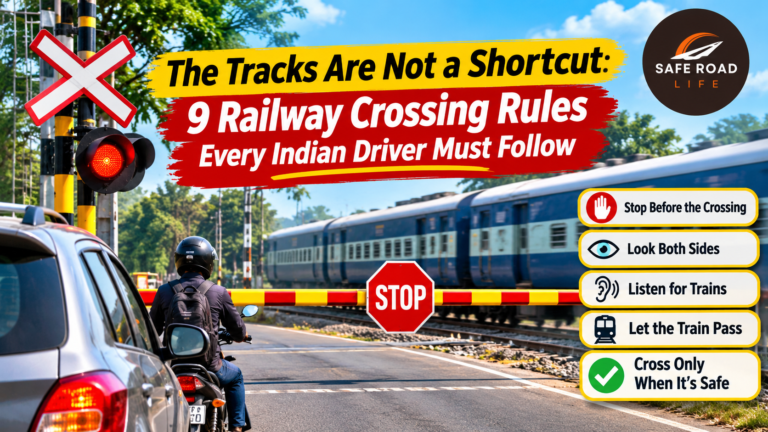
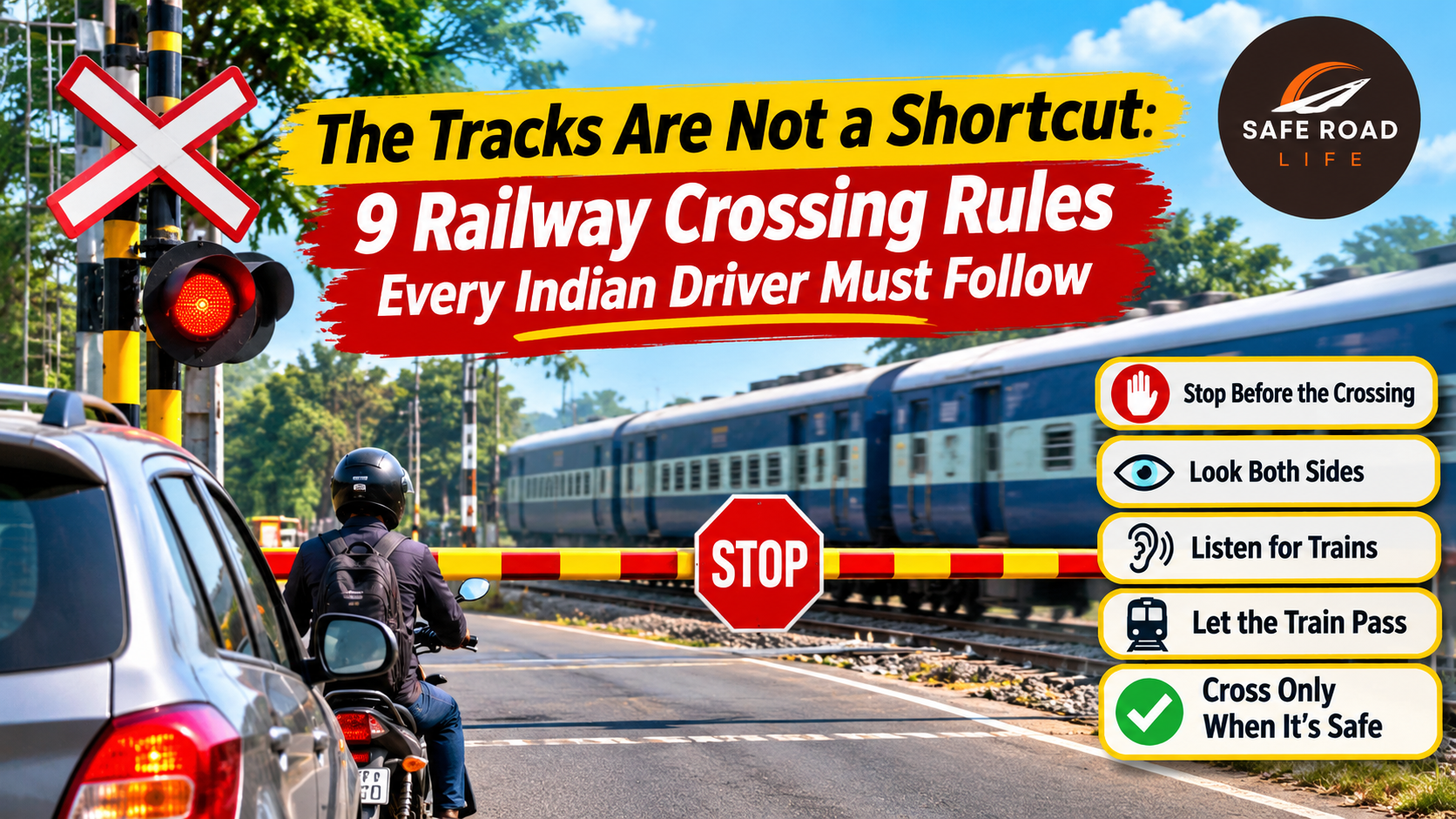
A railway crossing is not a place to save five seconds. One impatient move around a barrier can put an entire vehicle—and everyone inside it—in the path of a train that cannot swerve away.
Whether you are driving a car, riding a two-wheeler, operating a bus or moving a loaded truck, the safest crossing is the one you approach slowly, enter only when clear and leave without stopping on the tracks.
Why railway crossings demand extra caution
At a level crossing, road traffic and rail traffic share the same space. A train is wide, heavy and cannot change direction to avoid a road vehicle. A driver may misjudge its speed or distance, miss a warning, follow another vehicle too closely or enter a crossing without enough room to exit.
Risk can increase when visibility is poor, the road is crowded, more than one railway line is present, or a long vehicle needs extra time to clear the tracks. The Government of West Bengal’s driver training manual, prepared with IIT Kharagpur, specifically advises drivers to slow down, look and listen, obey barriers and avoid stopping on the tracks.
9 railway crossing safety rules every driver should follow
1. Reduce speed before you reach the crossing
Ease off the accelerator well before the warning boards, stop line or barrier. Be ready to stop smoothly. Do not approach at speed and brake at the last moment. A slower approach gives you time to read the signals, notice queues and assess whether the road beyond the tracks is clear.
2. Treat every warning as a command to wait
Stop for a red road signal, ringing warning, lowered barrier, stop board or instruction from railway staff. Never drive around, under or through a barrier that is down, moving down or moving up. Wait until the barrier is fully raised and any road-user signal permits you to proceed.
3. Stop at the correct place
Use the marked stop line or the position indicated by signs and railway staff. Keep the vehicle clear of the rails and barrier mechanism. Do not edge forward to get a better view, and never allow the front or rear of your vehicle to obstruct the crossing.
4. Look and listen in both directions
At an unmanned or unguarded crossing, stop at the stop board or before the nearest rail, look both ways and listen for a train before proceeding. Do not rely only on the absence of a gate, a quiet horn or another driver’s movement. If your view is blocked or you are unsure, wait until you can confirm that the crossing is clear.
5. Check for a second train on another track
If one train has passed, do not automatically move. A second train may be approaching on another line or from the opposite direction. Look both ways again and obey the signals. Never weave between a stopped train and the barrier or attempt to cross behind a passing train without checking.
6. Enter only when there is room to exit
Before moving onto the tracks, check the traffic on the far side. If vehicles are queued and you cannot clear the entire crossing, wait before the stop line. Do not follow the vehicle ahead just because it has started moving. A clear exit is as important as a clear entry.
7. Cross steadily—never stop or change gears on the tracks
Once the crossing is safe and clear, move across in a controlled, steady line. Avoid sudden braking, overtaking, turning or changing gears while on the tracks. Do not use the crossing to make a U-turn or to squeeze past another vehicle.
8. Give buses, trucks and long vehicles extra planning space
Drivers of buses, trucks, trailers, tractors and vehicles carrying long or heavy loads must consider the full vehicle length and the time needed to clear the tracks. Follow height, width and route warning signs. Do not enter if the vehicle may become stuck, ground out or block the exit. Never let a queue trap the rear of a long vehicle on the crossing.
9. If your vehicle stalls, get people to safety first
If a vehicle becomes immobilised on the crossing, do not stay inside trying repeated starts or attempting repairs on the tracks. Get all occupants out immediately and move them well away from the railway line. From a safe place, alert the railway staff or nearest station and contact the appropriate emergency service. Use the crossing identification details displayed at the site if available. Do not return to collect belongings.
Do’s at a railway crossing
- Slow down early and prepare to stop.
- Obey signals, barriers, signs and railway staff.
- Look and listen in both directions, including after a train passes.
- Wait until the exit side is clear before entering.
- Keep passengers seated; do not let anyone walk near the tracks while waiting.
- Follow designated routes and use an overbridge or underpass where provided.
Don’ts at a railway crossing
- Do not race a train or bypass a closed or moving barrier.
- Do not follow another vehicle onto the tracks without checking the exit.
- Do not stop, park, overtake, reverse or make a U-turn on the crossing.
- Do not assume the crossing is safe because the first train has passed.
- Do not use a phone or allow passengers to distract you while approaching.
- Do not try to lift, break or force a barrier.
What safe behaviour protects
Following these rules protects vehicle occupants, train passengers, railway staff and people waiting on both sides of the crossing. It also reduces the chance of a vehicle being struck, damaged barriers, blocked railway movement and dangerous secondary incidents caused by sudden braking or congestion.
The Railways Act, 1989 addresses unauthorised opening or breaking of a closed level-crossing gate and negligent crossing of an unmanned level crossing. The safe choice is simple: never force your way through and never treat an unguarded crossing as permission to proceed without checking.
Your 10-second crossing checklist
- Have I slowed down and checked the warning signs?
- Are the barrier and road signals clearly permitting me to cross?
- Have I looked and listened in both directions?
- Is the entire exit space clear for my vehicle?
- Can I cross steadily without stopping on the rails?
Never let impatience decide at a railway crossing
A few seconds of waiting are worth more than a lifetime of regret. Stop when warned, cross only when clear and leave the tracks completely behind you.
Drive Safe Stay Safe
@SafeRoadLife
Sources and further reading
- Transport Department, Government of West Bengal, with IIT Kharagpur – Training Manual for Drivers (Railway Crossing guidance, Chapter 4.9)
- Indian Railways CAMTECH – Safety Precautions and Installation/Maintenance Guidelines for Level Crossing Gates (March 2024)
- Indian Railways – Chapter XVI: Level Crossings
- India Code – The Railways Act, 1989 (Sections 160–161)
About the Author