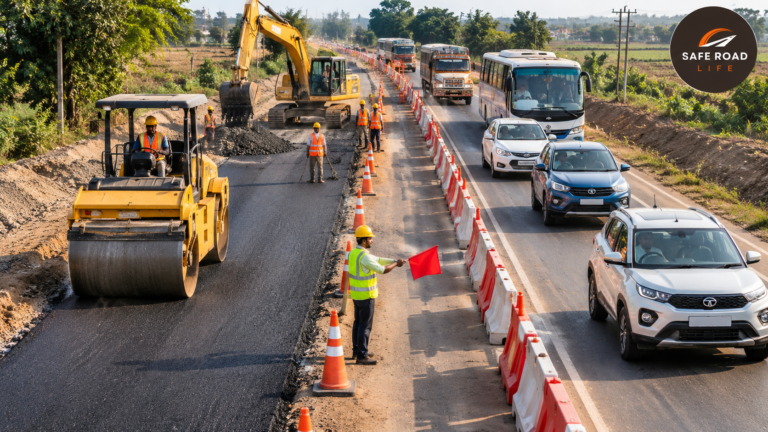
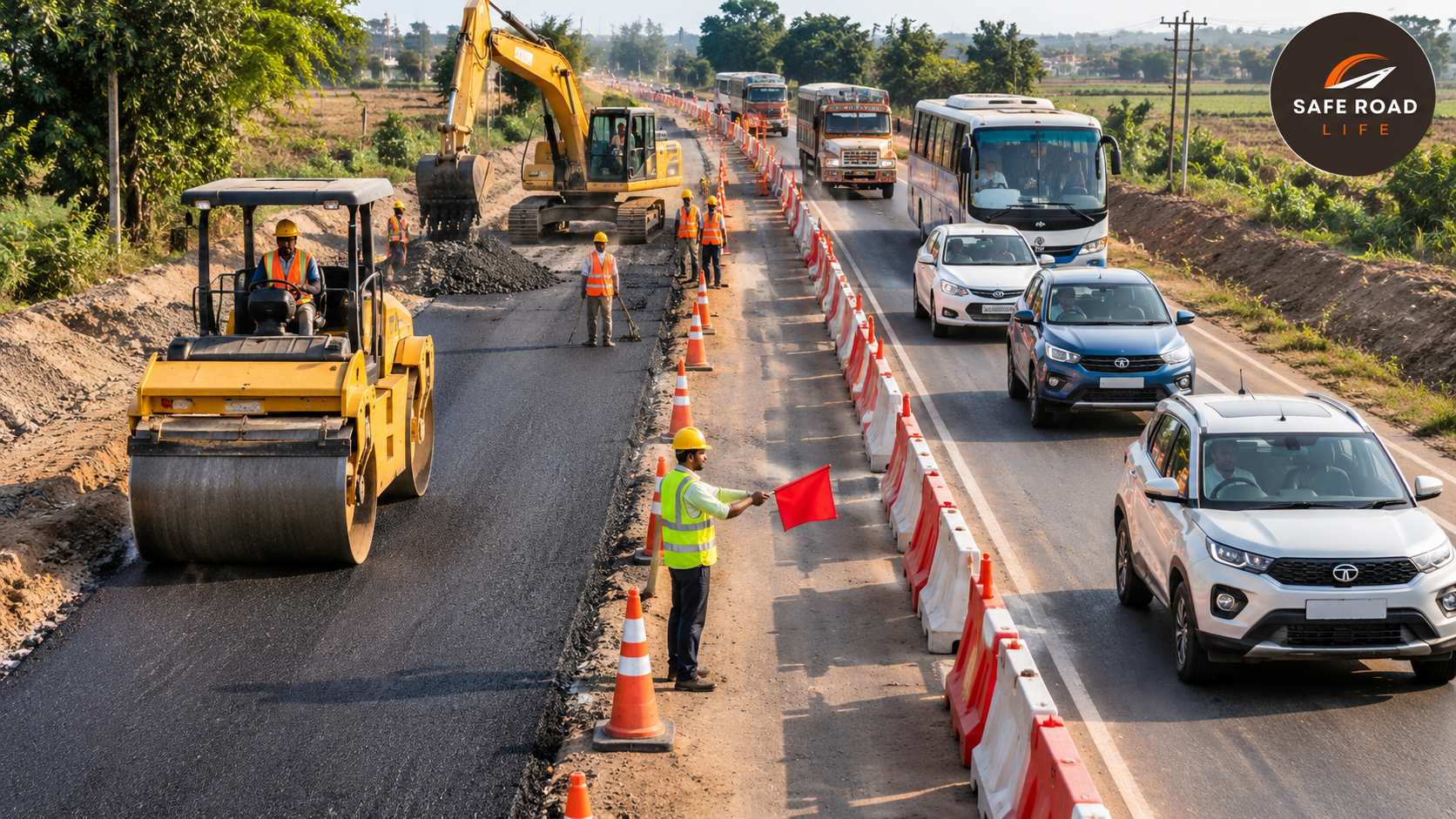
One lane suddenly narrows. Cones appear ahead. A road roller is working beside the carriageway, and a worker steps into view. Would you have enough time to react?
Road construction and maintenance zones are not ordinary stretches of road. Lanes may shift, the surface may change, machinery may move close to traffic and workers may be only a few metres away. A driver who enters too fast or changes lanes at the last moment can put road users and workers at risk.
The safest approach is simple: notice the warning early, slow down before reaching the work area and follow the temporary traffic arrangement. Here are eight rules every driver should remember.
Why road construction zones need extra attention
A construction zone can include a work area, a traffic area and a buffer space separating the two. The route may be unfamiliar, the usable lane may become narrower and vehicles may need to merge or stop unexpectedly. Road workers, pedestrians, cyclists and motorcyclists can also be exposed to passing traffic.
India’s Motor Vehicles (Driving) Regulations, 2017 specifically address construction zones. Where a construction-zone sign is displayed, overtaking is prohibited. The regulations also set a maximum of 25 km/h—or a lower speed shown on the sign—when passing a construction site indicated by signage.
8 rules to pass through a roadwork zone safely
1. Notice warning signs early and prepare
Look well ahead for roadwork, lane-closure, diversion and speed-limit signs. Ease off the accelerator as soon as you see the warning. Do not wait until cones or barricades are directly in front of your vehicle before deciding what to do.
2. Slow down before entering the work zone
Reduce speed smoothly before the narrowed section begins. Follow the temporary speed limit and any directions from authorised traffic personnel. Under the Motor Vehicles (Driving) Regulations, 2017, the limit is 25 km/h or a lower displayed speed when passing a construction site indicated by signage. Do not treat this as a target speed if the road, weather or traffic requires you to go slower.
3. Never overtake where a construction-zone sign is displayed
Do not try to pass a slow vehicle just before a lane closure or inside the signed construction zone. The available road width, sight distance and traffic pattern may change without warning. The 2017 driving regulations prohibit overtaking on a road where a construction zone is indicated by road signs.
4. Follow cones, barricades and traffic marshals
Temporary traffic devices are there to guide vehicles around the work area and keep traffic separate from workers and machinery. Follow the marked path, obey flag persons and police directions, and do not drive through gaps in barricades or enter a closed lane because it looks clear.
5. Leave extra distance from the vehicle ahead
Traffic can slow or stop suddenly near a diversion, a flag point or a queue. Keep a generous following gap and avoid tailgating. Do not assume the vehicle ahead will maintain speed just because it was moving normally a few seconds earlier.
6. Watch for workers, machinery and vulnerable road users
Scan both sides of the route for workers, reversing trucks, excavators, rollers, cyclists and pedestrians. Construction vehicles may need room to turn or enter the work site. Be patient, avoid using the horn unnecessarily and never squeeze past a worker or machine in a narrow gap.
7. Expect uneven surfaces and sudden changes
Temporary lanes can have loose gravel, raised edges, steel plates, fresh asphalt, potholes or abrupt level changes. Keep both hands on the steering wheel, avoid sharp braking and steering inputs, and do not accelerate hard over an unfamiliar surface. Motorcyclists should be especially careful around loose material and uneven edges.
8. Be extra cautious at night and in rain
Work-zone signs, lane markings and barriers can be harder to identify after dark or in heavy rain. Reduce speed further when visibility or grip is poor. Look for reflective markers and temporary lighting, use headlights appropriately and never follow another vehicle blindly through a diversion.
Do’s: Make every work-zone passage safer
- Read the warning signs and plan your lane change early.
- Slow down before the lane narrows.
- Obey temporary speed limits, signs and authorised traffic directions.
- Keep a safe gap and be ready for sudden stops.
- Give workers and construction vehicles plenty of room.
- Use indicators before changing lanes or merging.
- Stay alert for pedestrians, cyclists and two-wheelers near the work area.
- Allow extra travel time instead of trying to recover time by speeding.
Don’ts: Avoid these dangerous mistakes
- Don’t overtake in a signed construction zone.
- Don’t ignore temporary speed-limit signs.
- Don’t make a last-second lane change across cones or solid markings.
- Don’t drive through or move barricades.
- Don’t follow another vehicle into a closed or unverified diversion.
- Don’t stop or park in the traffic taper or work area.
- Don’t use a mobile phone while approaching or passing roadworks.
- Don’t assume workers have seen your vehicle.
Why these precautions matter
1. More time to react: Lower speed gives you more time to respond to queues, lane shifts and unexpected hazards.
2. Better protection for workers: Following barriers and traffic directions helps maintain separation between moving vehicles and the work area.
3. Fewer sudden conflicts: Early merging and no overtaking reduce last-minute lane changes in restricted space.
4. Safer movement for everyone: Careful driving protects passengers, motorcyclists, cyclists, pedestrians and construction crews.
5. Smoother traffic flow: Predictable speed and spacing help reduce harsh braking and unnecessary congestion around the work site.
The two-minute work-zone safety check
As you approach roadworks, remind yourself:
- ☐ Have I read the advance warning signs?
- ☐ Have I reduced speed before the lane closure?
- ☐ Am I following the displayed speed limit?
- ☐ Have I avoided overtaking in the signed zone?
- ☐ Am I leaving enough space from the vehicle ahead?
- ☐ Can I see the cones, barriers and temporary lane clearly?
- ☐ Have I checked for workers, machinery and pedestrians?
Remember: Roadwork delays are temporary. A serious crash can change lives permanently. Slow down, follow the signs and give the people working on the road the space they need.
Share this message with family members, professional drivers, fleet operators and everyone who travels on highways. Safer work zones need responsible road users as well as well-managed construction sites.
Drive Safe Stay Safe
@SafeRoadLife
Sources and further reading
- Ministry of Road Transport and Highways – Motor Vehicles (Driving) Regulations, 2017
- MoRTH – Safety in Road Construction Zones on National Highway Projects (2023 circular)
- Press Information Bureau – Barricades on National Highways
About the Author