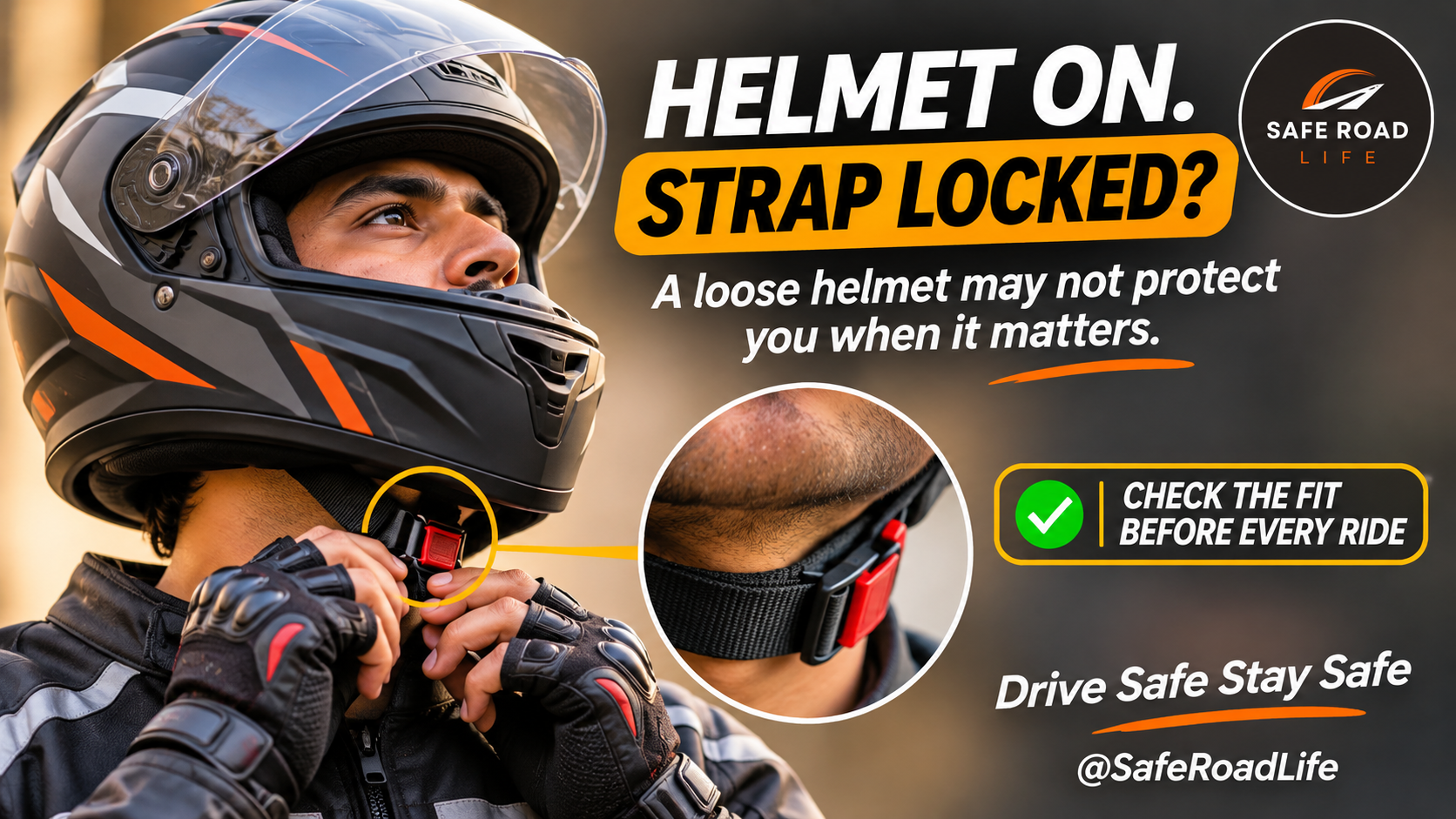
A helmet is on your head. But is it secured well enough to stay there when you need it most?
Many riders check their mirrors, start the engine and move away with the chin strap hanging loose—or fasten it so loosely that the helmet can shift. It may look like a small shortcut. In a crash, however, a helmet that moves or comes off cannot provide the protection it was designed to give.
Helmet safety is not just about wearing something on your head. It is about choosing a certified helmet, getting the fit right and fastening it correctly on every ride.
The difference between wearing a helmet and being protected
A motorcycle helmet is designed to manage impact energy and help reduce the risk of head injury. Its outer shell, energy-absorbing liner, comfort padding and retention system work together. If the helmet is too loose, sits at the wrong angle or is not fastened, it may shift or come off during a fall.
The World Health Organization explains that safe, quality helmets are a critical part of motorcycle injury prevention. A helmet cannot prevent every injury, but a properly selected and worn helmet provides far more meaningful protection than a decorative, uncertified or badly fitted one.
Start with the certification mark—not the price tag
In India, look for a genuine BIS Standard Mark (ISI mark) for IS 4151:2015, the Indian Standard for protective helmets for motorcycle riders. The Ministry of Consumer Affairs and BIS have reiterated that BIS certification is compulsory for these helmets under the Quality Control Order in force since 2021.
Do not choose a helmet only because it is cheap, lightweight, colourful or sold as a “traffic-police style” helmet. A printed logo or sticker alone is not proof of genuine certification. Buy from a reliable seller, check the manufacturer and model details, and verify the BIS licence information where available. Avoid novelty helmets and products with suspicious or counterfeit marks.
Try it on before you buy it
Head shape and size differ from person to person. A helmet that fits a friend may not fit you—even if both helmets carry the same size label. Measure your head according to the manufacturer’s instructions and try different models if necessary.
- It should feel evenly snug: The inner padding should touch your head and cheeks without painful pressure points.
- It should sit level: The helmet should cover the forehead properly and should not tilt far back or sit loosely above the eyebrows.
- It should not wobble: With the strap fastened, gently move the helmet side to side and front to back. It should not rotate freely on your head.
- It should stay in place: Follow the manufacturer’s fit or roll-off test. If the helmet can be pulled forward off your head with the strap secured, the fit is not right.
- It should allow clear vision: Check that the helmet and visor do not obstruct your normal field of view. The visor should be clean and free from cracks or distracting scratches.
A new helmet may feel firmer than an old one because its padding has not yet settled. Do not buy a loose helmet for comfort. Ask the retailer or manufacturer for fit guidance rather than choosing a size that moves around.
The buckle is not an optional finishing touch
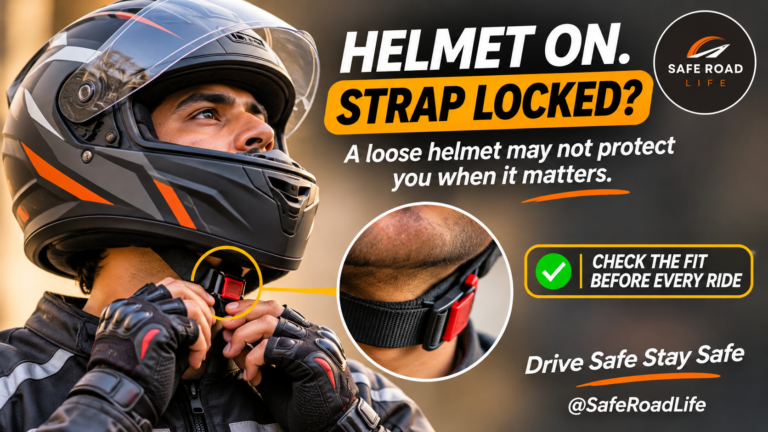
After putting the helmet on, fasten the chin strap and adjust it until it is snug, using the manufacturer’s instructions. Check that the buckle is fully engaged, the strap is not twisted and there is no loose length that can flap in the wind. Give the strap a firm pull to make sure the fastening holds.
Section 129 of India’s Motor Vehicles Act defines protective headgear as a helmet that is securely fastened to the wearer’s head by the straps or fastenings provided. In other words, wearing an unfastened helmet is not the same as wearing protective headgear correctly.
Your passenger needs proper protection too
The person sitting behind the rider is exposed to road risk as well. Do not carry a pillion passenger with a loose, damaged or uncertified helmet. The rider should check that the passenger’s helmet fits and is fastened before moving.
India’s Section 129 requires people above four years of age who drive, ride or are carried on a motorcycle in a public place to wear the prescribed protective headgear. The Act provides an exception for a Sikh person wearing a turban while riding or driving.
There are also specific provisions for young children. Under Rule 138(7) of the Central Motor Vehicles Rules, when a child between nine months and four years is carried as a pillion, the child must have a properly fitting child helmet and be secured to the rider using a safety harness; the motorcycle’s speed must not exceed 40 km/h. Do not put an adult-sized helmet on a small child and assume the child is protected.
When the helmet has taken an impact, do not judge it by appearance
A helmet may look normal outside even when its energy-absorbing liner has been compressed or damaged. If it has been involved in a crash or a significant impact, follow the helmet manufacturer’s replacement instructions and do not return it to service merely because there is no visible crack. Also replace a helmet with damaged straps, a faulty buckle, a cracked shell or deteriorated padding.
Store the helmet carefully. Do not drop it, hang it from a mirror, place heavy objects on it or modify the shell or lining with unapproved accessories. Keep it away from harsh chemicals, excessive heat and direct conditions that the manufacturer warns against.
Small habits that make a real difference
- Before every ride: Check the shell, visor, strap and buckle; put the helmet on level and fasten it.
- For every passenger: Provide a separate, correctly sized and certified helmet. Never share one helmet between two people.
- For children: Use child-specific protection and follow the applicable harness and speed requirements.
- After an impact: Stop using the helmet until you have followed the manufacturer’s replacement guidance.
- At purchase: Check the genuine BIS mark and IS 4151:2015 certification details.
Do not let these shortcuts undo the protection
- Do not ride with the chin strap hanging loose or the buckle only partly closed.
- Do not use a helmet that rocks, rotates or lifts easily on your head.
- Do not buy a novelty or non-certified helmet for road use.
- Do not assume a pillion passenger is safe just because the rider is wearing a helmet.
- Do not ignore a damaged visor, frayed strap, broken buckle or compressed padding.
- Do not keep using a helmet after a significant impact without following replacement guidance.
The mirror-side check before you move
Before starting the engine, pause for a moment:
- ☐ Genuine BIS certification mark checked
- ☐ Helmet fits snugly and sits level
- ☐ Vision is clear through the visor
- ☐ Chin strap is correctly adjusted
- ☐ Buckle is fully locked
- ☐ Pillion passenger is wearing a separate, properly fitted helmet
A helmet is not a fashion accessory. It is protective equipment that must fit, stay in position and be fastened every time. The most important helmet check takes only a few seconds—but those seconds should never be skipped.
Share this with the person who rides without fastening the strap, the friend buying a cheap unmarked helmet and the family member who always says, “It is only a short ride.” A short journey still deserves full protection.
Drive Safe Stay Safe
@SafeRoadLife
Sources and further reading
- Government of India – Motor Vehicles Act, 1988, Section 129
- Bureau of Indian Standards – IS 4151:2015, Protective Helmets for Motorcycle Riders
- Press Information Bureau / Department of Consumer Affairs – Use BIS-certified helmets, 5 July 2025
- Ministry of Road Transport and Highways – Central Motor Vehicles (Second Amendment) Rules, 2022: Child Pillion Safety
- U.S. National Highway Traffic Safety Administration – Choose the Right Motorcycle Helmet
- World Health Organization – Helmets: A Road Safety Manual for Decision-Makers and Practitioners
About the Author