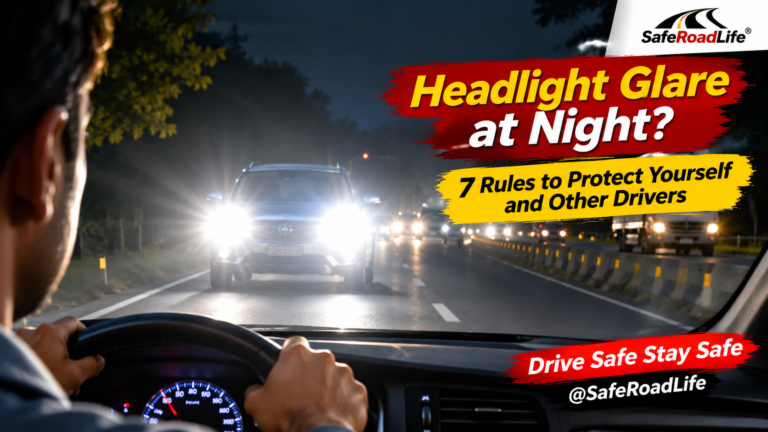
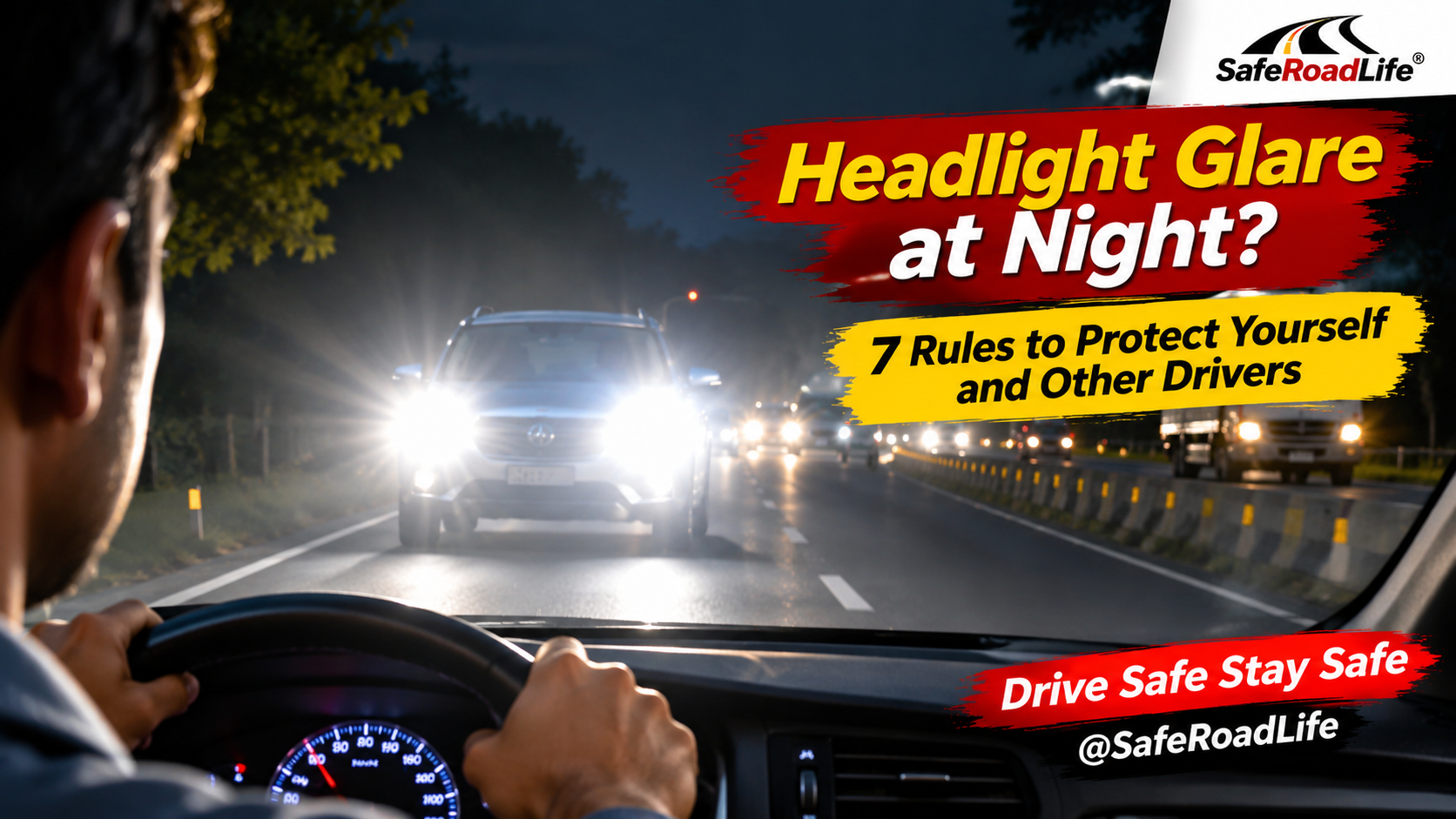
One flash of high beam. Your vision disappears for a moment. A pedestrian, cyclist or stalled vehicle may be just ahead. What would you do?
Night driving demands more attention because the road, road edges and other road users are harder to see. Headlight glare makes the challenge worse—especially when a vehicle approaches with full beam switched on or follows too closely with bright lights.
The answer is not to respond with another high beam. The safer response is to reduce glare, protect your vision and drive at a speed that matches what you can clearly see.
Here are seven practical rules every night driver should remember.
Why headlight glare is dangerous at night
Bright or poorly aimed headlights can make it difficult to judge the road ahead, spot road users and recognise hazards in time. A dirty windscreen, damaged wipers, mist or condensation can spread light and make glare feel even stronger.
India’s Motor Vehicles (Driving) Regulations, 2017 say that high beam must not be used inappropriately, for long periods or on well-lit roads. Drivers must dip high beam in good time when an oncoming vehicle approaches or when driving close behind another vehicle.
7 rules to stay safe when headlights dazzle you
1. Use high beam only when it is appropriate
Use dipped headlights on well-lit roads and whenever another road user could be dazzled. High beam may help on a dark, unlit stretch when there is no vehicle close ahead or approaching, but dip it in good time before meeting another vehicle or following one closely.
2. Do not stare directly at oncoming headlights
When a bright beam approaches, avoid looking straight into it. Keep your vehicle on its path and briefly use the left edge of the road or lane marking as a visual guide. Do not turn your head away for long or allow the vehicle to drift out of its lane.
3. Reduce speed to match the distance you can see
Do not drive at a speed that takes you beyond the clear area illuminated ahead. Ease off the accelerator when visibility is poor and be ready to slow further. The Motor Vehicles (Driving) Regulations, 2017 require drivers to choose a speed that allows control in the prevailing conditions, including visibility and weather.
4. Keep a longer gap from the vehicle ahead
At night, it can take longer to notice braking, debris or a person near the road. Leave more space than you might during daylight and avoid tailgating. If the vehicle behind you has bright headlights, use your rear-view mirror’s anti-glare setting if fitted and avoid sudden braking.
5. Keep the windscreen, mirrors and lights clean
Dust, fingerprints, scratches and condensation can scatter light and create halos around headlights. Clean the windscreen inside and outside, clean the mirrors and lamp lenses, and make sure the wipers clear the glass properly. Use the demister when the windscreen fogs up.
6. Check headlight aim and avoid unsafe modifications
Both headlights, tail lamps and indicators must work correctly. Get misaligned or damaged headlamps checked, especially after a repair or a front-end impact. Avoid unapproved bulbs or lighting modifications that change the beam pattern and may dazzle other road users. If luggage or a heavy load changes the vehicle’s stance, check the headlight levelling setting where your vehicle provides one.
7. Use fog lamps only when visibility is seriously affected
In fog, dust or heavy rain, slow down and use dipped headlights. High beam can reflect from fog and make it harder to see. India’s vehicle-lighting regulation permits fog lamps when visibility is considerably affected by fog, dust, storm, rain or snow, and specifies their use with dipped headlamps. Switch them off when the conditions no longer require them.
Do’s: Make night driving safer
- Check headlights, tail lamps, brake lights and indicators before a night journey.
- Dip high beam early for oncoming traffic and when following another vehicle closely.
- Keep the windscreen, mirrors and headlamp lenses clean.
- Wear your prescribed glasses or contact lenses if you need them for driving.
- Reduce speed and increase following distance when visibility is limited.
- Watch carefully for pedestrians, cyclists, animals and unlit vehicles.
- Take a safe break if tiredness is affecting your concentration.
Don’ts: Avoid these common mistakes
- Don’t keep high beam switched on when another vehicle approaches.
- Don’t use high beam continuously on well-lit roads.
- Don’t retaliate with high beam when another driver dazzles you.
- Don’t drive using parking lights alone when headlights are required.
- Don’t use fog lamps unnecessarily or leave them on after visibility improves.
- Don’t drive fast just because the road ahead looks empty.
- Don’t continue if glare, fatigue or poor visibility makes it unsafe to drive.
Why these precautions matter
1. Better visibility: Clean glass and correctly aimed lights help you see the road more clearly.
2. Less glare for everyone: Dipping high beam helps protect the vision of oncoming drivers and people ahead.
3. More time to react: A suitable speed and a longer following gap give you more time to respond to hazards.
4. Safer for vulnerable road users: Careful scanning helps you notice pedestrians and cyclists who may be difficult to see after dark.
5. Fewer avoidable lighting problems: Routine checks can identify failed bulbs, dirty lenses and poor headlight aim before a journey.
The two-minute night-driving check
Before driving after dark, check:
- ☐ Headlights work on dipped and main beam
- ☐ Tail lamps, brake lights and indicators work
- ☐ Headlamp lenses and windscreen are clean
- ☐ Wipers and demister work properly
- ☐ Mirrors are clean and correctly adjusted
- ☐ Prescribed spectacles are available
- ☐ Your route includes safe places to stop and rest
Remember: High beam is not a weapon and it is not a substitute for safe speed. Use the correct lights, respect the vision of other road users and never drive faster than your visibility allows.
Share this message with family members, professional drivers and everyone who travels after dark. A small change in lighting behaviour can make the road safer for many people.
Drive Safe Stay Safe
@SafeRoadLife
Sources and further reading
- Ministry of Road Transport and Highways – Motor Vehicles (Driving) Regulations, 2017
- Ministry of Road Transport and Highways – Road Safety Book: Night Driving and Visibility
- UK Department for Transport – Minimising Headlight Glare and Its Effects
- Waka Kotahi NZ Transport Agency – Night Driving
About the Author