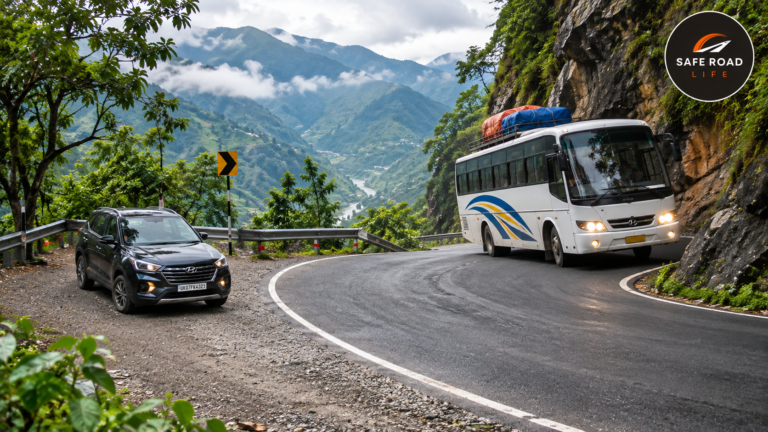
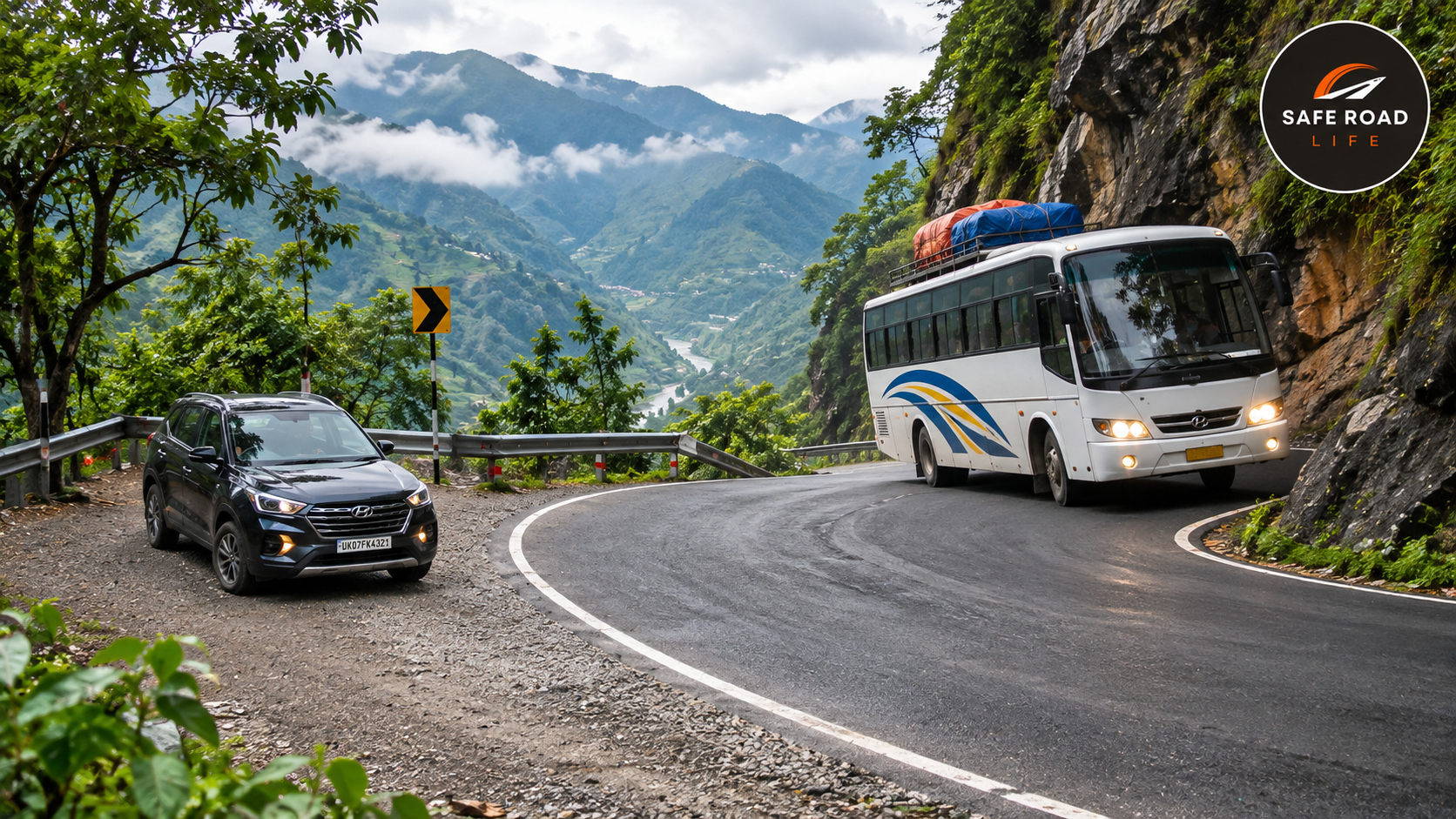
You are descending a narrow hill road. Around the next bend, a bus is climbing towards you. There is barely enough room for both vehicles. Who should make way?
Mountain driving is not simply highway driving with a view. The road can narrow without warning, bends can hide oncoming traffic, and a long downhill stretch can place continuous demands on a vehicle’s braking system. A moment of impatience—or the wrong gear choice—can turn a beautiful journey into a dangerous one.
India’s Motor Vehicles (Driving) Regulations, 2017 contain an important rule that many drivers overlook: on a narrow mountain or steep road where vehicles cannot pass freely, the driver travelling downhill must stop on the left and allow the vehicle travelling uphill to pass first.
The uphill vehicle gets priority on a narrow mountain road
Regulation 21 of the 2017 Regulations sets out this precedence. When the road is not wide enough for vehicles to cross each other freely, the downhill driver must stop on the left side and allow the uphill vehicle to pass first.
This is not a competition to see who can reverse faster. The downhill driver should identify a suitable safe place to stop, avoid blocking the bend and give the climbing vehicle room to continue. If a traffic marshal or police officer is controlling the movement, follow their directions.
The most demanding part may begin after the summit
Long descents can build speed quickly because gravity is constantly pulling the vehicle downhill. If the driver relies only on continuous heavy footbrake use, the brakes can overheat and lose effectiveness—a condition commonly called brake fade.
Select an appropriate lower gear before starting a steep descent, following the vehicle manufacturer’s guidance. Engine braking helps control speed and reduces the need for continuous braking. Use the service brakes when required, smoothly and in a controlled way. Never coast downhill in neutral or with the clutch pressed down: this removes engine braking and can make the vehicle harder to control.
Read the bend before you reach it
A hairpin bend can hide a bus, truck, cyclist, animal, fallen rock or stopped vehicle. Slow down before entering the bend, stay on your side of the road and avoid cutting across the centre line to make a shorter turn. Keep enough room to stop if an oncoming vehicle appears.
Do not overtake near blind bends, narrow bridges or places where the view ahead is restricted. Sound the horn only where appropriate and permitted to warn of your approach; it does not give you priority and it does not make an unsafe overtake safe.
Give the vehicle, the road and the weather a proper check
Before a hill journey, check the condition of the tyres, brakes, steering, lights, wipers and coolant level. Make sure the vehicle is not overloaded, luggage is secured and the tyres are suitable and correctly inflated according to the manufacturer’s placard or manual.
Rain, fog, loose gravel, snow, landslide debris and road repairs can change the grip and visibility within a short distance. Reduce speed to match the conditions. If visibility becomes poor or the route is under an official closure or warning, do not continue just to keep to your itinerary.
Passengers can help the driver stay in control
Everyone should wear a seat belt. Passengers should avoid distracting the driver on narrow sections, sharp bends and steep descents. Do not ask the driver to stop suddenly for photographs. Use designated viewpoints or a wide, safe parking area well away from the edge of the road.
For professional drivers and fleet operators, hill routes deserve a specific journey briefing. Confirm the vehicle’s fitness, permitted load, route conditions, weather alerts and safe stopping locations. Drivers should understand the correct gear and braking technique for the actual vehicle they operate, whether it is a car, bus or goods vehicle.
When the road becomes too narrow to pass
Do not force a crossing at a blind bend or squeeze a vehicle against the edge. Follow the uphill-priority rule where it applies, stop on the left at a suitable place and allow the other vehicle to pass. Communicate calmly, leave space and never reverse towards an edge unless you can see that the manoeuvre is safe.
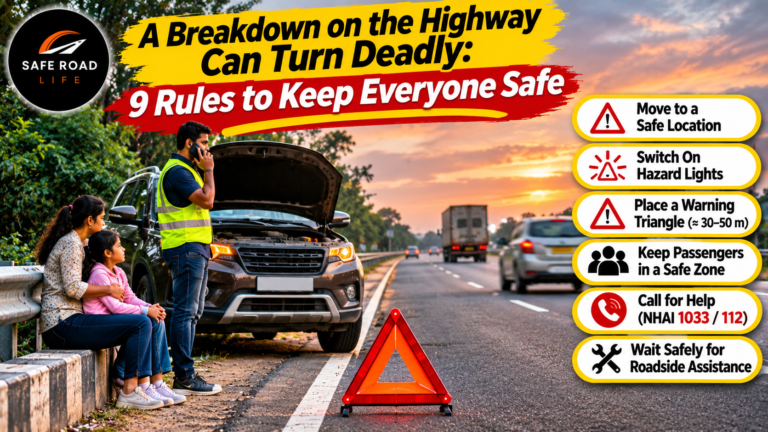
If your vehicle develops a problem, avoid stopping on a sharp bend or narrow section if you can safely reach a wider, visible place. Switch on hazard warning lights, use the warning equipment as required by the applicable rules and seek assistance. Keep passengers away from moving traffic and exposed road edges.
Hill-driving habits worth keeping
- Keep to the left and stay within your lane, especially near bends and restricted views.
- On narrow mountain roads, give way to uphill traffic as required by Regulation 21.
- Choose a suitable lower gear before a long descent and never coast in neutral.
- Control speed before a bend, not halfway through it.
- Do not overtake where sight distance, road width or markings make it unsafe.
- Check brakes, tyres, steering, lights and coolant before the trip.
- Stop only at safe, sufficiently wide places—not on blind bends or narrow stretches.
- Follow local police, road-authority, weather and landslide instructions.
The question to ask before every downhill stretch
Before the vehicle begins descending, ask yourself: Have I selected the right gear, reduced my speed and left enough room to respond? If the answer is no, prepare before the slope begins. Do not wait until the vehicle is gathering speed to make the decision.
A mountain road rewards patience and punishes shortcuts. Give climbing vehicles room, respect the bend, protect your brakes and remember that reaching the destination safely is more important than reaching it quickly.
Share this with family members planning a hill holiday, professional drivers, bus operators and anyone who travels through ghats and mountain routes.
Drive Safe Stay Safe
@SafeRoadLife
Sources and further reading
- Ministry of Road Transport and Highways – Motor Vehicles (Driving) Regulations, 2017, Regulation 21
- Transport Department, Government of West Bengal – Training Manual for Drivers: Driving on Hilly Terrain
- Transport Department, Government of Uttarakhand – Do’s and Don’ts for Char Dham Yatra
- Ministry of Housing and Urban Affairs – Drivers’ Handbook: Gear Selection and Downhill Driving
- UK Highway Code – General Driving Techniques: Coasting and Vehicle Control
About the Author