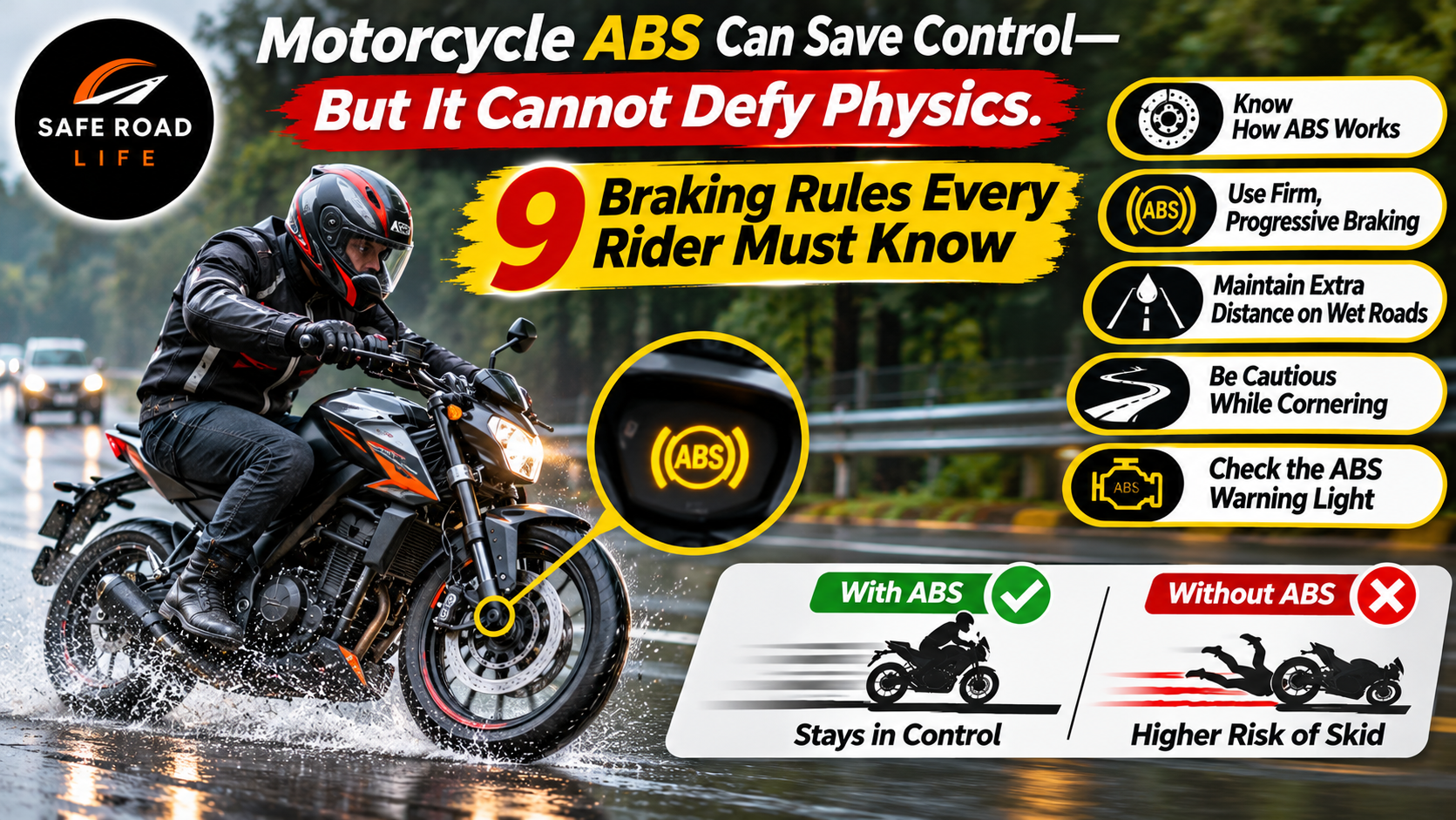
A vehicle cuts across your path. A pedestrian steps onto the road. The car ahead brakes suddenly. In that split second, a motorcycle rider has very little time to react—and one panicked brake input can turn an emergency into a fall.
Anti-lock Braking System (ABS) is one of the most important motorcycle safety technologies because it helps prevent wheel lock during hard braking. But ABS is not an invisible shield. It cannot create tyre grip, cancel excessive speed or replace sound riding decisions.
Here are nine practical rules every motorcycle and scooter rider should understand before the next emergency.
1. Understand what motorcycle ABS actually does
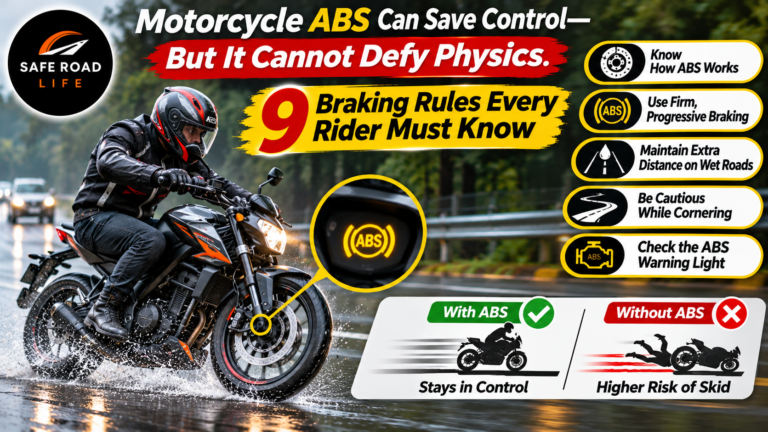
ABS monitors wheel speed. If the system detects that a wheel is about to lock under braking, it rapidly adjusts brake pressure to help the wheel keep rotating. This can help the rider maintain stability and steering control instead of sliding with a locked wheel.
Depending on the motorcycle, ABS may operate on the front wheel only or on both wheels. Check your owner’s manual so you know exactly what system your vehicle has.
2. Do not mistake ABS for permission to ride faster
ABS is a support system—not a licence to follow too closely, accelerate into hazards or ride beyond your ability. It cannot overcome the laws of physics. At higher speeds, the distance needed to stop is greater, and poor road grip can still cause a loss of control.
Ride at a speed that allows you to see, decide and stop safely within the clear distance ahead.
3. Use both brakes firmly and progressively
In an emergency, apply the front and rear brakes decisively and progressively, using the controls as designed for your motorcycle. Avoid grabbing the front brake violently or relying only on the rear brake. Practise the correct technique for your particular model under qualified instruction.
As the motorcycle slows, keep it as upright and stable as the situation allows. Follow the manufacturer’s guidance for your braking system.
4. If the ABS pulses, do not panic
You may feel pulsing or vibration through the brake lever or pedal when ABS activates. This can be normal system feedback. Do not release the brakes simply because you feel it, and do not repeatedly pump the controls. Maintain firm, controlled braking and keep your attention on the escape path and surrounding traffic.
5. Keep a safe following distance
ABS cannot compensate for tailgating. Leave enough space to respond if the vehicle ahead brakes suddenly. Increase your gap in rain, poor visibility, loose gravel, uneven road conditions and when carrying a pillion or luggage.
Look beyond the vehicle directly in front of you. Early observation gives you more time to ease off the throttle and brake smoothly instead of making a last-second emergency stop.
6. Brake before a bend—do not depend on ABS mid-corner
Slow down before entering a turn and choose a speed that allows you to negotiate it safely. Braking while leaned over can use up the limited grip available for cornering. ABS may help manage wheel lock, but it cannot guarantee that the motorcycle will remain on its intended line or prevent every cornering skid.
7. Treat wet paint, sand, gravel and oil as warning signs
Road markings, metal covers, loose stones, sand, diesel spills and wet leaves can reduce tyre grip. ABS may help prevent a wheel from locking, but it cannot manufacture traction where the road surface offers very little. Reduce speed early, keep the motorcycle smooth and avoid sudden steering or braking inputs on slippery patches.
8. Check the ABS warning light and braking system
When you start the motorcycle, the ABS warning lamp may illuminate as part of its self-check. Follow the owner’s manual for the normal indicator sequence. If the warning light remains on when it should have switched off, or the brake lever feels abnormal, do not assume the ABS is working. Get the system inspected by an authorised service centre before relying on it.
Use the manufacturer-recommended tyres and sizes, maintain correct tyre pressure, and never ignore damaged wheel-speed sensors, tone rings, wiring or brake components.
9. Practise emergency stops in a safe, controlled place
Do not wait for a real emergency to discover how your motorcycle responds. With a qualified instructor, practise progressive braking and controlled emergency stops in a closed, level training area with adequate space. Learn how ABS feels on your own motorcycle and build the habit of looking where you want to go.
Never practise panic stops in live traffic or on public roads. Training should be gradual, supervised and appropriate to your experience and the motorcycle.
A quick pre-ride ABS and braking checklist
- Check that the ABS warning light behaves as described in the owner’s manual.
- Inspect both tyres for damage, wear and correct pressure.
- Check brake lever and pedal feel, brake fluid and visible brake components.
- Confirm that the motorcycle has the correct manufacturer-approved tyres and parts.
- Keep a safe following gap and adjust speed to the road surface.
- Wear a certified, correctly fastened helmet and protective riding gear.
Frequently asked questions
Does motorcycle ABS guarantee a shorter stopping distance?
No. ABS is primarily designed to help prevent wheel lock and preserve stability and steering control during hard braking. Stopping distance varies with speed, tyres, road surface, motorcycle design and rider input. On some loose or uneven surfaces, ABS may not shorten the stop.
Should I pump the brakes when ABS activates?
No. On an ABS-equipped motorcycle, do not pump the brake controls just because you feel pulsing. Maintain firm, controlled braking and follow the motorcycle manufacturer’s instructions.
Is single-channel ABS the same as dual-channel ABS?
No. Single-channel ABS generally controls one wheel, commonly the front. Dual-channel ABS controls both front and rear wheels. Check the specifications and owner’s manual for your exact model.
Can ABS prevent every motorcycle skid?
No. ABS can help prevent wheel lock during braking, but it cannot prevent every loss of grip caused by cornering, excessive speed, poor tyres, oil, sand or other hazards. Safe speed, observation and smooth control remain essential.
The final message: technology helps—but the rider decides
ABS can give a rider a better chance of staying in control when sudden braking is unavoidable. But the strongest safety system begins before the brake lever is touched: a sensible speed, a clear view, a safe gap, maintained tyres and a rider who is ready for the unexpected.
Do not ride as if ABS will save you from every mistake. Ride so you do not need an emergency stop.
DRIVE SAFE. STAY SAFE.
@SafeRoadLife
Sources and further reading
- World Health Organization: Motorcycle ABS to Save Lives
- Ontario Ministry of Transportation: Motorcycle Handbook—Dealing with Emergencies
- Insurance Institute for Highway Safety: Motorcycles and ABS
- Press Information Bureau: Two-wheeler ABS requirements in India
- Royal Enfield India: Motorcycle safety and ABS guidance
About the Author