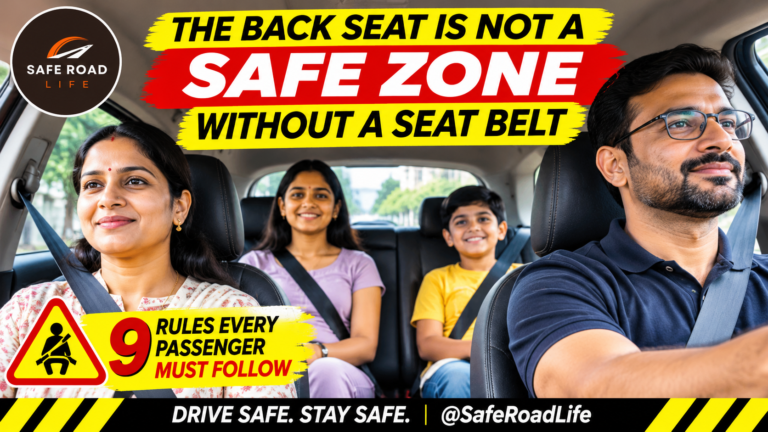
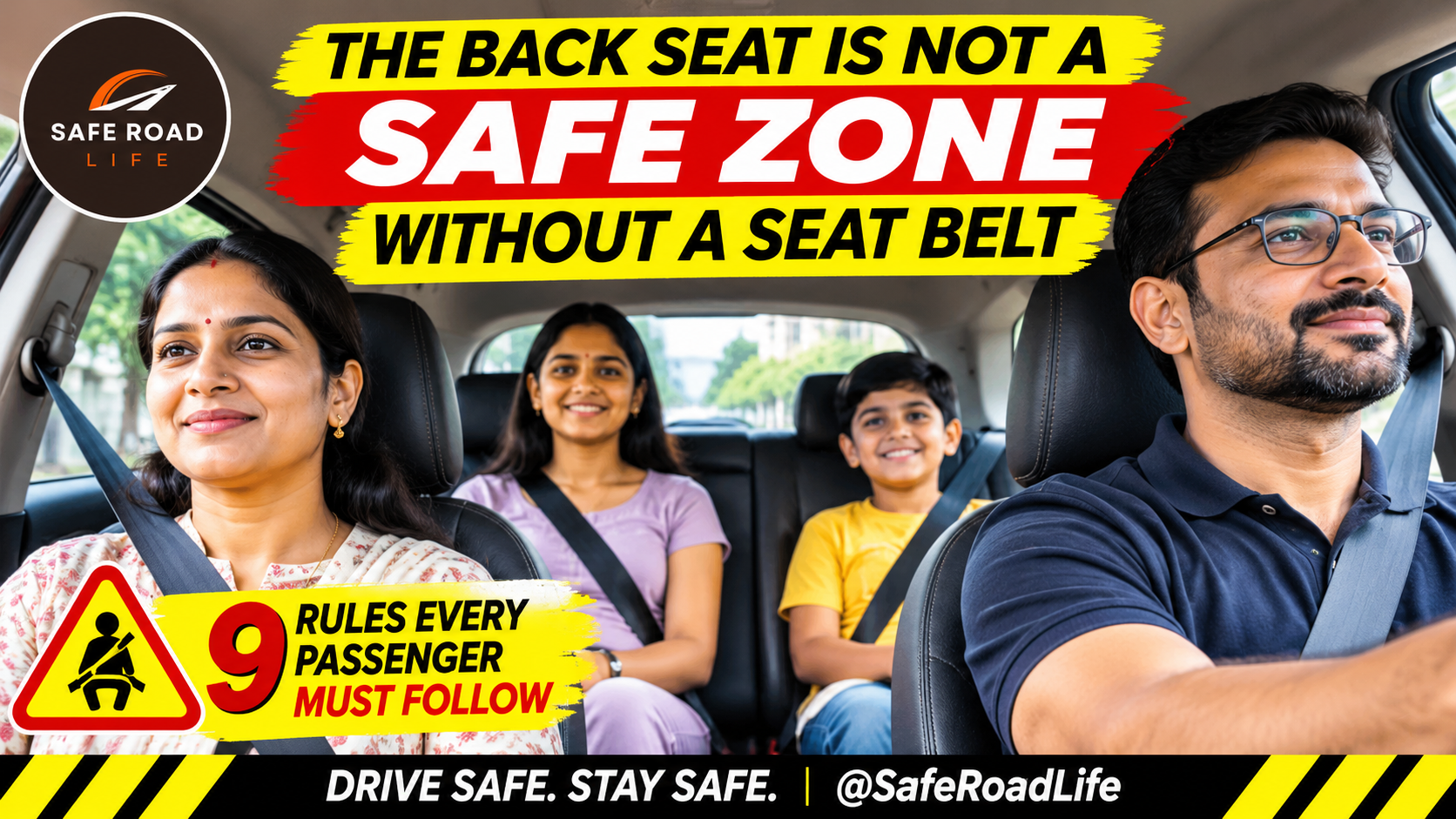
Many passengers believe that the front seat is the dangerous place and the back seat is automatically safe. That belief can have serious consequences.
In a sudden stop or collision, an unrestrained rear-seat passenger can be thrown forward, suffer severe injuries or injure other occupants. Sitting behind the driver does not remove the forces created by a crash.
A seat belt is not just a legal requirement. It is one of the most important protections inside a moving vehicle.
Every seat is a safety seat only when its occupant is properly restrained.
1. Wear a seat belt even on short journeys
A collision can happen close to home, on a familiar road or during a slow city journey. Never skip the seat belt because the destination is nearby.
2. Use the correct belt for your seating position
Use the available seat belt designed for that seat. Never share one belt between two passengers or place the belt around more than one person.
3. Position the lap belt low across the hips
The lap portion should sit low and snug across the hips or upper thighs, not across the soft abdomen.
4. Position the shoulder belt correctly
The shoulder strap should cross the middle of the chest and shoulder. Never place it behind your back or under your arm.
5. Never allow children to travel on an adult’s lap
Children need an appropriate child restraint based on their size. An adult cannot hold a child safely during a collision.
6. Do not recline excessively or sit sideways
Sit upright with your back against the seat. Incorrect posture can cause the belt to sit improperly and reduce its protective effectiveness.
7. Check the belt before the vehicle moves
Look for twists, cuts, damaged buckles and belts that fail to retract or lock correctly. Report defects and have them inspected.
8. Never ignore rear-seat passengers
Drivers should check that everyone is properly restrained before moving. Parents and fleet operators should make seat-belt checks part of every departure routine.
9. Never unbuckle while the vehicle is moving
Keep the belt fastened until the vehicle is safely parked. Do not remove it to reach luggage, use a phone or change seating position.
Rear-seat passenger safety checklist
- Every passenger has an individual seat belt.
- Lap belt positioned low across the hips.
- Shoulder belt crosses the chest correctly.
- No twisted or damaged belts.
- Children use suitable child restraints.
- Passengers sit upright.
- No belt is shared.
- Everyone is restrained before departure.
- Seat belts remain fastened throughout the journey.
A message for families and professional drivers
Whether travelling in a private car, taxi, company vehicle or fleet vehicle, every occupant shares responsibility for seat-belt safety.
Drivers should never begin a journey until all passengers are properly restrained. Employers and fleet managers should reinforce this behaviour through regular safety briefings.
“The front seat does not own the risk, and the back seat does not escape it. Every life deserves a seat belt.”
Protect every passenger. Make every journey count.
DRIVE SAFE. STAY SAFE.
@SafeRoadLife
About the Author