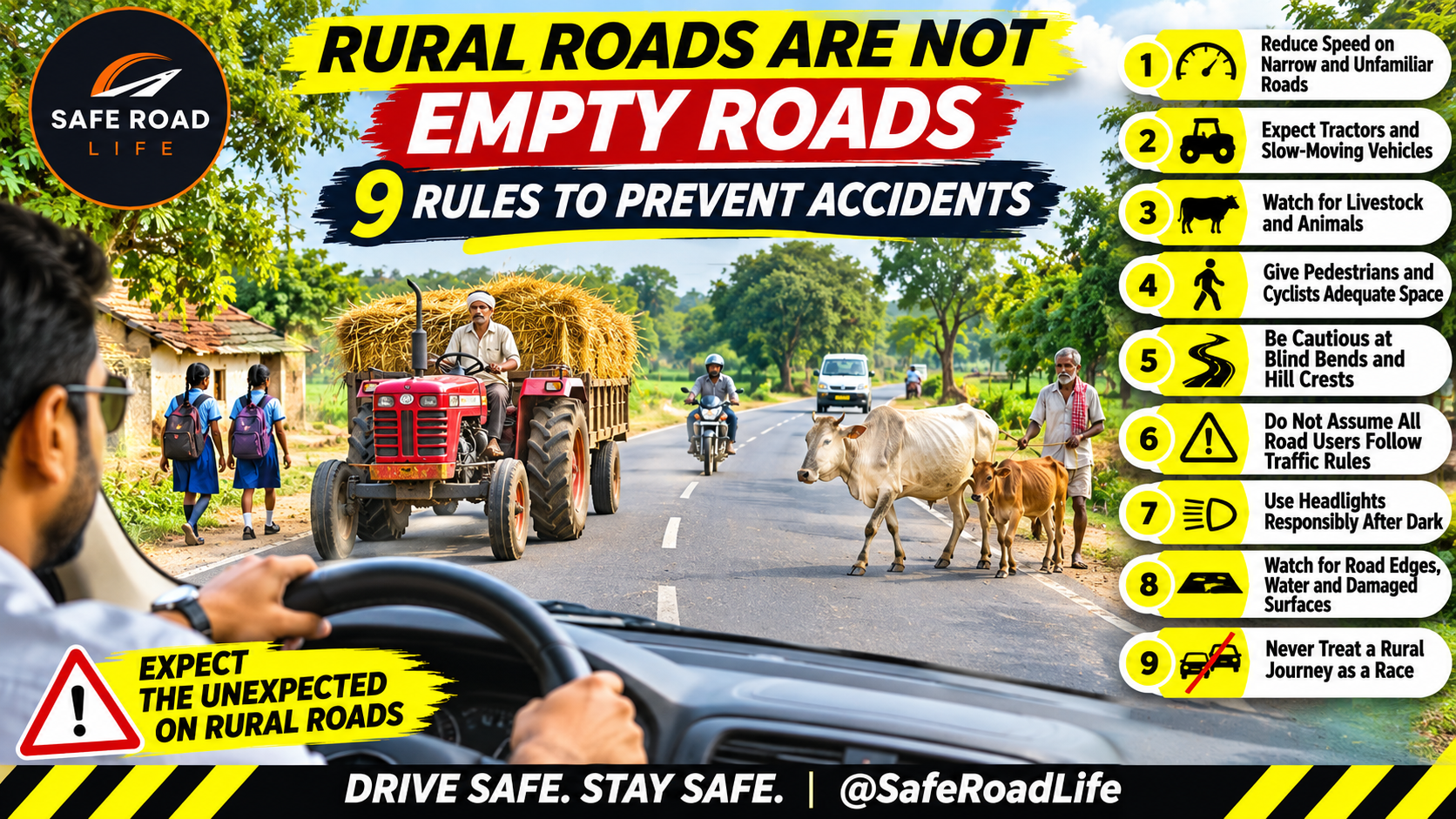
A rural road may look quiet, but quiet does not mean safe. A tractor can emerge around a bend, cattle may cross without warning, pedestrians may walk along the carriageway, and the road surface can change suddenly. Drivers who carry highway speeds into villages and countryside roads leave themselves little time to respond.
Rural road safety depends on anticipation, patience and respect for every person and animal sharing the route. The safest driver is not the one who expects an empty road, but the one who is prepared for every life sharing it.
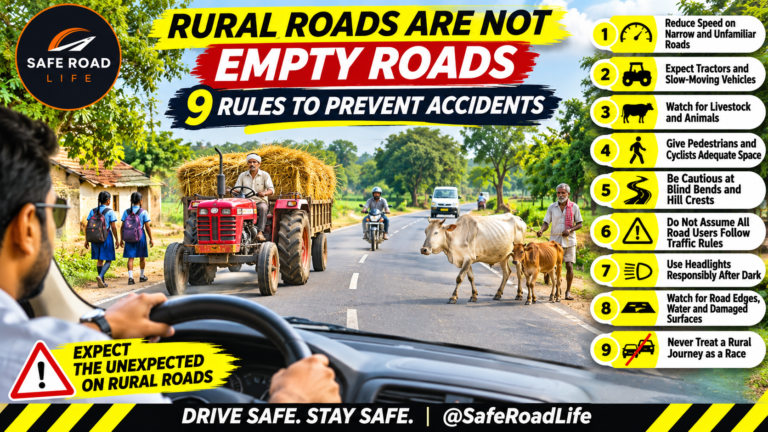
1. Reduce speed on narrow and unfamiliar roads
Do not judge a safe speed only by how clear the road looks ahead. Narrow village roads, parked vehicles, sharp edges, unmarked junctions and sudden crossings can limit your escape space. Slow down before entering a settlement, approaching a junction or passing a place where people may step onto the road. Keep a speed that allows you to stop within the distance you can clearly see to be safe.
2. Expect tractors and slow-moving agricultural vehicles
Tractors, trailers, harvesters and other agricultural vehicles may move slowly, turn widely or carry loads that obscure their indicators and rear lights. Do not tailgate or make an impatient overtake. Wait until the road ahead is visible, the available space is sufficient and the driver’s intention is clear. Never squeeze past near a bend, bridge, junction or hill crest.
3. Watch for livestock and animals
Cattle, goats, dogs and other animals may enter the carriageway suddenly or behave unpredictably when startled by a horn or fast-moving vehicle. Ease off the accelerator, increase your following distance and be ready to stop. Avoid aggressive honking and sudden swerving, which can create a second collision. Give animals time and space to move away safely.
4. Give pedestrians and cyclists adequate space
People may walk along the road because footpaths or shoulders are absent, uneven or obstructed. Children, older people and cyclists may be difficult to see, especially near homes, shops, bus stops and schools. Slow down, leave generous clearance when passing and be prepared for someone to change direction. Never force a pedestrian or cyclist onto a soft or broken road edge.
5. Be cautious at blind bends and hill crests
A bend, tree line, wall or rise in the road can hide an approaching vehicle, a stopped tractor, a person or an animal. Reduce speed before the bend or crest, stay in your lane and avoid overtaking where visibility is restricted. Use the horn only where appropriate as a warning; it does not make an unsafe manoeuvre safe.
6. Do not assume every road user will follow traffic rules
You may encounter vehicles travelling in the wrong direction, unmarked turns, sudden U-turns or people crossing outside designated points. Your responsibility is to anticipate risk without copying unsafe behaviour. Scan far ahead and to both sides, check mirrors regularly and leave enough space to react. Defensive driving means preparing for mistakes made by others.
7. Use headlights responsibly after dark
Rural roads may have limited street lighting, unlit vehicles, pedestrians in dark clothing and animals that are difficult to detect. Use appropriate headlights, dip high beam for oncoming traffic and slow down when visibility is poor. Keep the windscreen, mirrors and lamps clean. Never drive at a speed that exceeds what your visible headlight range and stopping distance allow.
8. Watch road edges, water and damaged surfaces
Shoulders may be soft, drains may be uncovered, and potholes or water-filled depressions may conceal their depth. Avoid abrupt steering to miss a pothole if doing so could put another road user at risk. Reduce speed, choose a safe line and maintain control. Be especially careful after rain, when mud, loose gravel and damaged edges can reduce tyre grip.
9. Never treat a rural journey as a race
Saving a few minutes is never worth risking a life. Leave early, allow extra time for slow vehicles and village traffic, and take a break if you are tired. Do not compete with another driver, pressure a tractor to move faster or overtake simply because a vehicle behind you is impatient. Calm decisions create safer journeys.
A practical rural-road safety checklist
- Slow down before villages, bends, junctions and narrow stretches.
- Keep a safe following distance behind tractors and other slow vehicles.
- Look for animals, pedestrians, cyclists and children near the road.
- Never overtake without a clear view and enough space.
- Use headlights correctly and reduce speed at night.
- Watch for potholes, soft shoulders, water and loose gravel.
- Stay patient; never race or drive under pressure.
A message for professional and fleet drivers
When operating a bus, truck, delivery vehicle or company car, rural-road risk must be part of route planning and driver briefings. Drivers should be reminded to reduce speed in settlements, anticipate vulnerable road users, avoid risky overtaking and report dangerous road conditions. Supervisors should reinforce these behaviours through toolbox talks, route-risk reviews and practical coaching—not merely after an incident.
“The safest driver is not the one who expects an empty road, but the one who is prepared for every life sharing it.”
Every rural road connects homes, farms, schools and communities. Respect the people and animals who share it. Arrive safely; let everyone else do the same.
DRIVE SAFE. STAY SAFE.
@SafeRoadLife
About the Author