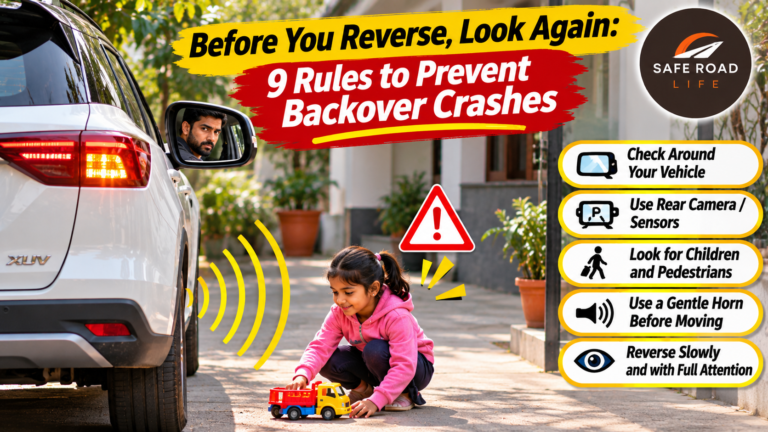
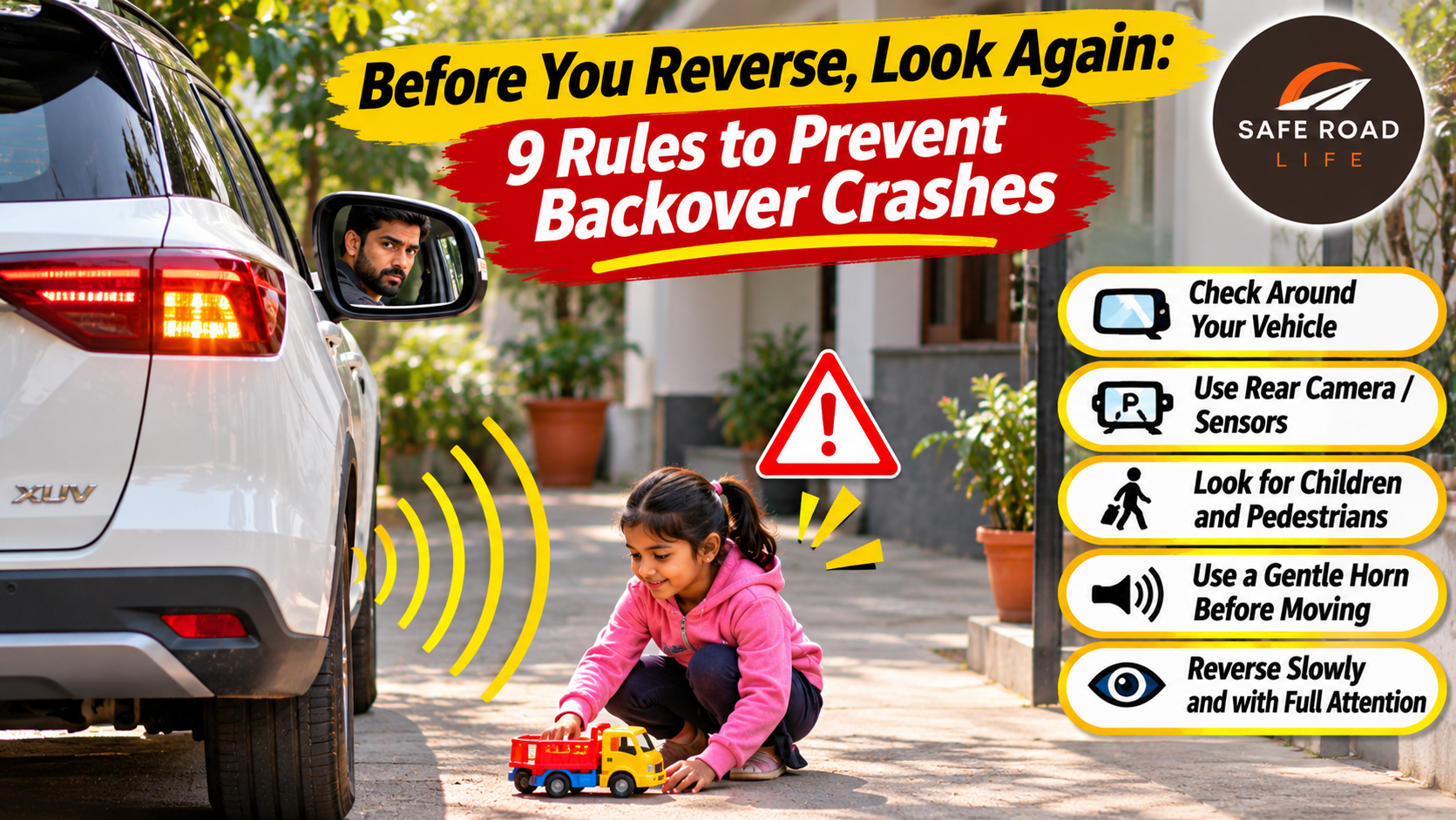
Your parking space looks empty. You check the mirror, select reverse and begin moving. But a child, pedestrian, cyclist or two-wheeler may be hidden just outside your view. One short reversing movement can have life-changing consequences.
Reversing is common in apartment basements, shopping areas, offices, depots and residential lanes. The rear view is restricted, so treat it as a high-attention manoeuvre. Avoid unnecessary reversing; when it is needed, keep it slow, short and controlled.
Why reversing can become dangerous
Rear pillars, headrests, high boot lids, spare wheels, parked vehicles and poor lighting can hide people or objects. Small children may be below the driver’s line of sight. A pedestrian can also enter the area after the driver has checked it.
Reversing cameras, parking sensors and alarms are useful aids, but they do not show every angle or guarantee that the path will remain clear. The driver must keep checking the surroundings and be ready to stop immediately.
9 reversing safety rules every driver should follow
1. Avoid reversing when you can plan a safer exit
Choose a bay that lets you drive out forwards when the layout allows. In depots and workplaces, organise traffic flow to minimise reversing. If you can safely turn around, avoid a long reverse through a crowded lane.
2. Walk around the vehicle before starting
Before selecting reverse, check both rear corners, the sides, ground and space behind the bumper. Look for children, pets, cycles, scooters, trolleys, low walls and bollards. Recheck if the vehicle has been parked for some time.
3. Make sure passengers and children are in a safe place
Have passengers board or leave from a safe side. Never let children play behind or around a running vehicle. Keep toys and cycles out of vehicle paths, and confirm who is supervising a child rather than assuming.
4. Use mirrors and the camera together
Clean and adjust mirrors and camera before moving. Check the display, both mirrors and windows; turn your head where safe. Dirt, rain, darkness and camera angle can limit the image. Technology supports judgement; it cannot replace it.
5. Reverse at a walking pace
Move slowly enough to stop immediately if a person or obstacle appears. Keep your foot ready over the brake and avoid sudden acceleration. Do not rush because another vehicle is waiting or because you are holding up traffic. A few extra seconds are far better than a collision.
6. Keep the reversing distance short
Do not reverse a long distance through a crowded lane if you can reposition safely. If the route becomes unclear, stop, secure the vehicle and get out to check the surroundings before continuing. Never keep moving backwards while guessing where the rear of the vehicle is.
7. Use a trained guide for large or restricted manoeuvres
For buses, trucks and fleet vehicles, use a trained guide when the site’s safe system requires one. Agree on signals first. The guide must stay visible in a safe position, never directly behind the vehicle. Stop if you lose sight of them; keep pedestrians out of the area too.
8. Treat sensors and warning beeps as alerts, not permission to continue
Sensors may miss people, narrow objects or moving road users; alarms can be lost in noise. Stop and investigate every warning. Report faulty cameras, sensors, alarms or lights before work use.
9. Stop whenever the view or situation changes
Stop if a pedestrian approaches, another vehicle enters, a child moves nearby or lighting is poor. Lower the window to hear your surroundings. When reversing towards a live road or footpath, wait until it is clear and use a forward exit if possible.
Do’s: Build a safe reversing habit
- Do a complete walk-around before moving.
- Do check mirrors, windows and the camera display together.
- Do reverse slowly and keep the distance as short as possible.
- Do keep children, passengers and pedestrians clear of the vehicle path.
- Do stop and re-check if you are uncertain about any obstruction.
- Do use a trained guide for difficult fleet or depot manoeuvres.
- Do report defective reversing aids and poor lighting.
Don’ts: Never take these risks
- Don’t rely only on the reversing camera or parking sensors.
- Don’t reverse quickly to save time or satisfy waiting traffic.
- Don’t assume the space is still clear because you checked it earlier.
- Don’t allow anyone to stand directly behind the vehicle.
- Don’t continue if you lose sight of your guide.
- Don’t reverse while distracted by a phone, conversation or loud audio.
- Don’t ignore an alarm, warning or sudden change in visibility.
What safer reversing achieves
Careful reversing protects children, older people, pedestrians, cyclists, two-wheeler riders and passengers. It also prevents damage to vehicles and property, reduces stress in crowded parking areas and supports safer depot operations. A simple routine—check, communicate, move slowly and stop when unsure—replaces guesswork.
Your 20-second reversing checklist
- ☐ Is reversing necessary, or can I drive out forwards?
- ☐ Have I walked around and checked both rear corners?
- ☐ Are children, passengers and pedestrians safely clear?
- ☐ Are my mirrors and camera clean and correctly adjusted?
- ☐ Is the path clear, well lit and free of obstacles?
- ☐ Can I reverse slowly and stop immediately?
- ☐ If using a guide, can I see them throughout the manoeuvre?
A clear mirror is not proof of a clear path. Before every reverse, pause, look again and move only when it is safe. The few seconds you spend checking may protect a life.
Sources and further reading
- National Highway Traffic Safety Administration (NHTSA) – Child Safety and Backover Prevention
- UK Health and Safety Executive – Safe Driving: Reversing
- NHTSA – Driver Assistance Technologies, including Backup Cameras and Rear Cross-Traffic Alerts
- Health and Safety Authority, Ireland – Workplace Transport Safety: Reversing Vehicles
Drive Safe Stay Safe
@SafeRoadLife
About the Author