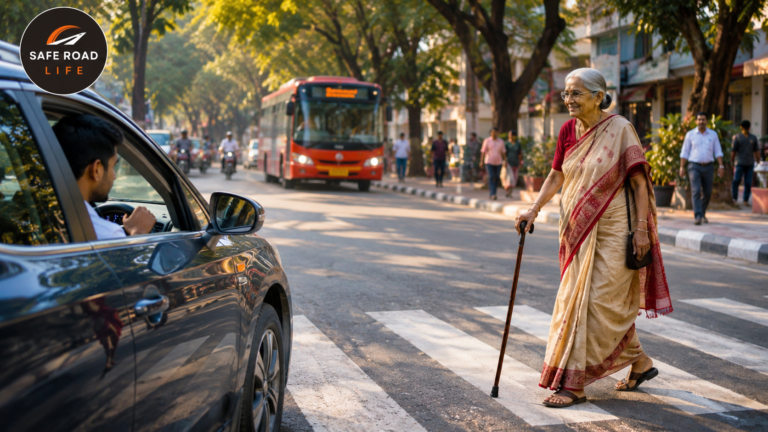
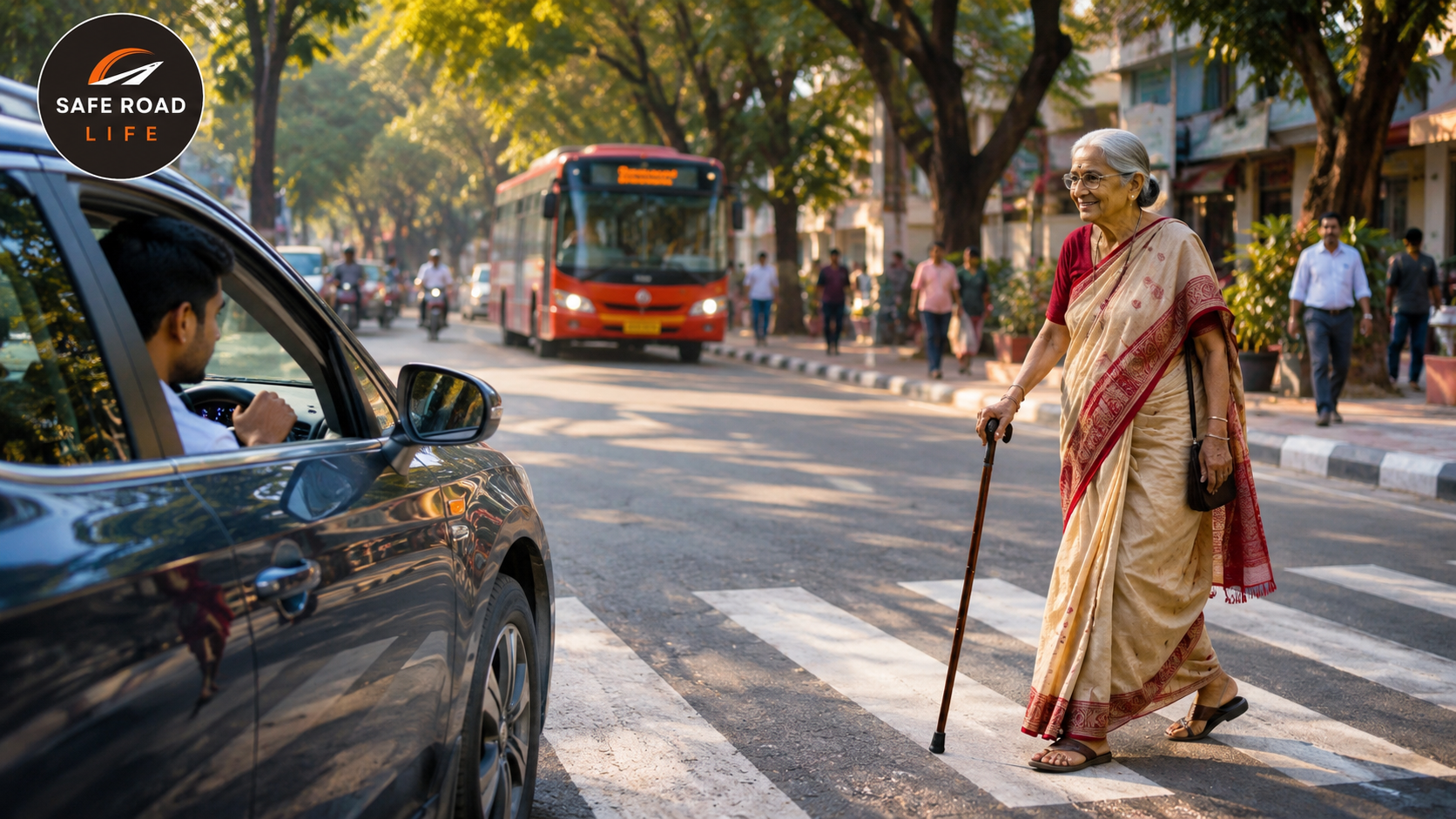
Every morning, an older man waits at the edge of a busy road. The pedestrian signal changes. Vehicles begin to move. He looks left, looks right, and starts crossing—but the countdown seems to move faster than his feet.
For someone walking with a stick, recovering from an illness or simply moving at a slower pace, a road designed around the speed of traffic can feel like a daily test. The problem is not that older people should stop going out. The problem is that streets should allow people of different ages and abilities to move safely.
Ageing does not remove the right to mobility
Older adults are not one uniform group. Many continue to drive, cycle, use public transport and walk independently well into later life. Some may experience changes in vision, hearing, balance, flexibility, strength or reaction time. Others remain highly active. A person’s age alone does not tell us whether they are safe to drive or how quickly they can cross a street.
What does change is the consequence of a collision. An older pedestrian or vehicle occupant may be more physically vulnerable and can suffer more serious injuries from an impact that a younger person might survive with less harm. That makes prevention, lower impact speeds and forgiving street design especially important.
The crossing signal should not become a countdown to panic
A pedestrian crossing is useful only when people have enough time and space to use it. Short signal phases, wide roads, raised kerbs, uneven paving and vehicles blocking the crossing can turn a simple journey into a difficult manoeuvre. Someone with limited mobility may need more time to start walking, negotiate the kerb and reach the other side.
Road authorities can make crossings more inclusive through suitable crossing times, refuge islands where appropriate, accessible kerb ramps, tactile paving, clear signals, good lighting and unobstructed footpaths. These improvements also help people using wheelchairs, parents with prams, children and anyone carrying luggage.
Junctions demand more than a quick glance
Intersections require people to judge vehicle speed, distance, direction and right of way, often while watching several movements at once. The US Federal Highway Administration notes that older road users can face particular challenges related to visibility, flexibility and the time needed to observe, decide and act. Its guidance highlights intersection design, signs, markings and lighting as important safety considerations.
For drivers, this is a reminder to approach junctions at a speed that allows a complete scan. Do not rush a turn because a pedestrian appears slow. Check the crossing path before moving, especially when turning across a footpath. A green signal does not mean the space ahead is automatically clear.
Older drivers deserve support, not stereotypes
Driving can be central to independence: visiting a doctor, buying groceries, seeing family or reaching a place where public transport is limited. Some older drivers may choose to avoid night driving, heavy traffic or complicated junctions. Others may benefit from a professional driving assessment, an eye check or a conversation with a healthcare professional about a condition or medication that could affect driving.
The right question is not simply, “How old are you?” It is, “Can you safely manage the driving tasks you face, and what support or adjustments would help?” Decisions should be based on individual ability and relevant medical or licensing guidance, not assumptions about everyone in an age group.
Small behaviours can make a big difference
If you are driving, slow down near hospitals, clinics, markets, residential streets and places where older people may cross. Give pedestrians time. Never sound the horn to hurry someone across the road. Keep crossings and footpaths clear when parking.
If you are walking, choose a marked crossing where available, wait for a safe gap and do not assume that an approaching driver has seen you. If you need more time, use a refuge island or ask for assistance where available. Reflective or light-coloured clothing can improve visibility in low light, but it does not replace safe crossing facilities or careful driving.
Families can protect independence without taking it away
Families can help by checking whether a regular route has safe footpaths and crossings, accompanying a relative on a difficult journey if they want support, and discussing driving concerns respectfully. If a person’s ability to drive has changed, explore alternatives such as accessible public transport, community transport, shared journeys or help with essential trips.
The aim should be to preserve connection and independence while reducing exposure to danger. Taking away mobility without offering an alternative can isolate people; ignoring a genuine safety concern can put them and others at risk.
A safer street is one where nobody is left behind
Good road design should not work only for the fastest, strongest or most confident road user. It should give an older person enough time to cross, a driver enough information to make a decision and a person with limited mobility a continuous, accessible route.
When we make streets safer for older people, we make them safer for almost everyone. The true measure of a modern road is not how quickly traffic moves through it. It is whether every generation can reach home with dignity and safety.
DRIVE SAFE. STAY SAFE.
@SafeRoadLife
Sources and further reading
- Federal Highway Administration – Older Road Users
- European Road Safety Observatory – Older Drivers
- World Health Organization – Pedestrian Safety Manual (2023)
- National Academies – Human Factors Guidelines for Road Systems: Older Road Users (2025)
Related reading: Every Step Matters: Pedestrian Safety.
About the Author