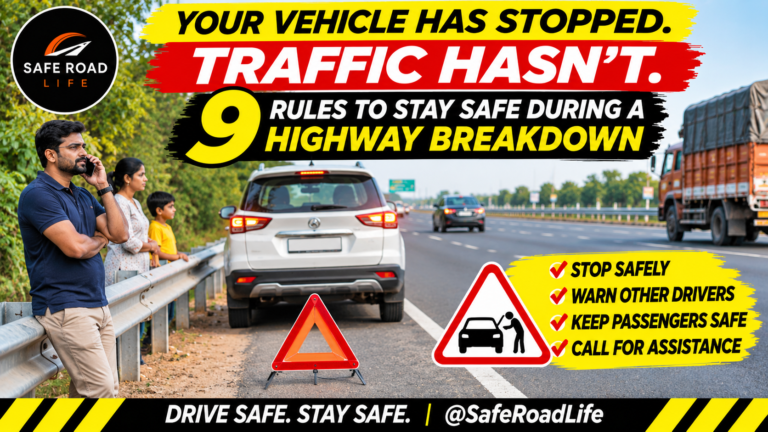
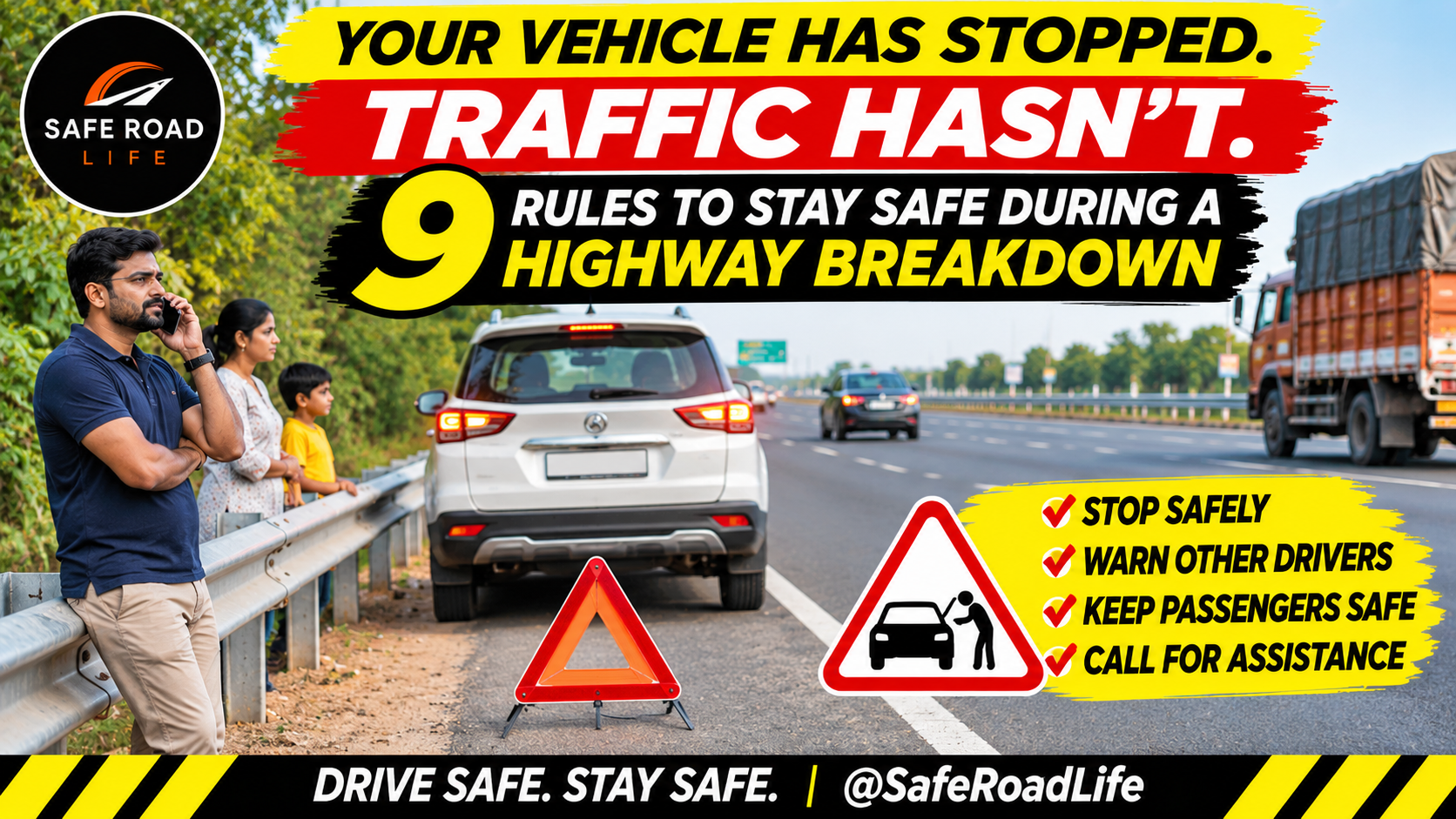
A vehicle breakdown can happen without warning. A tyre problem, engine failure, overheating or electrical fault can force a driver to stop in the middle of a journey.
But the danger does not end when the engine stops. On a busy highway, approaching vehicles may be travelling at high speed. A driver who steps out without checking traffic, stands behind the vehicle or attempts an unsafe roadside repair can face another serious danger.
A breakdown is a vehicle problem. Turning it into a roadside accident is preventable.
1. Stay calm and move out of the traffic lane
If you notice a mechanical problem, avoid sudden braking or steering. Signal your intention and, if the vehicle remains controllable, move towards a safe shoulder or designated stopping area. Never stop abruptly in a live traffic lane unless continuing would create an even greater danger.
2. Switch on hazard warning lights
Once safely stopped, activate the hazard warning lights to alert approaching traffic. Remember: hazard lights do not make a stopped vehicle safe. They are a warning, not a substitute for a safe stopping location or other precautions.
3. Park as far from moving traffic as possible
Where available, use a designated emergency stopping area or a sufficiently wide, firm shoulder. Avoid stopping just beyond a blind bend, on a narrow bridge or near the crest of a hill where approaching drivers may not see you in time.
4. Get passengers away from traffic
If it is safe to exit, ask passengers to leave through the side away from moving traffic. Move everyone to a protected location, preferably behind a crash barrier where one is provided and where it is safe to reach. Keep children under adult supervision. Never allow passengers to stand behind the vehicle or walk along the live carriageway.
5. Use a warning triangle only when it is safe
A warning triangle can help alert approaching drivers to a stationary vehicle. Follow the vehicle manufacturer’s instructions and applicable road rules for its placement. Never walk into a live traffic lane or put yourself at risk to position it. If conditions are unsafe, prioritise getting people to safety and calling for assistance.
6. Never attempt a dangerous roadside repair
Do not crawl beneath a vehicle, stand in front of it or work close to moving traffic. Avoid opening a hot radiator cap or touching hot engine components. If the vehicle is smoking, leaking fuel or showing signs of fire, move away and seek emergency assistance.
7. Do not stand directly behind or in front of the vehicle
A stationary vehicle can be struck from behind. Standing close to it can place you directly in the path of a secondary collision. Keep a safe distance and remain in a protected location. Do not use the vehicle as a shield against approaching traffic.
8. Call for professional roadside assistance
Contact your roadside assistance provider, highway patrol or the appropriate emergency service. Share your highway or road name, direction of travel, nearest landmark, kilometre marker or toll plaza, and the nature of the problem. On Indian national highways, the emergency helpline 1033 can be used for highway-related assistance.
9. Rejoin traffic only when it is safe
Before moving again, check the vehicle condition and ensure the fault has been properly addressed. Do not pull into traffic suddenly. Check mirrors and blind spots, signal your intention and merge only when there is a safe gap. If the vehicle is not roadworthy, arrange recovery instead of continuing.
Highway breakdown safety checklist
- Move out of the traffic lane if safe and possible.
- Switch on hazard warning lights.
- Stop in a safe location away from moving traffic.
- Move passengers to a protected area.
- Keep children supervised.
- Use a warning triangle only if safe.
- Avoid roadside repairs in dangerous locations.
- Contact roadside assistance or emergency services.
- Rejoin traffic only after the vehicle is safe to drive.
A message for professional and fleet drivers
For bus, truck, taxi and commercial vehicle operators, breakdown response should be part of driver training. Fleet operators must ensure that drivers know emergency contact procedures, vehicle-specific safety instructions and approved roadside recovery arrangements.
A driver should never be pressured to repair a vehicle in an unsafe location merely to save time or avoid a delay.
“When your vehicle stops on a highway, your first responsibility is not to save the vehicle. It is to save the lives around it.”
A journey can be delayed. A life cannot be replaced.
DRIVE SAFE. STAY SAFE.
@SafeRoadLife
About the Author