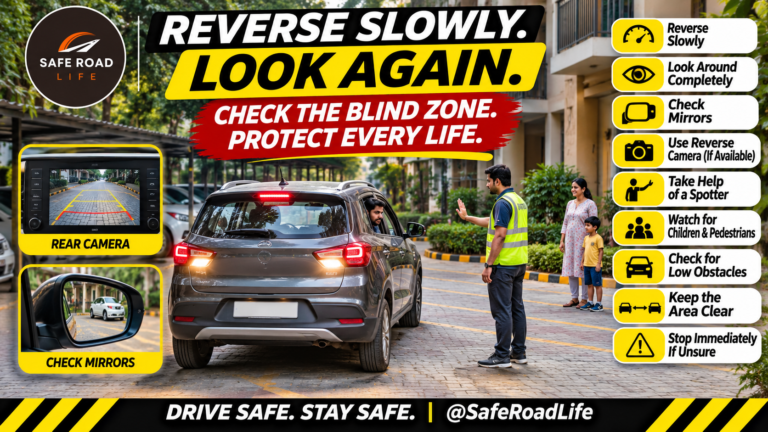
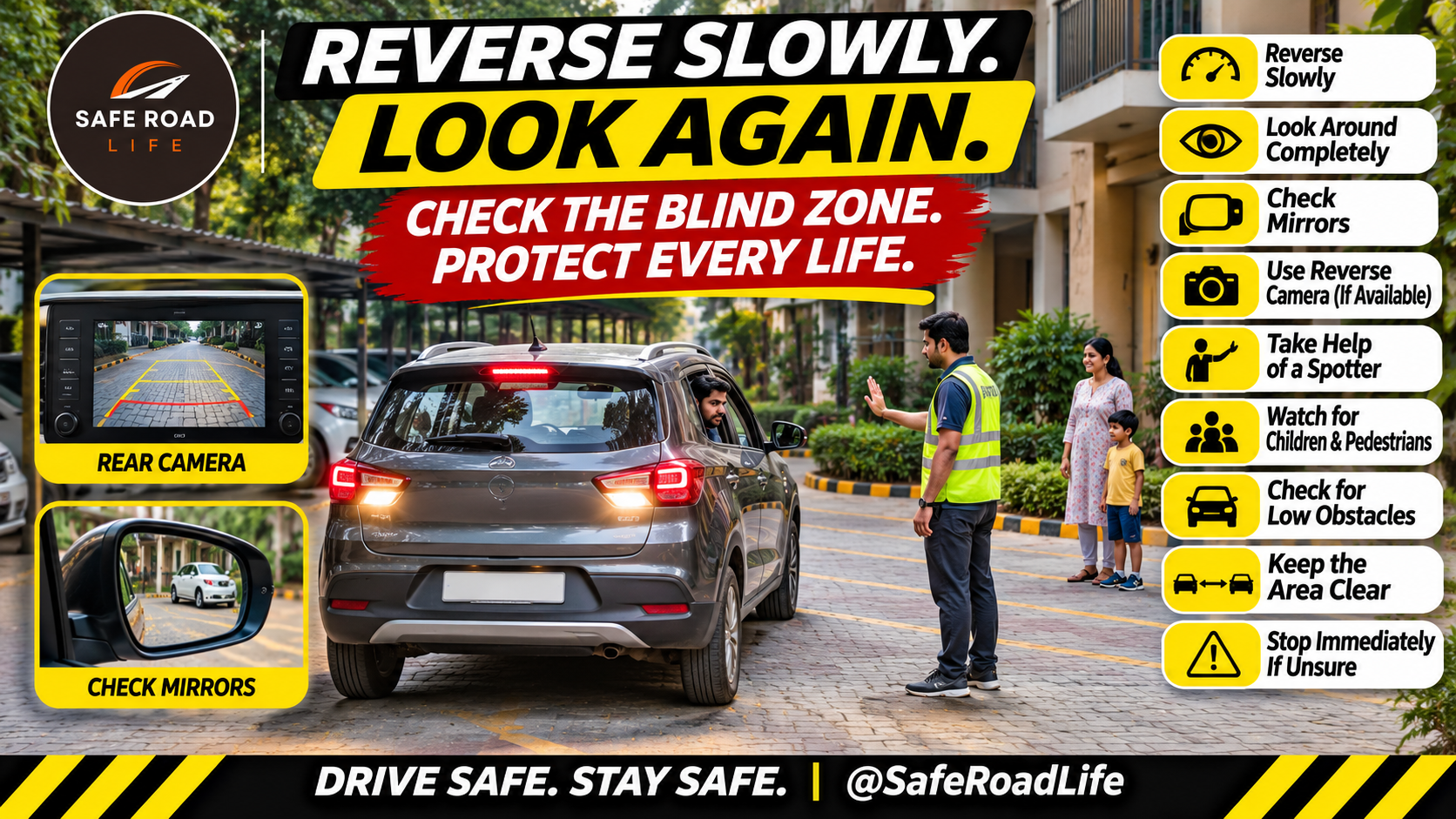
A vehicle moving backwards can become a serious danger in just a few seconds. A child walking behind a parked car, a pedestrian passing through a driveway, a two-wheeler moving between vehicles or an object hidden below the rear window can all be missed by a driver who relies only on mirrors or a reversing camera.
Reversing is different from normal forward driving. The driver’s view is restricted, the vehicle’s path may be difficult to judge, and people nearby may not expect the vehicle to move.
The safest reversing manoeuvre is the one you do only after confirming that the path is clear.
1. Plan your parking before you stop
Whenever possible, choose a parking space that allows you to drive forward when leaving. Look for pedestrians, children, pillars, walls, parked vehicles and moving traffic before entering the space. Avoid choosing a position that forces a difficult reverse into a busy road.
2. Check all around the vehicle before reversing
Walk around the vehicle if the situation requires it and it is safe to do so. Check for children, animals, obstacles, low walls and objects that may not be visible from the driver’s seat. Do not assume the space is clear just because it was clear a few moments earlier.
3. Use mirrors and cameras—but never depend on them alone
Rear-view cameras, parking sensors and mirrors are useful aids. However, they may not detect every person or obstacle. Cameras can have blind areas, dirty lenses or delayed images. Sensors may not detect small objects or people in every situation. Look around directly as well as using the available equipment.
4. Reverse at walking pace
Move slowly enough to stop immediately if a person or obstacle appears. Avoid accelerating sharply or reversing while distracted. Keep your foot ready to brake and make small, controlled movements.
5. Never reverse blindly into a road
Before leaving a driveway, parking space or private entrance, check for approaching traffic, pedestrians and cyclists. If your view is restricted, use a safe alternative where possible. Do not force the vehicle into traffic hoping others will stop.
6. Take extra care around children
Children may move unpredictably and can be difficult to see from the driver’s seat. Before reversing near homes, schools, residential parking areas or playgrounds, check carefully for children. Ask a responsible adult to keep children away from the vehicle’s path. Never assume a child will understand a reversing vehicle’s danger.
7. Use a trained spotter when visibility is restricted
For buses, trucks and other large vehicles, a trained spotter can help guide difficult reversing manoeuvres. Agree on clear signals before starting. Keep the spotter visible to the driver at all times. If the spotter disappears from view, stop immediately. Do not continue reversing based on guesswork.
8. Avoid distractions and keep windows clear
Put the phone away. Reduce unnecessary conversation and keep music at a level that allows you to hear surrounding activity. Clean mirrors, windows and camera lenses. Poor visibility can turn a routine parking movement into a preventable collision.
9. Stop immediately if you are uncertain
If you lose sight of the area behind the vehicle, stop. Apply the brake and reassess the situation. Get out and check the surroundings if safe, or ask for assistance. Never continue reversing simply because you are in a hurry.
A reversing safety checklist
- Check the area around the vehicle.
- Look for children, pedestrians and two-wheelers.
- Check mirrors, windows and camera display.
- Reverse slowly and keep control of the brake.
- Use a spotter for difficult large-vehicle manoeuvres.
- Stop if visibility is lost or the path is uncertain.
- Never rely on sensors or cameras alone.
A special responsibility for fleet and commercial drivers
Buses, trucks and commercial vehicles have larger blind zones and need additional space to manoeuvre. Fleet operators should establish reversing procedures, train drivers and spotters, maintain cameras and audible alarms where fitted, and identify safe parking and turning areas at depots.
A reversing alarm is a warning—not proof that the path is clear.
The final message
A few seconds spent checking behind your vehicle can prevent a lifetime of regret.
“Before moving backwards, make sure no one is standing where your mirrors cannot see.”
DRIVE SAFE. STAY SAFE.
@SafeRoadLife
Further reading
NHTSA — Vehicle Safety
Federal Motor Carrier Safety Administration
Ministry of Road Transport and Highways, India
About the Author