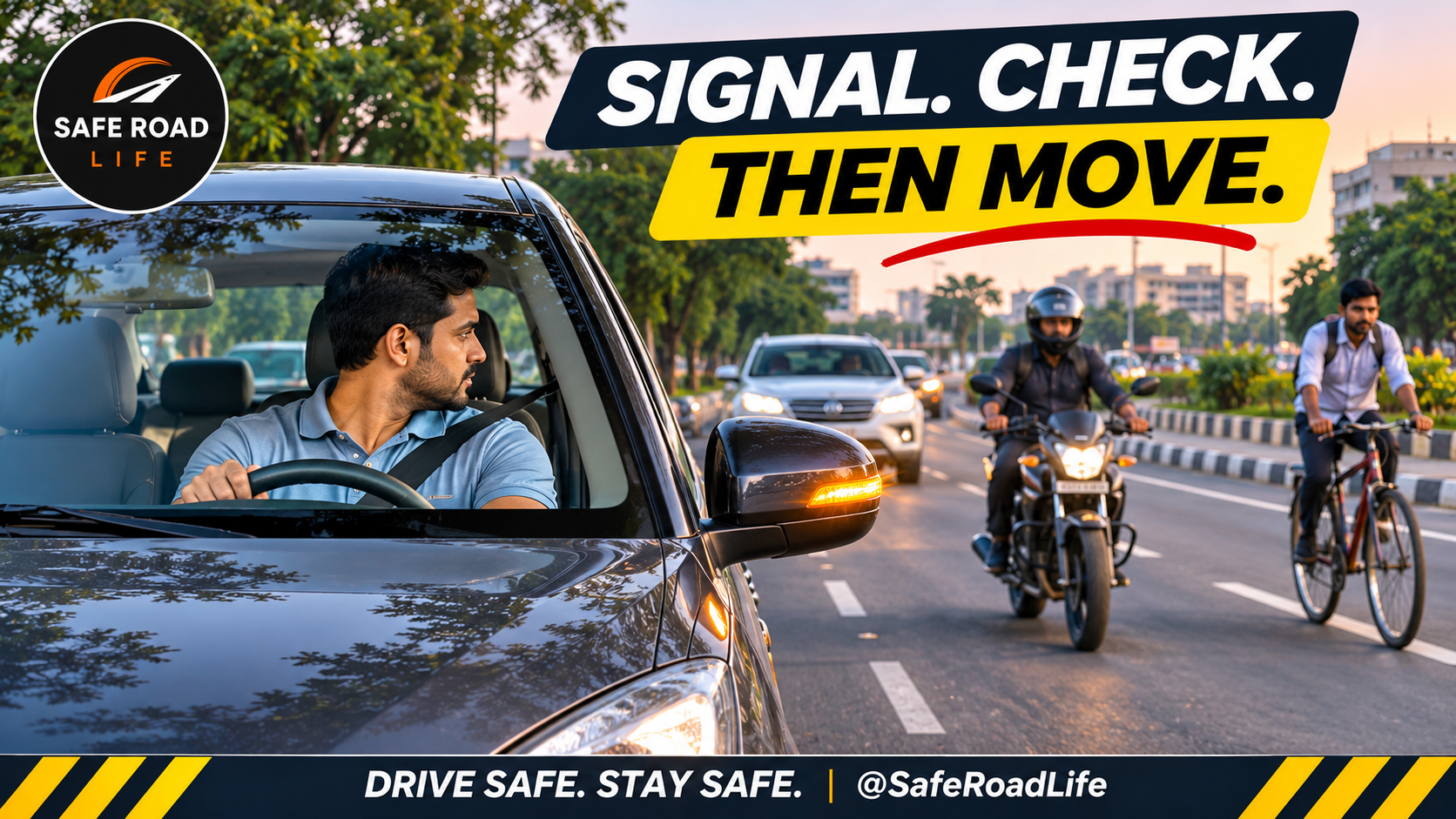
A flashing indicator does not make a manoeuvre safe. It only tells other road users what a driver intends to do.
Yet on Indian roads, vehicles often change lanes without warning, turn suddenly across the path of a motorcycle, or signal only after beginning to move. A driver may switch on the indicator and immediately turn, expecting everyone else to make way.
That is not safe driving.
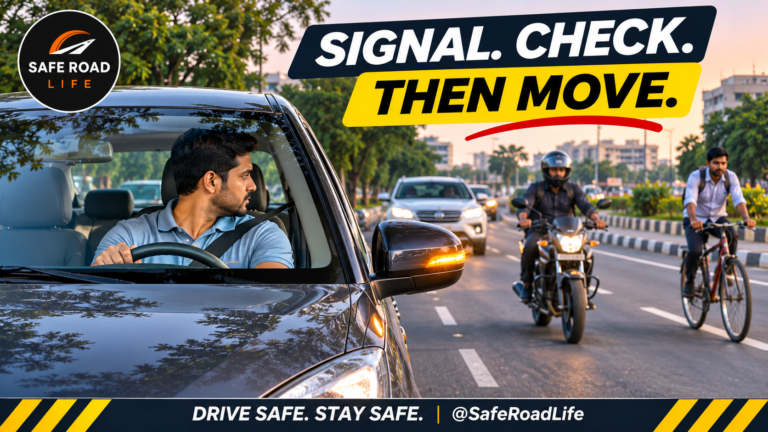
A direction indicator is a communication tool—not a request for automatic right of way. The driver must still check mirrors, assess blind spots, judge the speed of approaching traffic and make sure the manoeuvre can be completed safely.
India’s Motor Vehicles (Driving) Regulations, 2017 require drivers to indicate their intention before changing course or turning, and to take appropriate precautions while doing so.
1. Signal before you begin the manoeuvre
Do not switch on the indicator at the exact moment you start turning or changing lanes. Give other road users enough time to understand your intention and respond. Signal early enough to communicate clearly, without misleading people at an earlier junction or driveway.
2. Mirrors first, blind-spot check next
Mirrors do not show everything. Before changing lanes, check the rear-view and side mirrors, then make an appropriate shoulder check for the blind spot. A motorcycle may be travelling beside your car, or a cyclist may be approaching along the left side. Never assume that an empty mirror means an empty lane.
3. An indicator does not give you priority
Switching on the right indicator does not mean the vehicle behind must brake and let you enter. A left indicator does not give permission to cut across a cyclist or pedestrian. Wait for a safe gap. If another road user is already occupying the space, allow them to pass.
4. Choose the correct lane well in advance
Do not make a last-second dash across multiple lanes to reach an exit or turn. Plan ahead, read road signs and lane arrows, and move gradually into the appropriate lane. If you miss a turn, continue safely and find another route. Never force a sudden correction.
5. Protect cyclists and two-wheelers when turning left
A left turn can create a dangerous conflict with cyclists and motorcyclists travelling beside the vehicle. Check the left-side mirror and blind spot, look for people alongside, do not cut across their path, and complete the turn only when the path is clear. The Indian driving regulations specifically require drivers turning left to give way to cyclists and other slow-moving traffic.
6. Never use the indicator as a substitute for checking traffic
A signal communicates intention. It does not measure distance or speed. A vehicle approaching from behind may be much closer than it appears. A motorcycle may be moving through a gap. Observe the traffic, judge the available space and wait if there is any doubt.
7. Cancel the indicator after the turn
A forgotten indicator can mislead other road users. Someone may believe you are about to turn when you are actually continuing straight. Check that the indicator has switched off after completing the turn or lane change. If it has not, cancel it manually.
8. Do not make sudden turns from the wrong lane
Turning from the wrong lane can place a vehicle directly in the path of traffic moving in the intended direction. Follow lane arrows, signs and road markings. Avoid cutting across a queue at the last moment. Large vehicles need additional turning space, but their drivers must still check surrounding traffic carefully.
9. Maintain your indicators and use hand signals when necessary
A defective indicator is not a minor inconvenience. Check front and rear indicators during routine vehicle inspections. India’s driving regulations also provide for prescribed hand signals when the vehicle’s mechanical or electrical signalling device is not fitted or is not functioning. Use them only when safe and appropriate.
A simple pre-manoeuvre checklist
- Check road signs and lane markings.
- Signal your intention in good time.
- Check mirrors and blind spots.
- Look for motorcycles, cyclists and pedestrians.
- Wait for a safe gap.
- Move smoothly without cutting across another road user’s path.
- Cancel the indicator after completing the manoeuvre.
What every road user should remember
For car drivers: Never assume a motorcycle is far away just because it appears small in the mirror.
For two-wheeler riders: Do not remain in a vehicle’s blind spot. Watch for wheels turning and vehicles drifting towards your lane.
For bus and truck drivers: Plan turns early, account for the vehicle’s turning radius and watch for people alongside the vehicle.
For pedestrians and cyclists: Stay alert near junctions and turning vehicles. Do not assume a flashing indicator means the driver has seen you.
The final message
Road safety depends on communication, patience and respect. An indicator can warn someone of your next move, but only proper observation and a safe decision can protect them.
“An indicator tells others where you intend to go. Your responsibility is to make sure nobody gets hurt when you get there.”
DRIVE SAFE. STAY SAFE.
@SafeRoadLife
References
Ministry of Road Transport and Highways — Motor Vehicle Driving Regulations, 2017
Delhi Traffic Police — General Safety Guidelines
UK Highway Code — Signals to Other Road Users
About the Author