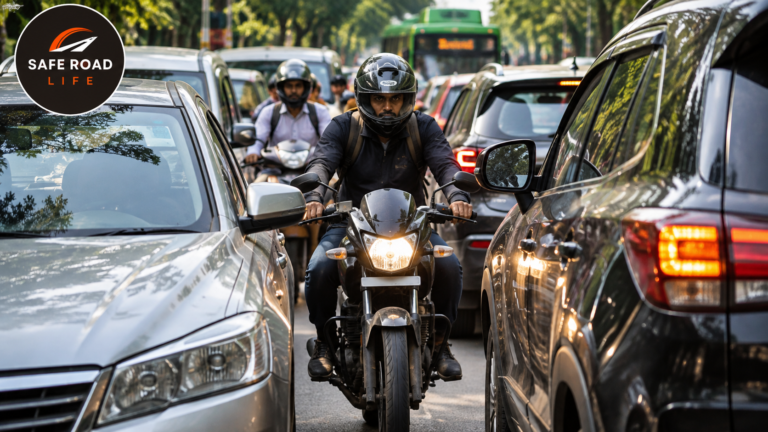
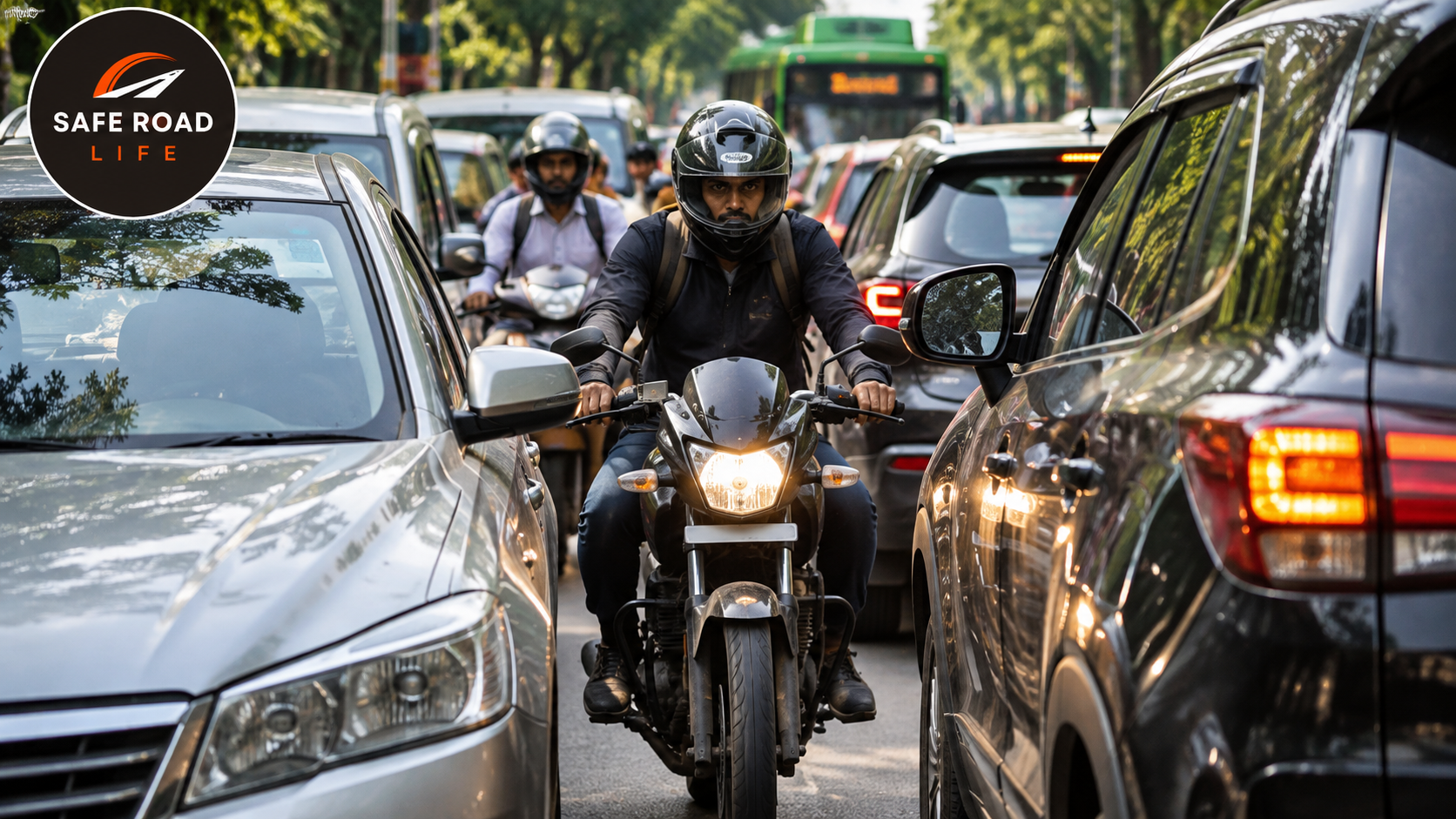
Traffic slows. A narrow gap appears between two rows of cars. A motorcyclist sees a way forward and begins to move between them. A car changes lanes without warning. A door opens. A vehicle edges sideways to avoid a pothole. In that small space, there may be almost no room to react.
Filtering through slow or stationary traffic can look effortless from the saddle. But the space between vehicles is not a guaranteed lane, and the fact that a motorcycle can physically fit does not mean it can pass safely. The danger lies in how quickly that gap can disappear—and how easily other road users can fail to notice the rider.
Why a narrow gap can become a trap
Drivers often make small movements in congestion. They may adjust their position to avoid a pothole, follow a turning vehicle, make room for an emergency vehicle or move towards an exit. Their mirrors may not show a motorcycle approaching from behind in the space between lanes. A rider moving through that space must anticipate these movements rather than assume every vehicle will remain exactly where it is.
The available width can also change without warning. A car’s mirror, a bus body, a truck’s wheels or a roadside barrier can leave less clearance than it first appears. Even a brief handlebar contact can destabilise a motorcycle and cause a fall into adjacent traffic.
Stationary traffic is not automatically safe traffic
When vehicles are stopped, a rider may be tempted to move faster because the surrounding traffic appears predictable. It is not. A pedestrian may step out from between parked cars. A passenger may open a door. A driver may suddenly move into a gap or turn across the rider’s path. The rider’s view of the road ahead may be blocked by larger vehicles.
Reduce speed substantially in congestion and be ready to stop. If the space is too narrow, visibility is restricted or the traffic pattern is uncertain, wait behind the queue. Saving a few seconds is never worth squeezing through a space that leaves no escape route.
Moving traffic raises the risk
Filtering between moving vehicles is especially unforgiving. The speed difference between the motorcycle and surrounding traffic can close a gap in an instant. A car may drift towards a lane marking, brake suddenly or change lanes after checking its mirror. A rider who is accelerating through the gap may have neither the distance nor the traction to respond safely.
Do not weave repeatedly between lanes or treat the painted lane line as a personal path. Keep a speed that allows you to stop within the visible clear distance, leave room for other vehicles to move, and avoid passing when the road narrows, bends or approaches a junction.
Junctions, turns and heavy vehicles demand extra caution
Intersections are among the worst places to filter. Vehicles may turn across your path, enter from side roads or move into a turning lane at the last moment. A driver may be watching for a gap in the main traffic stream and not expect a motorcycle to appear alongside. Slow down, take a clear position and avoid passing a queue where turning movements or crossing traffic could bring you into conflict.
Never squeeze alongside a bus or truck in a tight space. Large vehicles have substantial blind areas and may need extra room to turn. A motorcycle beside the body of a turning truck can be difficult for the driver to see and has little room to escape. Stay behind where necessary and allow the vehicle to complete its movement.
Make yourself visible—and leave an escape route
Use your headlight as required, keep mirrors adjusted and wear visible protective gear. Position yourself where drivers can reasonably see you, rather than lingering in a vehicle’s blind spot. Watch front wheels and indicators for clues that a vehicle may move, but never rely on an indicator alone to predict what a driver will do.
Keep both hands ready for control, avoid sudden steering and do not use a phone or other device while moving. On wet or dusty roads, painted markings, metal covers and uneven surfaces can reduce grip. A motorcycle needs a stable path and enough room to manoeuvre; a narrow gap between vehicles may offer neither.
Know the law where you ride
Rules on lane filtering and lane splitting differ between countries, states and road types. Some places permit limited filtering under specific conditions; others restrict or prohibit it. Do not assume that a practice seen in another city or country is lawful on your road. Follow local traffic regulations, lane markings, signs and police instructions. Where the law or road layout is unclear, the safest choice is not to filter.
In India, riders should follow the applicable Motor Vehicles Act provisions and the Motor Vehicles (Driving) Regulations, 2017, together with local traffic directions. A gap between two vehicles does not create a separate legal lane or remove the rider’s responsibility to avoid dangerous manoeuvres.
Arriving a little later is better than not arriving
Motorcycle filtering is not a test of confidence or skill. It is a decision made in a constantly changing space, surrounded by people who may not know you are there. If the gap is tight, the traffic is moving unpredictably or you cannot see a safe way through, do not enter it. Wait, keep a safe following distance and move only when the road and local rules make it safe.
The safest rider is not the one who reaches the front of every queue. It is the one who recognises when a few seconds saved could cost a lifetime.
DRIVE SAFE. STAY SAFE.
@SafeRoadLife
Sources
- Ministry of Road Transport and Highways, Government of India – Motor Vehicles (Driving) Regulations, 2017
- National Highway Traffic Safety Administration – Motorcycle Safety
- UK Highway Code – Rules for motorcyclists
- Federation of European Motorcyclists’ Associations – Motorcycle safety and policy resources
About the Author