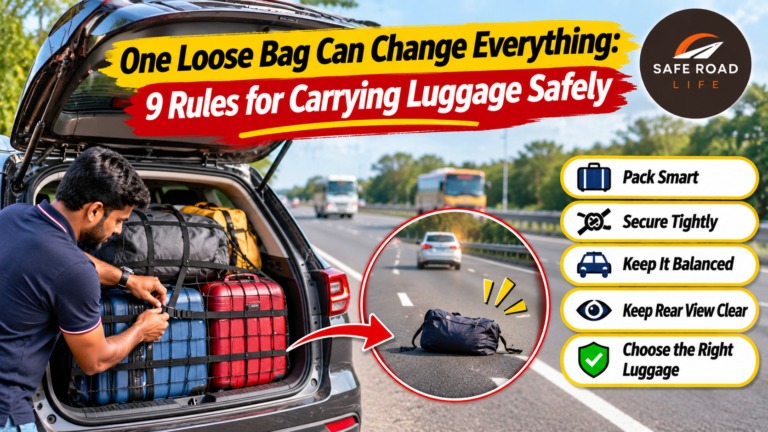
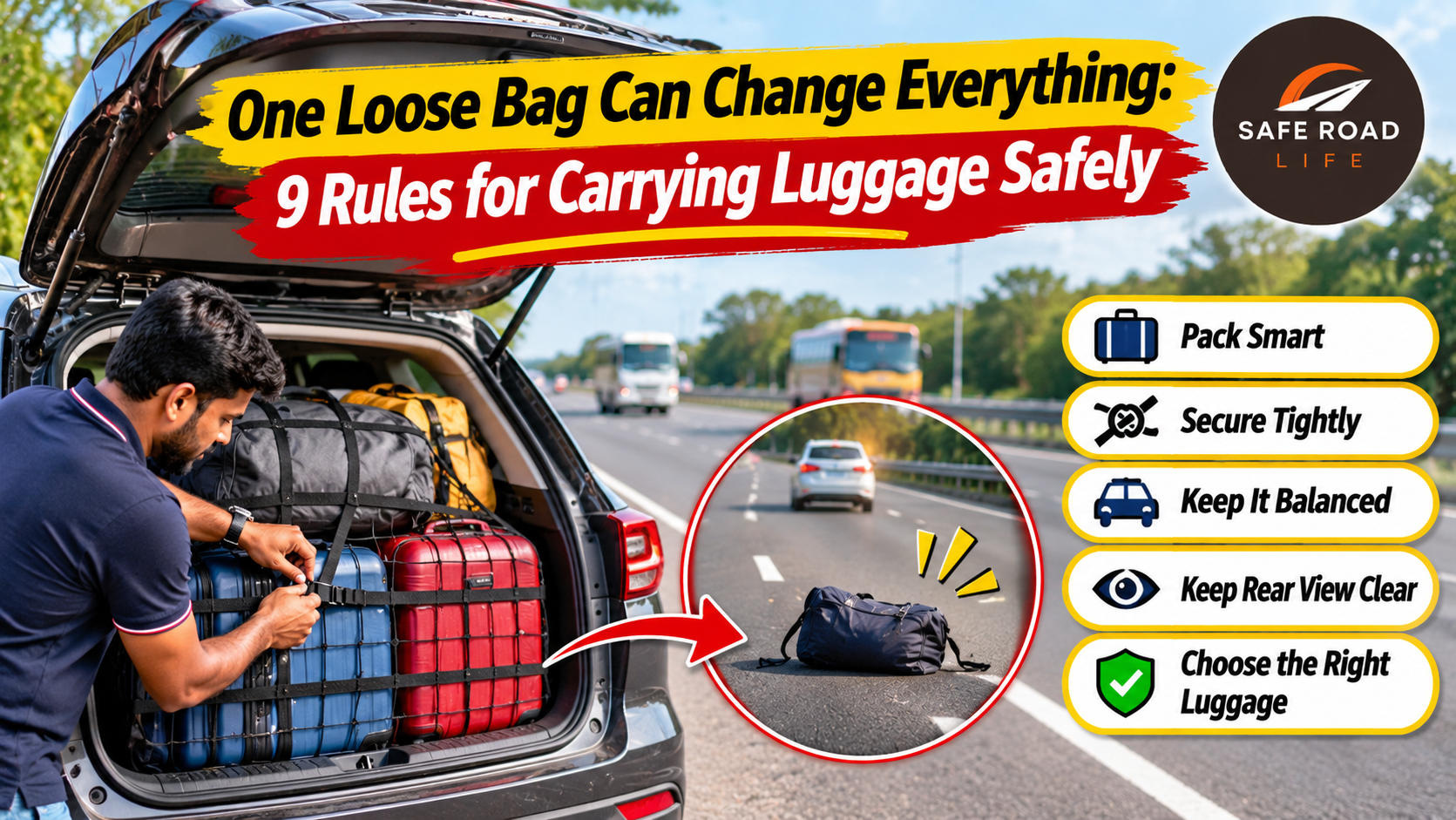
A suitcase sliding across the cabin during sudden braking can injure someone before the driver has time to react. Before starting a road trip, most people check fuel, tyre pressure and navigation. But one important safety check is often missed: how the luggage is packed and secured.
Whether you are travelling with family, carrying office equipment or transporting goods, an unsecured load can affect visibility, vehicle balance and the safety of everyone inside and outside the vehicle. Safe packing is not about fitting in one more bag. It is about making sure nothing shifts, falls or blocks the driver’s control.
Why unsecured luggage is a road-safety risk
During braking, cornering or a sudden evasive manoeuvre, loose objects can move forward, sideways or fall from the vehicle. A heavy bag placed on a rear parcel shelf may obstruct the rear view. Items around the driver’s feet can interfere with the pedals. An overloaded roof rack can raise the vehicle’s centre of gravity and affect handling, while poorly tied external luggage may come loose and endanger other road users.
India’s Central Motor Vehicles Rules also place limits on how a vehicle may be loaded. Rule 93(8) says a motor vehicle must not be loaded so that the load extends laterally beyond the body, forward beyond the foremost part of the load body, rearward beyond the rearmost part, or above the prescribed height limits. Always check the applicable rules and your vehicle manufacturer’s instructions for your vehicle type.
9 practical rules to carry luggage safely
1. Keep the driver’s area completely clear
Never place bags, bottles, footwear or loose objects near the accelerator, brake or clutch pedals. Keep the footwell clear so the driver can operate every pedal without obstruction.
2. Put heavy items low and secure them first
Place heavier suitcases and equipment low in the boot or designated cargo area. Position them so they cannot slide, and use the vehicle’s approved tie-down points, cargo net or restraints where provided. Avoid stacking heavy objects high.
3. Do not turn the rear parcel shelf into a luggage rack
Keep heavy bags, toolboxes and hard objects off the parcel shelf. They can block the driver’s rear view and may move forward during sudden braking. Use the boot or a suitable secured storage area instead.
4. Protect every mirror and window view
Pack below the window line wherever possible. Do not cover the rear windscreen, side windows, mirrors, cameras or sensors. If a load affects visibility, rearrange it before moving.
5. Use only a suitable roof rack and secure every item
Check the vehicle manual for roof-load limits and use a compatible rack or carrier. Distribute the load evenly and secure it with suitable straps and restraints. Recheck the load before departure and after the first short stop. Never assume that a closed door, loose rope or elastic cord is enough to hold heavy luggage.
6. Never overload the vehicle
Respect the vehicle’s permitted passenger and load capacity. Count passengers, luggage and accessories together. Overloading can affect braking, steering, tyre performance and stability. If everything does not fit safely, make another trip or use an appropriate vehicle.
7. Keep sharp, fragile and hazardous items contained
Pack tools and sharp objects in closed, secured containers. Protect glass and fragile items so they cannot roll or break. Do not carry fuel, chemicals, gas cylinders or other hazardous materials casually in a passenger cabin; follow the applicable transport and product-safety requirements.
8. Secure luggage in buses and commercial vehicles
Passengers should use designated luggage compartments and never block aisles, emergency exits or access to safety equipment. Drivers and fleet teams must ensure cargo is evenly distributed and properly restrained in the designated load area before the vehicle moves.
9. Stop safely if the load shifts or a strap loosens
If you hear movement, notice a change in handling or suspect a strap has loosened, do not reach for the luggage while driving. Reduce speed smoothly, find a safe stopping place away from moving traffic and inspect the load before continuing.
Do’s and Don’ts
Do’s
- Read the vehicle manual for passenger, boot and roof-load limits.
- Use proper tie-down points, cargo nets and approved carriers.
- Keep windows, mirrors, lights and number plates unobstructed.
- Check the load before departure and after stops.
- Ask passengers to keep their belongings in designated storage areas.
Don’ts
- Do not pile heavy objects on the parcel shelf or dashboard.
- Do not allow luggage to block pedals, exits or the driver’s view.
- Do not exceed the vehicle’s load or roof-rack rating.
- Do not carry loose objects on a roof or outside the vehicle.
- Do not continue driving when the load is unstable.
Benefits of safe luggage handling
Correctly secured luggage helps the driver maintain clear visibility and predictable vehicle control. It reduces the chance of objects striking passengers, falling onto the road or damaging the vehicle. It also makes journeys more comfortable because bags do not slide, roll or create distractions every time the vehicle turns or brakes.
Your 30-second pre-journey luggage checklist
- Are all bags inside the boot or a proper cargo area?
- Are heavy items low and firmly restrained?
- Are the pedals, windows, mirrors and exits clear?
- Is the roof load within the manufacturer’s limit and properly secured?
- Is the vehicle within its permitted passenger and load capacity?
- Have you checked straps, locks and closures?
A safer journey begins before the engine starts
Your luggage is part of your journey, but it must never become a danger to the people travelling with you or to strangers sharing the road. Pack thoughtfully, secure every item and leave anything that cannot be carried safely behind. A few minutes spent checking the load can prevent a lifetime of regret.
Sources and further reading
- The Central Motor Vehicles Rules, 1989 — Rule 93 (overall dimensions and loading)
- Ministry of Home Affairs — Advisory on implementation of Rule 93(8), 9 January 2015
- National Highway Traffic Safety Administration — Vehicle safety guidance
- UK Government — Loading and unloading a vehicle safely
Drive Safe Stay Safe
@SafeRoadLife
About the Author