A devastating accident on Florida’s Turnpike on August 12, 2025, claimed three lives and ignited a fierce debate over immigration policies and road safety. Harjinder Singh, a 28-year-old Indian-origin truck driver who entered the U.S. illegally in 2018, faces three counts of vehicular homicide and potential deportation after making an illegal U-turn that caused the fatal crash. Singh’s claim that he was “scared” to return to India, which allowed him to stay in the U.S. on an immigration bond, has intensified scrutiny on driver licensing and immigration enforcement.
The Deadly Florida Turnpike Crash
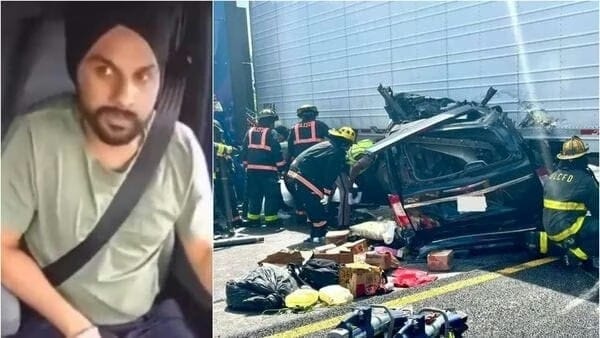
The tragedy unfolded around 3 PM near Fort Pierce, Florida, when Singh, driving a semi-truck with a trailer, attempted an illegal U-turn through an “Official Use Only” median pass on the Florida Turnpike. The maneuver caused the trailer to jackknife, blocking all northbound lanes. A minivan, unable to stop in time, crashed into the trailer at high speed, becoming lodged underneath. The collision killed all three occupants of the minivan: a 30-year-old man from Florida City, a 37-year-old woman from Pompano Beach, and a 54-year-old man from Miami. Two passengers died at the scene, and the driver succumbed to injuries after being airlifted to HCA Florida Lawnwood Hospital. Singh and his co-passenger, both in their 20s from California, emerged unharmed.
A viral video from the truck’s cab, widely shared on social media, showed Singh calmly parking the vehicle and turning off the engine after the crash, sparking outrage among viewers who perceived a lack of remorse. The Florida Highway Patrol has classified the incident as a homicide investigation, with Singh arrested by U.S. Marshals in California on August 16, 2025, and charged with three counts of vehicular homicide, a second-degree felony carrying up to 15 years in prison.
Singh’s Immigration Background
Harjinder Singh crossed the U.S. southern border illegally in September 2018. Arrested by Border Patrol, he claimed a fear of returning to India, citing a life-threatening situation. This claim was affirmed by U.S. Citizenship and Immigration Services, allowing him to enter the asylum system. Released on a $5,000 immigration bond in January 2019, Singh remained in the U.S. due to immigration court backlogs. In June 2021, he received work authorization, enabling him to obtain a Commercial Driver’s License (CDL) in California under Assembly Bill 60, which allows undocumented immigrants to apply for driver’s licenses with proof of identity and residency.
Singh’s ability to secure a CDL has drawn sharp criticism. The Department of Homeland Security (DHS) and the Trump administration have blamed California’s “sanctuary state” policies for issuing Singh a CDL, with DHS Secretary Kristi Noem calling the crash a “gut-wrenching tragedy” that “should have never happened.” The White House added, “Three innocent people were killed in Florida because Gavin Newsom’s California DMV issued an illegal alien a Commercial Driver’s License—this state of governance is asinine.”
Immigration and Safety Debate Intensifies
The crash has become a flashpoint in the ongoing debate over immigration and driver licensing. California Governor Gavin Newsom’s office countered that Singh entered the U.S. during the first Trump administration in 2018, arguing that federal immigration failures allowed him to remain. They emphasized that California’s law requires lawful presence for a CDL. Critics, including Florida Governor Ron DeSantis, have called for stricter immigration enforcement, stating, “He should have never been in our country in the first place!”
Social media platforms like X reflect public outrage, with some users condemning Singh’s immigration status and actions, while others criticized the politicization of the tragedy. One user wrote, “Illegal took the lives of three people by making an illegal U-turn… This tragedy was avoidable,” while another remarked, “Just business as usual in India,” reflecting discriminatory sentiments that have also emerged.
Similar Cases and Broader Context
Singh’s case echoes other incidents involving immigrant truck drivers. In 2018, Jaskirat Singh Sidhu, another Indian-origin driver, caused a crash in Canada that killed 16 members of a junior hockey team, leading to his deportation proceedings in 2024. Similarly, Sarbjeet Parmar faced charges in Montana in 2024 for a crash blamed on wind, highlighting heightened scrutiny on immigrant drivers. These cases underscore the complex interplay of immigration status and road safety regulations.
Push for Reform
The Florida crash has renewed calls for stricter immigration enforcement and driver licensing regulations. DHS has issued an ICE detainer for Singh, signaling deportation proceedings after his state charges are resolved. Critics argue that enhanced checks on commercial licensing for undocumented immigrants and faster deportation processes could prevent such tragedies. However, supporters of California’s policies argue that licensing undocumented immigrants ensures they are trained and insured, improving road safety.
Carlos Portela, a veteran truck driver, emphasized the responsibility tied to a CDL, stating, “The ‘Official Use Only’ turn is reserved for emergency vehicles… this was a clear violation.” The Florida Department of Highway Safety and Motor Vehicles (FLHSMV) called Singh’s actions “shocking and criminal,” pledging to enforce laws to prevent future incidents.
A Community Grieves
The loss of three lives has left the Fort Pierce community and the victims’ families in mourning. Emergency crews worked tirelessly to extract victims from the mangled minivan, with images showing the vehicle’s roof peeled back and debris scattered across the highway. The crash disrupted northbound traffic for hours, underscoring its severity.
As Singh faces vehicular homicide charges and deportation, the tragedy raises critical questions about immigration, accountability, and road safety. While some focus on Singh’s status, others emphasize the need to prevent reckless driving and ensure safer highways for all.
Moving Toward Solutions
This incident highlights the urgent need for reforms in immigration processing and commercial driver licensing. Strengthening oversight, improving training for truck drivers, and addressing asylum backlogs could reduce future risks. For now, the families of the victims—a 30-year-old man, a 37-year-old woman, and a 54-year-old man—grieve an irreplaceable loss, while the nation reflects on the intersection of policy and human error.
Our thoughts are with the victims’ families during this heartbreaking time. May their memory drive meaningful change to protect lives on America’s roads.
About the Author