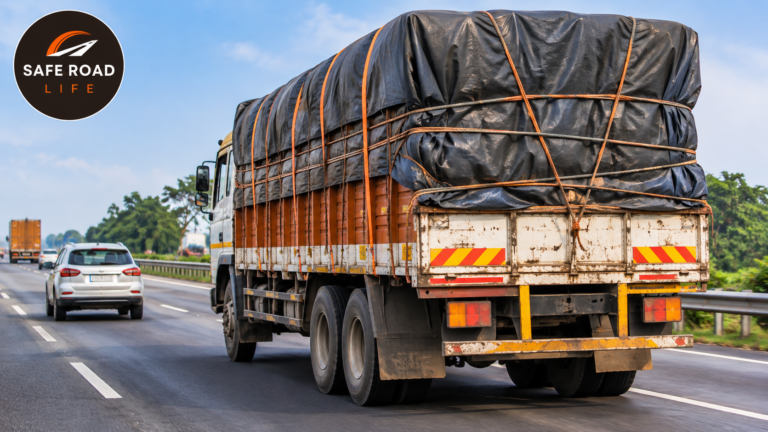
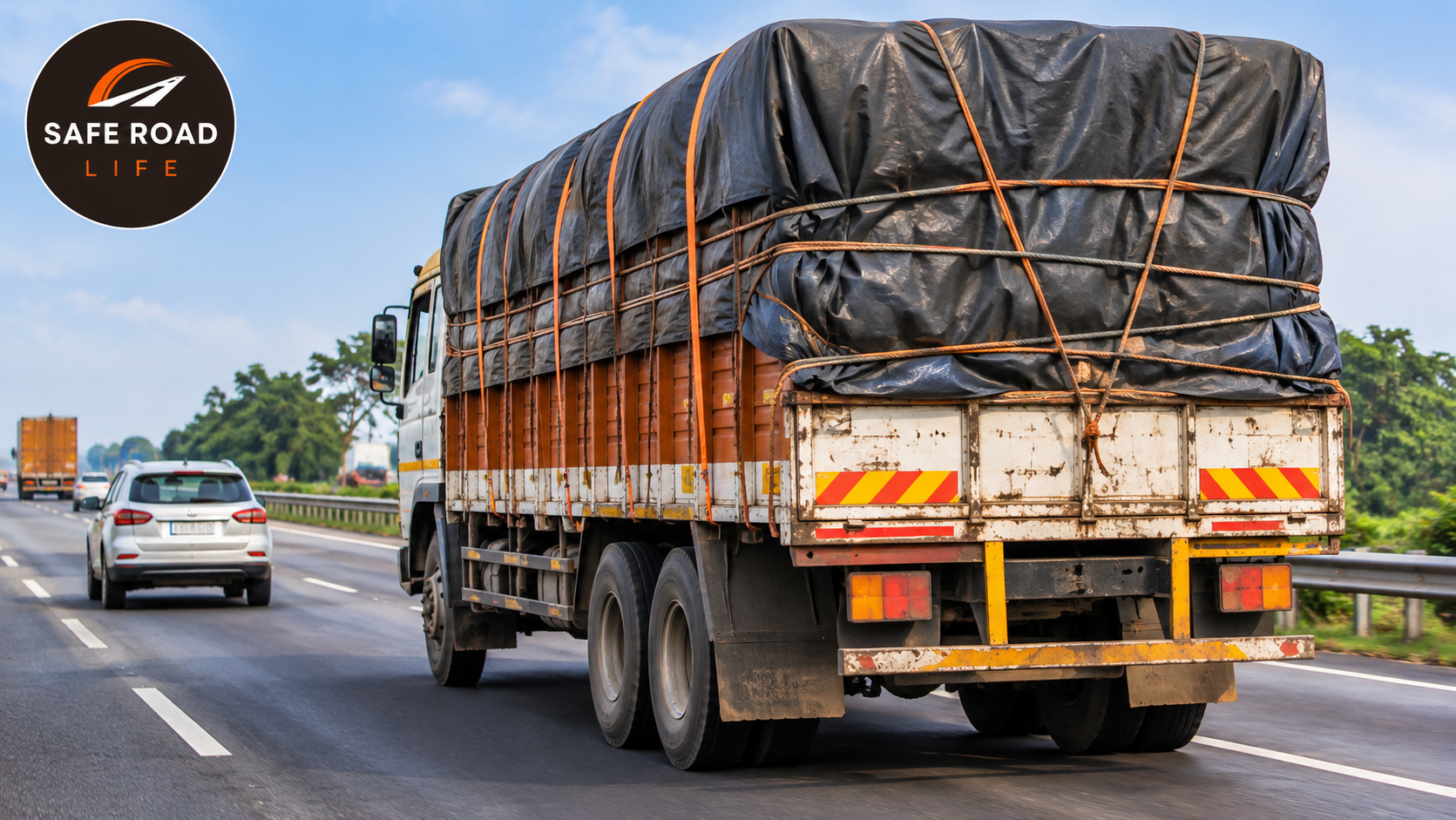
A truck moves along a highway carrying metal sheets, sacks, timber or construction material. From behind, everything appears normal. Then the driver brakes hard. A poorly restrained item shifts, a rope loosens or part of the load falls onto the road. The danger does not end with the truck. It is transferred to every motorcyclist, car driver and pedestrian who encounters what has fallen.
Falling cargo is often treated as a transport or housekeeping issue. It is a road-safety issue—and a preventable one. A load that is not properly packed, distributed and restrained can move during braking, cornering, acceleration or a sudden swerve. Even a relatively small object can cause a rider to lose control or force several vehicles into an emergency manoeuvre.
A load can move even when the truck is moving smoothly
Drivers may assume that a heavy load will stay in place because of its weight. That assumption is dangerous. When a vehicle brakes or changes direction, the cargo continues to exert force. If it is not blocked, contained or secured correctly, it can slide, roll, tip or fall. A sharp turn, uneven road surface or emergency stop can expose a weak restraint system in seconds.
India’s Motor Vehicles (Driving) Regulations, 2017 specifically require loads, restraints and loading equipment to be stowed and restrained so they cannot slip, fall over, roll around or fall off—even during emergency braking or a sudden swerve. The regulations also prohibit carrying a load in a way likely to endanger anyone, or beyond the permitted dimensions and weight of the vehicle.
Securement begins before the vehicle starts
Safe cargo transport starts at the loading point, not at the highway gate. The vehicle must be suitable for the type and weight of goods. The load should be distributed in accordance with the vehicle’s rated capacity and axle limits, with heavy items placed and supported so they cannot create an unstable centre of gravity. Uneven or excessive loading can affect steering, braking and stability.
Use appropriate restraints—such as rated web lashings, chains, blocking, chocks or purpose-built locking systems—according to the cargo and vehicle design. Ropes or straps that are frayed, cut, knotted, damaged or unsuitable for the load should not be trusted. Restraints must connect to proper anchor points and be tensioned correctly. A loose knot or a makeshift hook is not a substitute for a securement system designed for the job.
Different cargo needs different protection
Loose sand, aggregate, grain and similar materials can spill, scatter or create dust clouds. The Central Motor Vehicles Rules require goods in open-body goods carriages to be covered with an appropriate material such as a tarpaulin, subject to the stated exception for indivisible goods that cannot be covered. The cover must be suitable and secured so that it does not flap loose or become a hazard itself.
Long steel sections, pipes, timber and construction materials need proper support and restraint against rolling, sliding and projection. Drums, cylinders, pallets and machinery may require individual blocking or lashing. A container must be loaded so that its contents cannot burst through the doors or shift dangerously when the container is moved. There is no single rope arrangement that is safe for every cargo.
Do not confuse a covered load with a secured load
A tarpaulin can help contain or protect goods, but it is not automatically a load-restraint system. A sheet tied over an unstable stack will not stop heavy items from sliding underneath it. Likewise, a few visible straps do not prove that the load is safe. The restraint method must match the weight, shape, friction, packaging and expected movement of the cargo.
Before departure, the driver and loading team should walk around the vehicle and inspect the full load. Check the condition and tension of straps, chains and ropes; confirm that anchor points are secure; look for gaps that allow cargo to shift; verify that doors, tailgates and sideboards are properly closed; and make sure the load does not hide lamps, reflectors or the registration plate. Recheck the load after the journey begins and at suitable stops, especially after rough roads or hard braking.
Everyone in the transport chain has a part to play
The driver cannot be expected to correct every loading failure after leaving the depot. The consignor, loader, packer, transport operator, supervisor and driver all influence whether cargo reaches its destination safely. The United Nations’ cargo-transport guidance stresses that proper packing and securing are shared responsibilities across the logistics chain.
Transport companies should provide suitable vehicles, approved restraint equipment, practical training and enough time for proper loading checks. Supervisors should not reward speed of dispatch at the cost of securement. Drivers should have the authority to stop a departure when a load is visibly unsafe, the restraint equipment is damaged or the vehicle is overloaded.
What should you do if cargo falls in front of you?
If you are driving behind a vehicle and notice cargo shifting or falling, do not swerve blindly into another lane. Ease off the accelerator, increase the gap and brake progressively if needed. Look for a safe escape path, but avoid sudden steering that could put a motorcycle, car or pedestrian alongside you at greater risk. Once clear of immediate danger, report a serious obstruction or unsafe vehicle to the relevant highway or traffic authority. Never stop in a live lane to retrieve an object.
If you operate a goods vehicle, never assume that a load which survived the last journey is safe for the next one. Cargo, packaging, restraints and road conditions change. Inspect, secure and recheck every time.
The journey is not safe until the load is safe
A truck’s responsibility does not end with keeping its wheels on the road. It must also ensure that what it carries stays where it belongs. One failed strap, one overloaded platform or one careless loading decision can place strangers in danger kilometres away.
Secure the cargo. Respect the vehicle’s limits. Cover loose material appropriately. Inspect the restraints before departure and during the journey. A delivery is successful only when the goods—and everyone sharing the road—reach their destination safely.
DRIVE SAFE. STAY SAFE.
@SafeRoadLife
Sources
- Ministry of Road Transport and Highways – Motor Vehicles (Driving) Regulations, 2017, Regulation 35: Projection of loads
- Central Motor Vehicles Rules amendment – Rule 138B: Covering goods carried in open-body vehicles
- UNECE/ILO/IMO CTU Code – Securing cargo against sliding and tipping
- UNECE – Cargo securing and road safety responsibilities across the transport chain
About the Author