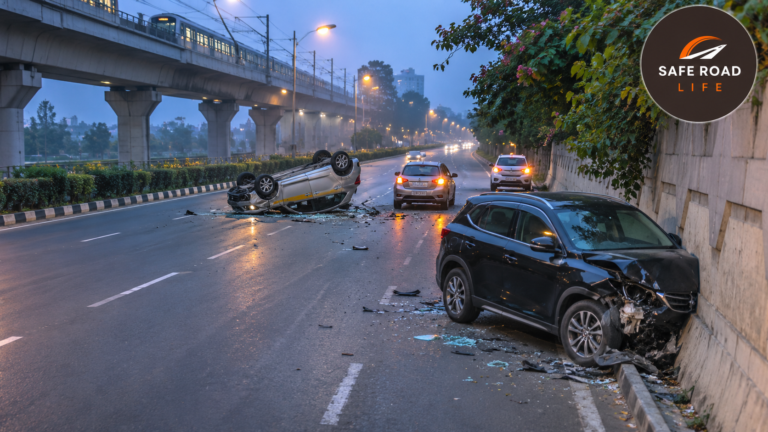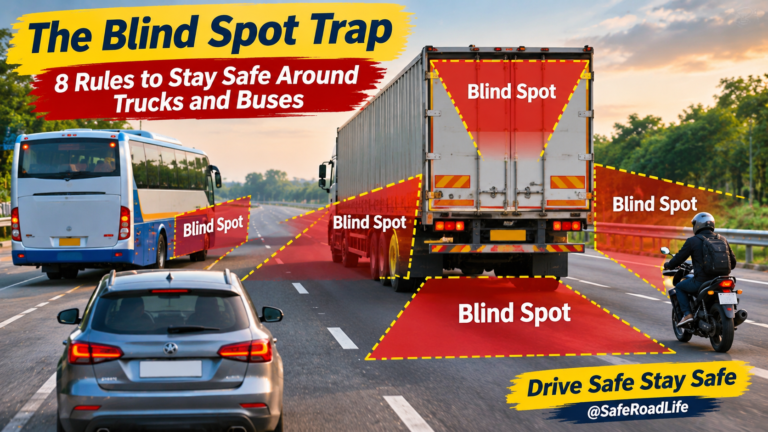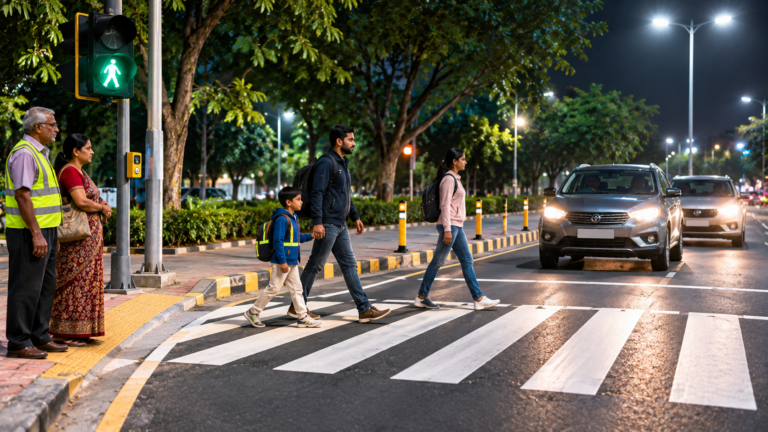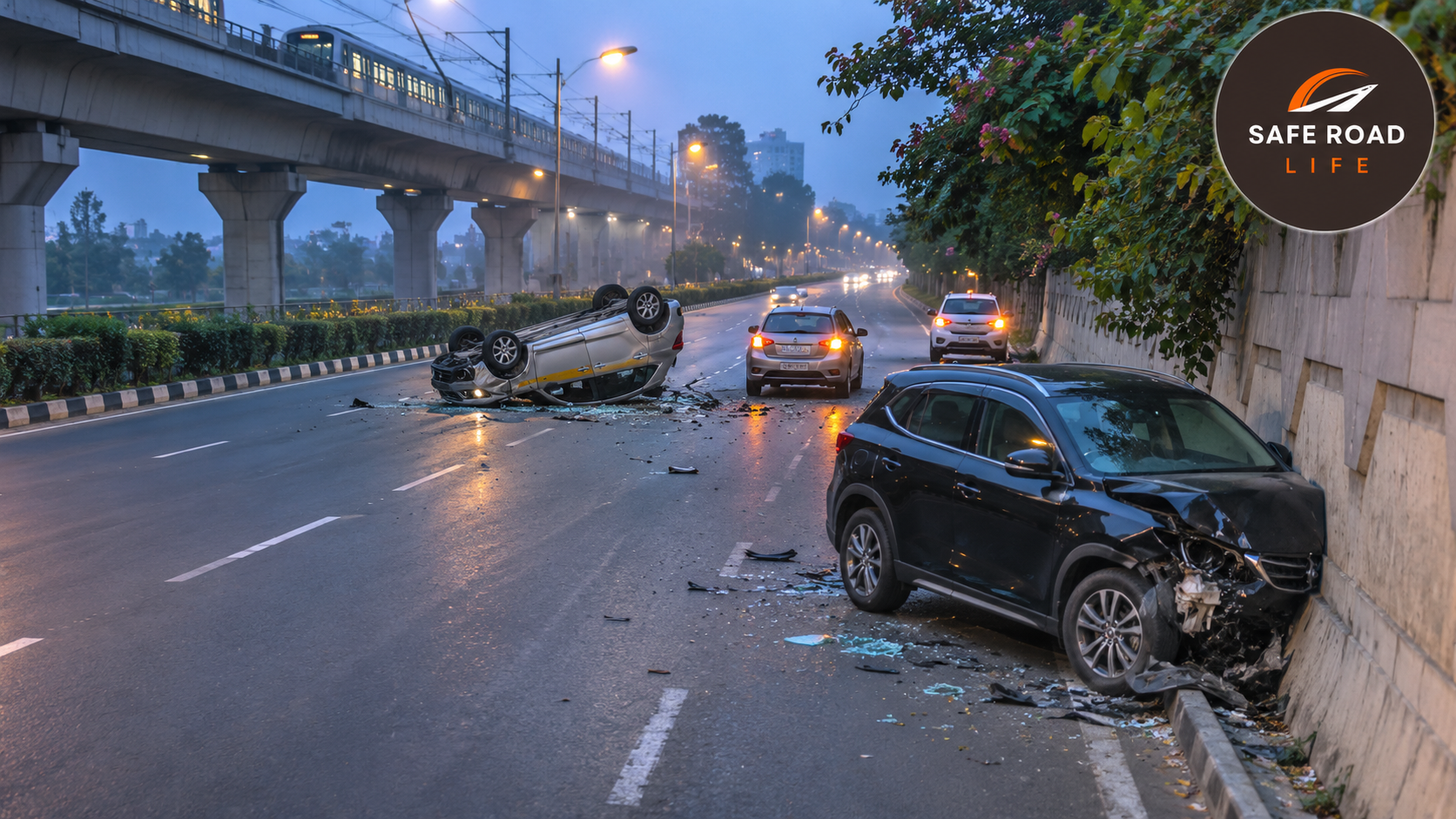
Illustrative image only — this is not the actual Gurugram crash scene or dashcam footage.
A dashcam captures a fast-moving vehicle striking traffic. A commercial taxi overturns and slides across the road. Within seconds, an ordinary late-night drive becomes a serious crash.
Dashcam footage of a multi-vehicle collision on Gurugram’s Golf Course connecting road has circulated widely online. The taxi overturned and its driver was seriously injured. The incident is a stark reminder that high-speed urban roads leave very little room for mistakes.
This is not a story to watch for shock value. It is a road-safety warning for every driver who believes a clear road at night is a safe place to accelerate.
What happened in the Gurugram dashcam crash?
News reports place the collision on the Golf Course connecting road beneath the Rapid Metro corridor in Gurugram, late on Friday night into the early hours of Saturday, 31 October 2026. A commercial taxi overturned after a chain of impacts involving other vehicles. The taxi driver suffered serious injuries and was taken for medical treatment. Another vehicle’s airbags reportedly deployed, and people at the scene helped rescue the trapped driver before emergency responders arrived.
Dashcam footage from a vehicle behind the collision reportedly shows a dark SUV making contact with other vehicles before the taxi overturns and the SUV strikes a roadside wall. Police and local patrolling personnel reached the location and began examining the incident.
One important verification note: published reports do not use identical details. NDTV described three vehicles and reported the crash at about 1:30 a.m.; a PTI report carried by The Week described four vehicles and gave a different approximate time. The precise sequence, vehicle count and cause should therefore be treated as subject to the investigation—not decided by a social-media clip.
At the time of the reports, the exact cause had not been established. The police were examining video and other evidence. There is no verified basis to claim intoxication, a specific mechanical failure or a final finding of responsibility.
7 road-safety lessons every driver should learn
1. Never treat an empty road as permission to speed
Late-night roads can look clear, but vehicles may still enter from side roads, change lanes or approach at different speeds. A high speed reduces the time available to recognise a hazard and makes it harder to stop safely. Follow the posted limit and slow further when visibility, road layout or traffic conditions demand it.
2. Keep enough distance to stop safely
Do not follow another vehicle closely, even when traffic is flowing smoothly. The Ministry of Road Transport and Highways’ Motor Vehicles (Driving) Regulations, 2017 require a driver to keep sufficient distance to stop safely if the vehicle ahead suddenly slows or stops. Increase the gap in rain and other adverse conditions.
3. Avoid weaving between lanes
Repeated lane changes and squeezing past vehicles create conflicts with drivers who may not expect your movement. Choose a lane early, maintain a predictable path and overtake only when it is legal and clearly safe. Never use the left or right edge of a lane as an invitation to force your way through a gap.
4. Look well beyond the vehicle in front
Keep scanning the road ahead, mirrors and surrounding lanes. Watch for brake lights, merging vehicles, stopped traffic, road barriers and unexpected movement. The MoRTH driving regulations require drivers to maintain a good lookout and concentrate on the road instead of engaging in distracting activities.
5. Make seat belts non-negotiable
Every occupant should wear the seat belt provided, including people travelling in the rear seats. A seat belt helps restrain occupants during a sudden deceleration or rollover. Drivers should check that passengers are belted before moving off, not after the journey has begun.
6. Professional drivers must protect their passengers and themselves
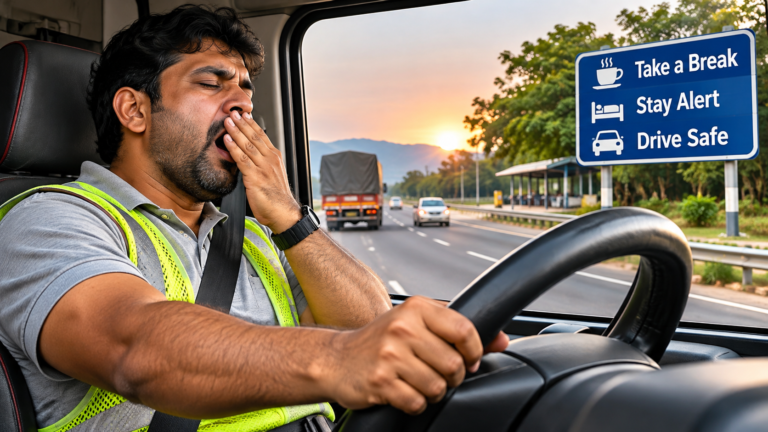
Taxi and fleet drivers face pressure to complete trips quickly, but a passenger’s safety must come before arrival time. Keep to a safe speed, avoid aggressive acceleration and lane changes, and do not drive when tired or distracted. Passengers should buckle up and speak up if a driver is taking unnecessary risks.
7. If you witness a crash, help without creating another one
Do not stop in a live lane or gather around damaged vehicles to film. Park only where it is safe, switch on hazard lights if appropriate, alert emergency services and give a clear location. Do not put yourself in the path of traffic or move an injured person unless there is an immediate danger that makes movement unavoidable. Follow instructions from emergency responders.
Do’s: Build safer driving habits
- Choose a speed that allows you to stop within the clear distance ahead.
- Maintain a safe following gap and increase it in poor conditions.
- Signal early and make lane changes smoothly.
- Keep your attention on the road and hands ready to control the vehicle.
- Make sure every occupant wears a seat belt.
- Allow extra time for night journeys instead of trying to save minutes by speeding.
- Keep emergency contact numbers accessible and know your route location.
Don’ts: Avoid these high-risk behaviours
- Don’t race or accelerate aggressively on an apparently empty road.
- Don’t tailgate or assume the vehicle ahead will never brake suddenly.
- Don’t weave through traffic or force a narrow overtake.
- Don’t use a mobile phone or watch video while driving.
- Don’t travel without a seat belt, even for a short trip.
- Don’t speculate about the cause of a crash from a short video.
- Don’t block emergency access or crowd the scene to record footage.
Why these precautions matter
1. More reaction time: A controlled speed gives the driver more time to recognise danger and respond.
2. Lower collision risk: A safe gap reduces the chance of running into a vehicle that slows suddenly.
3. Better protection in a crash: Proper seat-belt use helps restrain occupants when a vehicle is jolted, spun or overturned.
4. Safer shared roads: Predictable driving gives taxis, buses, two-wheelers and other road users space to react.
The 30-second reminder before every drive
- ☐ Am I alert, fit and free from distraction?
- ☐ Is my speed suitable for the road and visibility?
- ☐ Have I left enough distance to stop safely?
- ☐ Are all occupants wearing seat belts?
- ☐ Am I changing lanes only when it is safe?
- ☐ Am I prepared to slow down if something changes ahead?
Remember: A dashcam can record a crash, but it cannot undo one. The best outcome is to prevent the dangerous moment before it happens. Reach your destination safely—not a few minutes earlier at someone else’s risk.
Share this road-safety message with friends, family members, cab drivers and everyone who drives after dark.
Drive Safe Stay Safe
@SafeRoadLife
Sources and further reading
- NDTV – On Camera, Cab Flips After Vehicles Collide at High Speed in Gurugram (1 November 2026)
- Hindustan Times – Taxi Overturns After Three-Vehicle Collision in Gurugram (31 October 2026)
- The Week / PTI – Four Vehicles Collide on Gurugram’s Golf Course Road, Cab Driver Injured (31 October 2026)
- Ministry of Road Transport and Highways – Motor Vehicles (Driving) Regulations, 2017
About the Author