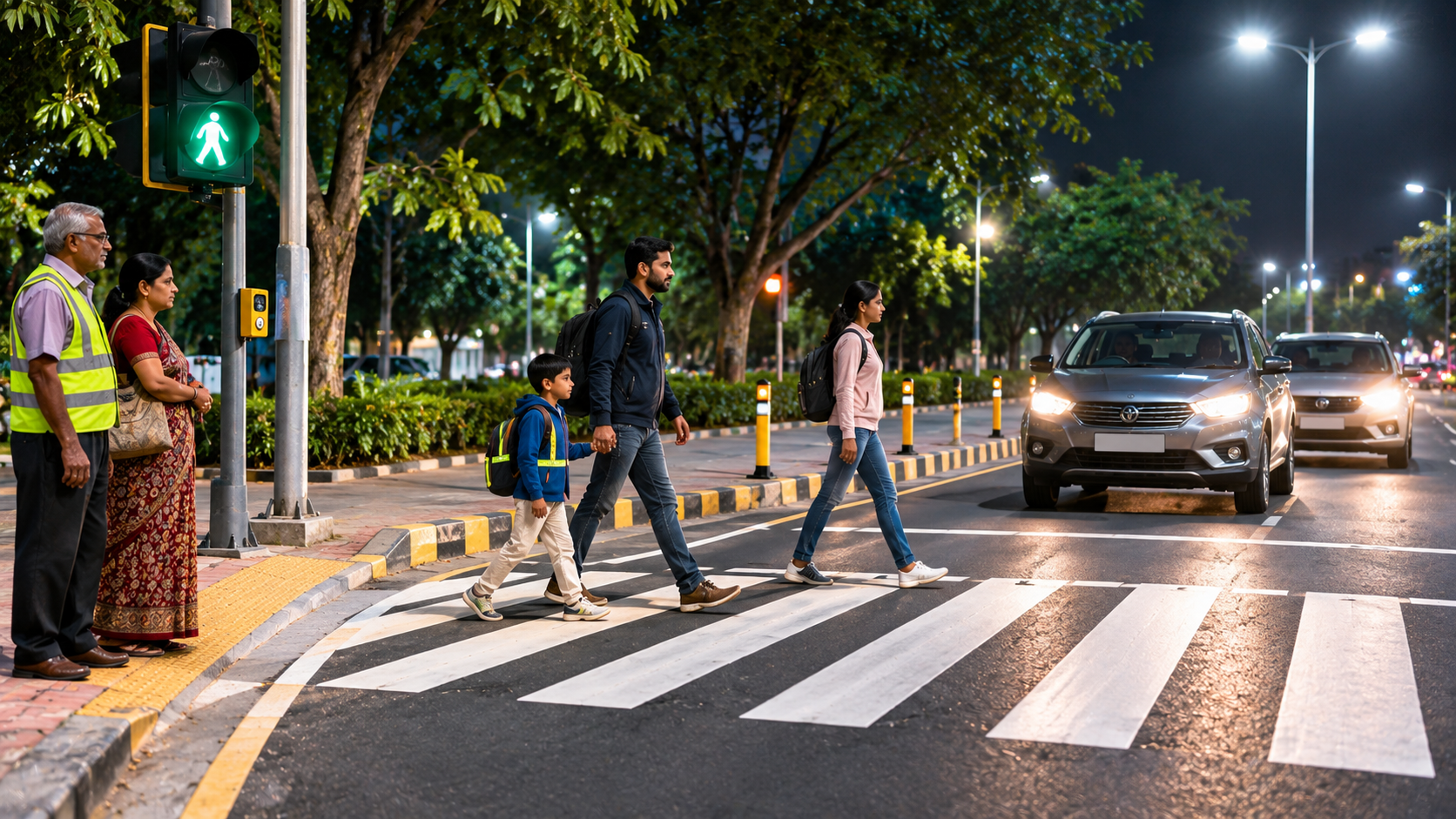
A person walking home should not have to gamble with their life just to cross a road. Yet pedestrians often face fast-moving traffic, missing footpaths, poorly lit stretches, parked vehicles blocking sightlines and drivers who do not expect someone to cross.
India’s Ministry of Road Transport and Highways reported 35,203 pedestrian deaths in 2023—about 20.4% of all road-accident deaths recorded that year. This is an official 2023 figure, not a 2026 estimate, but it shows why pedestrian protection deserves urgent attention from drivers, road authorities and every person who uses the street.
Pedestrian safety is a shared responsibility. People walking must choose safer places to cross and make themselves visible. Drivers must slow down, watch for people at crossings and never assume the road is clear simply because they do not immediately see someone.
Why pedestrians are especially vulnerable
Unlike people inside a vehicle, pedestrians have no protective vehicle structure around them. A collision can cause severe injury even at relatively low speeds. At night, in rain or in poorly lit areas, a person may be difficult to see—especially when wearing dark clothing or stepping out from behind a parked vehicle.
Risk also increases where footpaths are missing or obstructed, crossings are inconvenient, vehicles block junction views, or drivers approach intersections too quickly. These are not problems that pedestrians can solve alone. Safer street design, lower speeds where people walk, accessible footpaths and well-marked crossings all matter.
9 pedestrian safety rules every road user should remember
1. Use a proper crossing whenever one is available
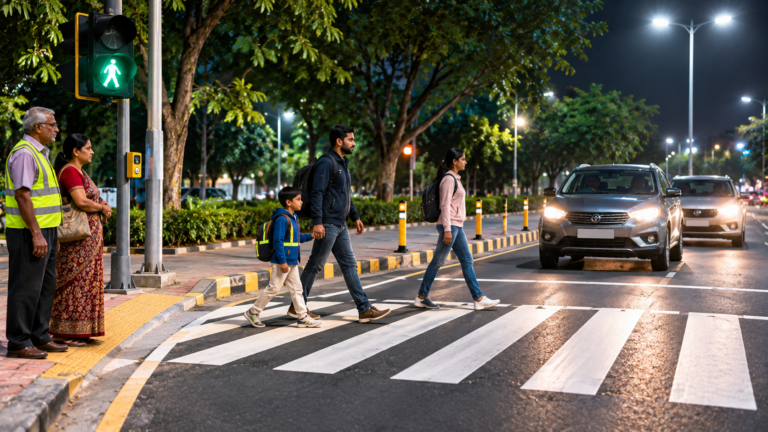
Choose a zebra crossing, signal-controlled crossing, foot overbridge or underpass where it is safe, accessible and practical to use. Follow pedestrian signals and road signs. Never assume that a vehicle will stop just because you have stepped onto a crossing—look for traffic to slow and stop before you proceed.
2. Stop, look and listen before stepping onto the road
Pause at the edge of the pavement. Check both directions and watch for turning vehicles, motorcycles and vehicles approaching from less obvious angles. Keep looking while crossing. Cross directly and steadily when the road is clear; do not run unpredictably between moving vehicles.
3. Make yourself visible after dark
Wear light-coloured or bright clothing where possible. After dark, reflective material is more useful because it reflects vehicle headlights. A reflective strip on a bag, jacket or umbrella can help drivers notice you earlier. Choose well-lit routes and cross at well-lit places whenever possible.
4. Walk on the footpath—not in the traffic lane
Use the pavement or footpath wherever one is provided and usable. If there is no footpath, police pedestrian guidance in India advises walking on the right side of the road so you can face oncoming traffic. Keep as far from moving vehicles as conditions allow and move to a safer place when the road layout makes walking dangerous.
5. Never cross from behind a parked vehicle
A parked car, bus or delivery vehicle can hide you from approaching drivers—and can hide approaching traffic from you. Move to a point where you can see clearly in both directions before deciding where to cross. Never step straight out from between parked vehicles.
6. Put your phone away while crossing
Do not read messages, watch videos or wear headphones at a volume that prevents you from hearing traffic. Give the road your full attention until you reach the other side. A few seconds of distraction can make you miss a turning vehicle or a signal change.
7. Take extra care with children and older people
Hold a young child’s hand near traffic and teach them to stop at the kerb, look and wait for a safe crossing. Allow older people and anyone with limited mobility enough time to cross. Drivers should be patient and never accelerate toward someone who is still crossing.
8. Drivers must expect pedestrians near people-centred places
Slow down near schools, markets, bus stops, hospitals, residential streets and junctions. Scan both sides before turning. Do not stop on zebra crossings or block footpaths. Give people crossing enough room and time; never use the horn or a sudden acceleration to pressure them out of the way.
9. Do not take a chance when visibility is poor
In rain, fog, glare or darkness, wait for a clear and safe gap. Do not assume a driver has seen you. Drivers should reduce speed to suit visibility, keep windscreens and lights clear, and be prepared for pedestrians near the edge of the road.
Do’s: small habits that can protect lives
- Do use designated crossings and obey pedestrian signals.
- Do stop at the kerb, look both ways and listen before crossing.
- Do wear reflective material at night and choose well-lit routes.
- Do use footpaths; where none exist, walk facing oncoming traffic and well away from moving vehicles.
- Do hold children’s hands and assist people who need extra time.
- Do stay alert at junctions, driveways, bus stops and parking exits.
- Do slow down and give way to pedestrians where required by signals, markings and traffic rules.
- Do report broken crossings, blocked footpaths and faulty streetlights to the responsible local authority.
Don’ts: dangerous choices to avoid
- Don’t dash across gaps in moving traffic.
- Don’t cross from behind buses, trucks or parked cars.
- Don’t assume a vehicle will stop until it has visibly slowed and stopped.
- Don’t use a phone or allow headphones to distract you while crossing.
- Don’t walk in the carriageway when a usable footpath is available.
- Don’t stand or wait in the path of turning vehicles.
- Don’t ignore pedestrian signals or cross against a red signal.
- Don’t drive fast through school zones, markets or residential streets.
Benefits of safer pedestrian behaviour and streets
- Fewer serious collisions: safer crossing choices and lower approach speeds reduce exposure to dangerous conflicts.
- Earlier visibility: reflective clothing and better lighting help drivers notice people sooner.
- Safer journeys for vulnerable users: children, older people and people with disabilities benefit from accessible paths and adequate crossing time.
- Better traffic flow: predictable crossings, clear footpaths and drivers who anticipate pedestrians reduce sudden braking and confusion.
- Healthier communities: walkable, safer streets make everyday walking more practical for school, work and local trips.
A message for every driver
A pedestrian may be a child going to school, a worker returning home, an older person visiting a clinic or a parent walking with family. They are not an obstacle to your journey. They are people sharing the road environment with you.
One careful pause at a crossing can protect a life. Slow down. Look twice. Let people reach the other side safely.
Drive Safe Stay Safe
@SafeRoadLife
Sources and further reading
- Ministry of Road Transport and Highways: Road Accidents in India 2023 — pedestrian fatalities, pages 62–64
- Delhi Traffic Police: General Safety Guidelines
- Uttar Pradesh Police: Road Safety — pedestrian guidance
- Uttar Pradesh Police: Guidelines for Pedestrians
- World Health Organization: Pedestrian Safety — A Road Safety Manual for Decision-Makers and Practitioners
About the Author