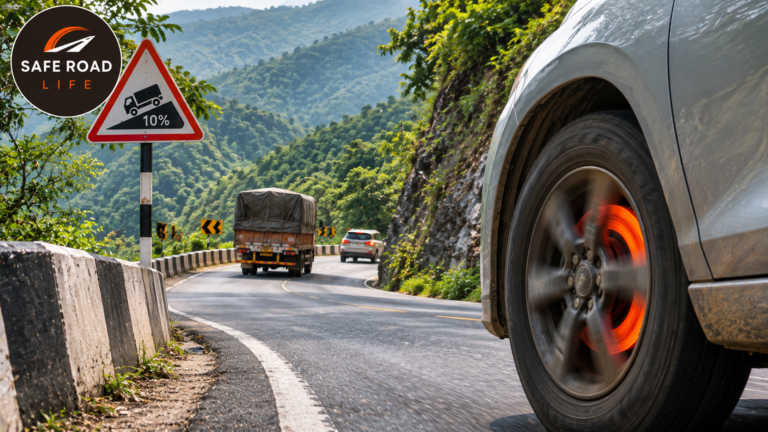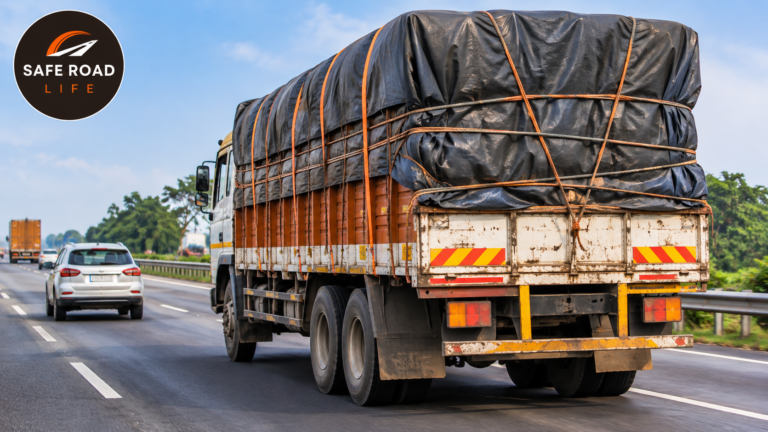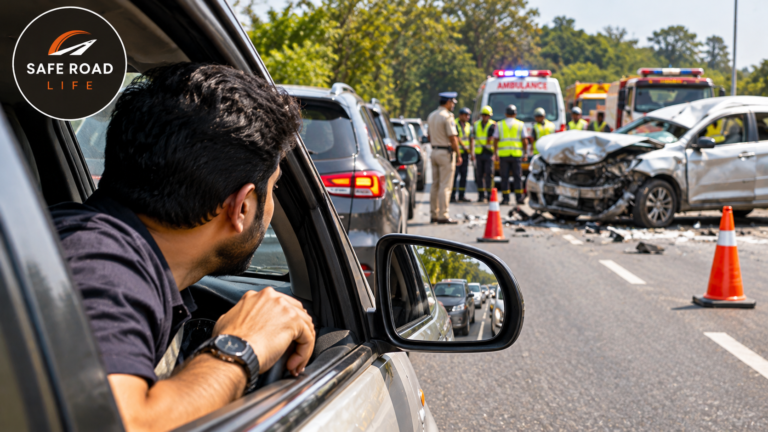
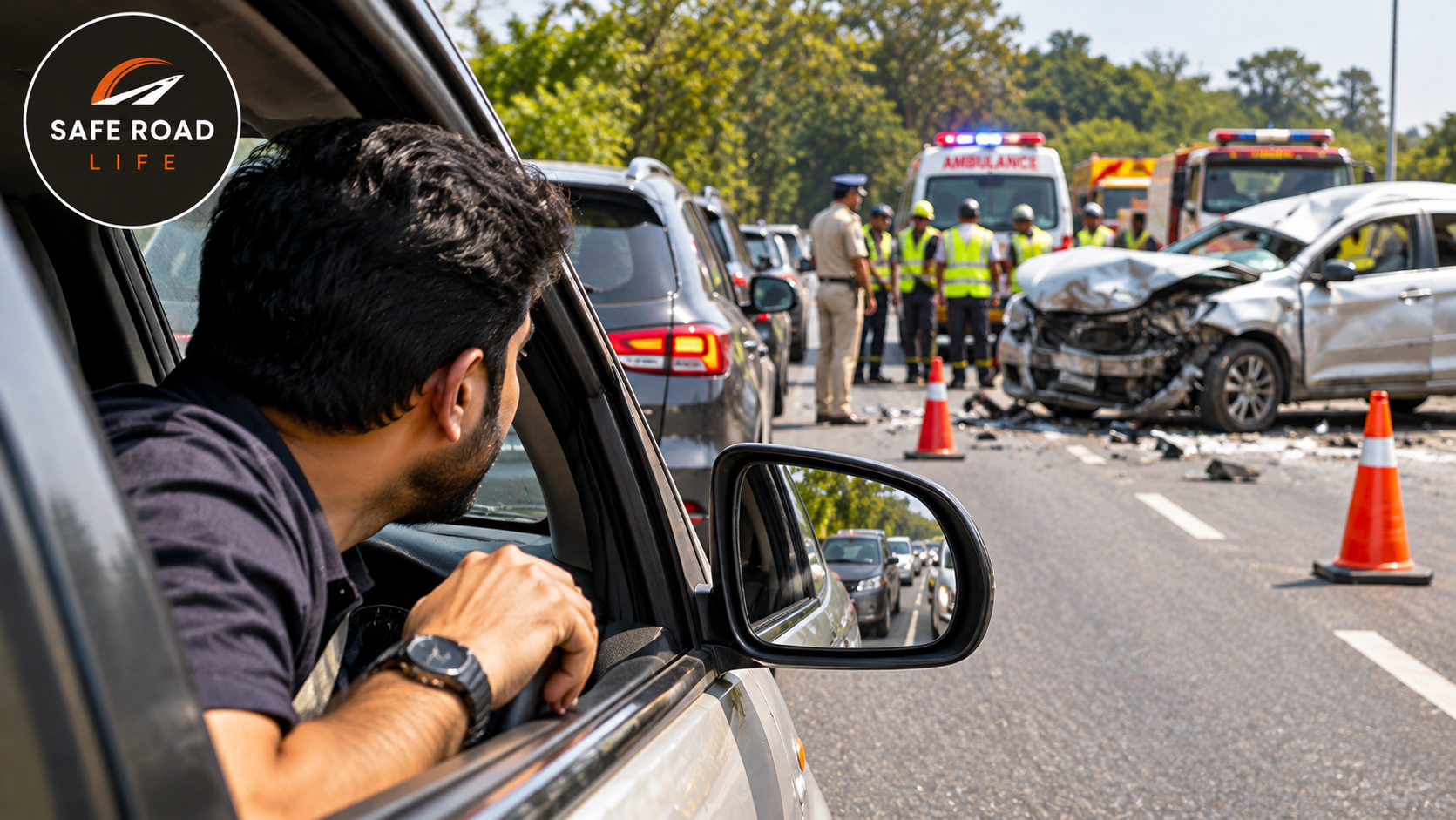
A crash has happened on the opposite carriageway. Emergency vehicles are already there. Your lane is open, the road ahead is clear—and then traffic slows. Drivers turn their heads. Someone reaches for a phone. A vehicle drifts towards the lane marking. The queue grows, and a driver approaching from behind is forced to brake hard.
The original crash may be over for the people passing by, but their reaction can create another one. This behaviour is commonly called rubbernecking: slowing down or looking towards an incident instead of concentrating on the road ahead. It may feel like harmless curiosity. At highway speed, a few seconds of lost attention can be enough to cause a second collision.
Why looking at a crash creates another danger
Drivers naturally notice unusual activity—damaged vehicles, flashing lights, police officers or an ambulance. The problem begins when attention shifts away from the driving task. A vehicle may slow unexpectedly, wander within its lane or fail to notice that traffic ahead has stopped. Drivers behind then react late, creating a chain of sudden braking and lane changes.
The Federal Highway Administration identifies roadside distractions and rubbernecking as causes of traffic slowdowns and crashes. Its research describes how drivers looking at incidents, including those on the opposite side of a road, can reduce traffic flow and contribute to collisions. A crash scene can therefore create risk well beyond the lane where the original incident occurred. FHWA research on roadside distractions and rubbernecking.
The queue may be more dangerous than the scene
One of the most serious risks is a secondary crash: a collision that occurs because of the original incident or the traffic queue it creates. A driver may approach a line of stopped vehicles at normal highway speed, only to discover the queue too late. A rear-end collision can then injure people who were not involved in the first crash.
In a multistate analysis, the Federal Highway Administration examined secondary-crash reports and identified rear-end collisions in slowing traffic or queues near an earlier incident as a major pattern. The report also explains that rubbernecking can reduce roadway capacity and contribute to unexpected queues. FHWA Secondary Crash Research: A Multistate Analysis.
Opposite-direction traffic is not an exception
Some drivers assume that an incident on the other side of a divided highway cannot affect them. But staring across the median can take their eyes off the vehicles in front. It can also trigger unnecessary braking as several drivers slow down to see what happened. On undivided roads, the distraction can be even more dangerous because vehicles, pedestrians and emergency responders may be close to the live traffic lane.
Do not stop on the shoulder to watch, take photographs or record video. Do not use a phone while passing the scene. If you are not directly involved and have no role in helping, keep moving safely and leave space for emergency services.
What should a driver do when approaching an incident?
Look well ahead and scan for brake lights, warning signs, cones, emergency vehicles and the end of any traffic queue. Reduce speed smoothly when conditions require it, increase your following distance and be prepared for vehicles ahead to stop. Avoid abrupt lane changes or hard braking unless necessary to prevent a collision.
Follow instructions from police, traffic personnel and emergency responders. Move over only when it is safe and lawful. Never cross a solid line, use the shoulder as a shortcut or enter a closed lane to get past the queue. If an alternate route is clearly signed or advised, follow it calmly.
Do not make the emergency scene harder for responders
Police, ambulance crews, firefighters, highway patrol teams and recovery operators work close to moving traffic. They need predictable vehicle movements and enough room to reach injured people, position equipment and clear hazards. A passing driver who slows to stare, blocks access or ignores traffic control puts these responders at additional risk.
The Federal Highway Administration notes that motorists approaching an incident are vulnerable to secondary incidents caused by sudden slowing, lane changes and emergency-vehicle movements. It also stresses the importance of managing traffic not only at the crash scene but at the back of the queue, where approaching drivers may be surprised by stopped traffic. FHWA: Responder and Motorist Safety.
If you are the first person to discover a crash
If you are directly involved or are the first to come upon a crash, do not create another hazard by stopping in a live lane. Where possible, move to a safe location, switch on hazard warning lights when appropriate, and contact emergency services with the exact location and nature of the incident. In India, call 112 for emergency assistance. Follow the operator’s instructions and do not enter a dangerous traffic area to take photographs or attempt a rescue beyond your ability.
Once responders arrive, give them room to work. If you are simply passing the scene, your safest contribution is to stay attentive, obey directions and avoid becoming another incident for them to manage.
Curiosity can wait. The road cannot.
A crash scene is not a spectacle. Behind the flashing lights are injured people, worried families and responders trying to do their jobs in a dangerous environment. Looking for a better view does not help them. It only takes attention away from the road and can put more lives at risk.
When you approach an incident, keep your eyes on your driving, slow down smoothly when needed, leave a safe gap and follow traffic instructions. Do not film, stare or stop to watch. The next person who needs help should not be someone injured in a second crash caused by the first.
DRIVE SAFE. STAY SAFE.
@SafeRoadLife
Sources
- Federal Highway Administration – Responder and Motorist Safety
- Federal Highway Administration – Secondary Crash Research: A Multistate Analysis
- Federal Highway Administration – Roadside Distractions and Rubbernecking
- Government of India – Emergency Response Support System 112
About the Author