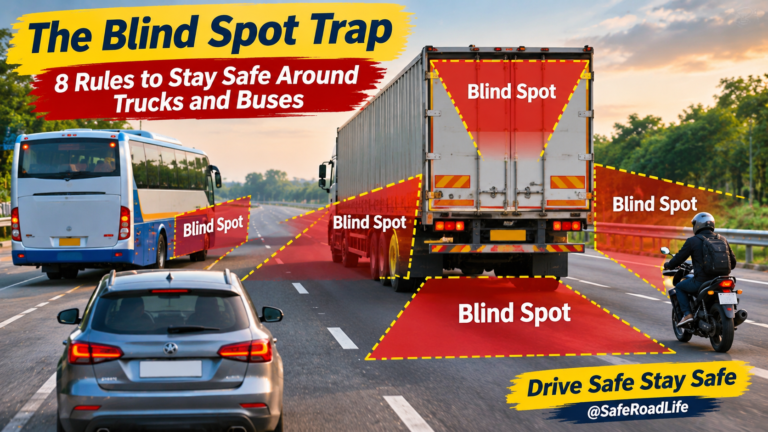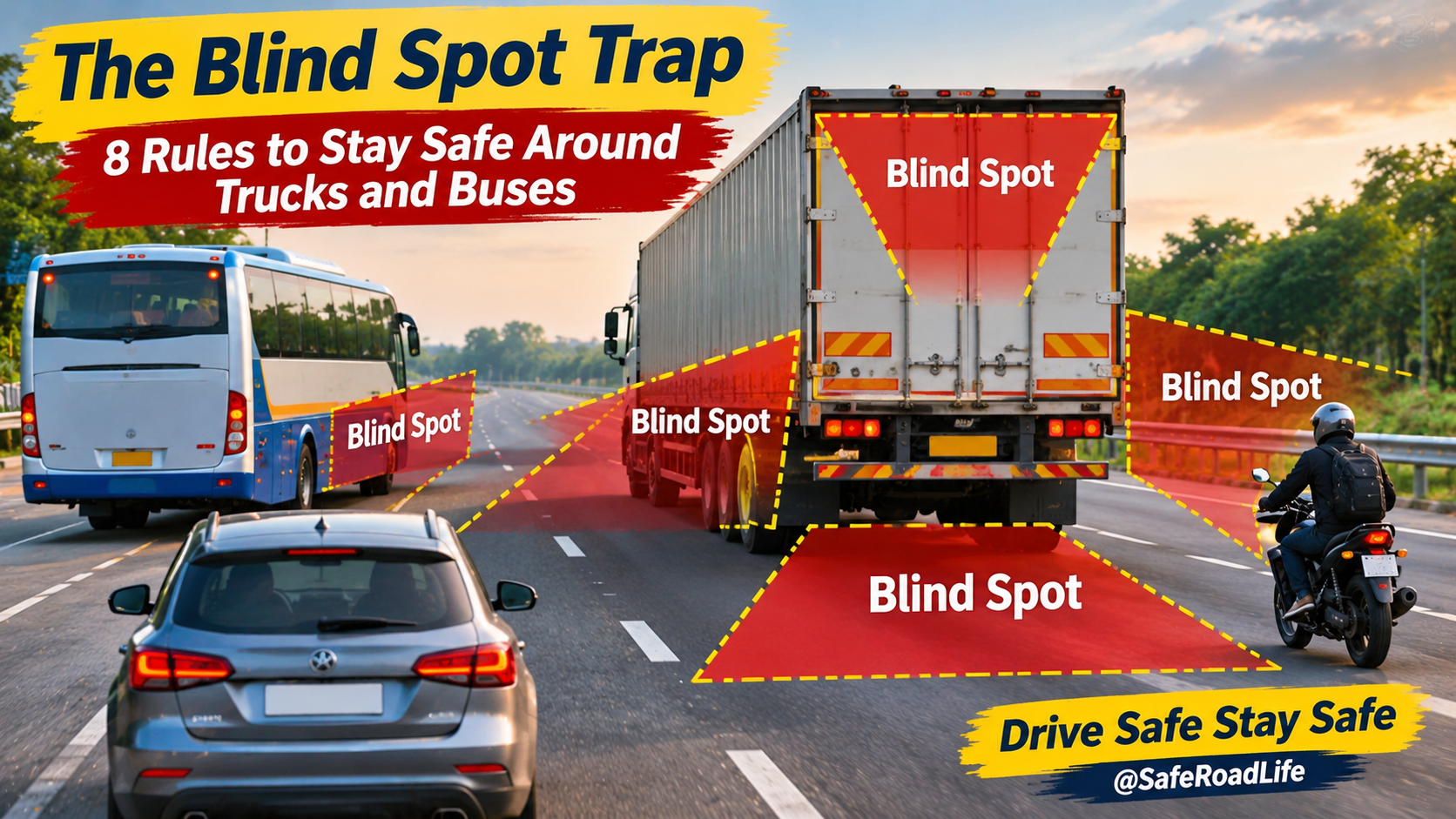
A truck driver can be looking ahead, checking mirrors and still not see a motorcycle, car or pedestrian beside the vehicle. That is the danger of a blind spot. Around a large bus or truck, a few seconds spent in the wrong position can leave a road user hidden from the driver’s view.
Large vehicles are essential to India’s transport system. They carry passengers, food, fuel, medicines and goods across cities and highways. But their size, cab position, body length and mirror coverage create visibility limits that smaller road users must understand.
The safest rule is simple: never assume the driver has seen you just because you can see the vehicle.
Where can a truck or bus driver fail to see you?
Blind zones differ with vehicle design, mirrors, cameras, load body and seating position. Common risk areas include:
- Close to the front: a person or two-wheeler directly ahead may be hidden below the driver’s sightline.
- Along the sides: vehicles travelling close beside the cab or body may disappear from the mirrors, especially around the door and rear body area.
- Immediately behind: the rear of a large vehicle can hide pedestrians, cyclists and vehicles when it reverses or moves away.
- Near the turning path: the vehicle may swing or track across a wider area than a car while turning.
India’s road-safety guidance recognises that commercial vehicles can have larger blind spots because of their size and design. The Ministry of Housing and Urban Affairs’ Drivers Handbook also illustrates blind areas around buses, including the rear and side zones.
8 safety rules every road user should follow
1. Do not ride or drive alongside a truck for too long
Avoid staying beside a large vehicle, especially near its cab, rear wheels or body sides. Either remain well behind it or pass only when permitted, with a clear view and enough space to complete the manoeuvre safely. Never accelerate into a gap that may close.
2. Never squeeze between a turning truck and the kerb
A truck or bus may need extra room to turn. Its body and wheels do not follow the same path as a small car. If a large vehicle signals or begins turning, stay back and allow it to complete the turn. Do not try to slip through the narrow space beside it.
3. Leave extra space before merging in front
Large vehicles need more distance and time to slow down than many passenger vehicles. Do not cut sharply in front of a truck or bus and then brake. After overtaking, return to your lane only when there is a safe, generous gap.
4. Never tailgate or follow too closely
Following close behind a truck or bus reduces your view of the road ahead and leaves little room to react if it brakes suddenly. Maintain a safe following distance and increase it in rain, poor visibility, on slopes or when carrying a load.
5. Stay out of the reversing area
Never walk, cycle or ride directly behind a truck or bus that may reverse. Do not rely only on a reversing alarm or camera. Keep clear until the driver has stopped and the manoeuvre is complete. Drivers should use a trained spotter where available and stop if the rear area is not confirmed clear.
6. Make yourself visible as a pedestrian or cyclist
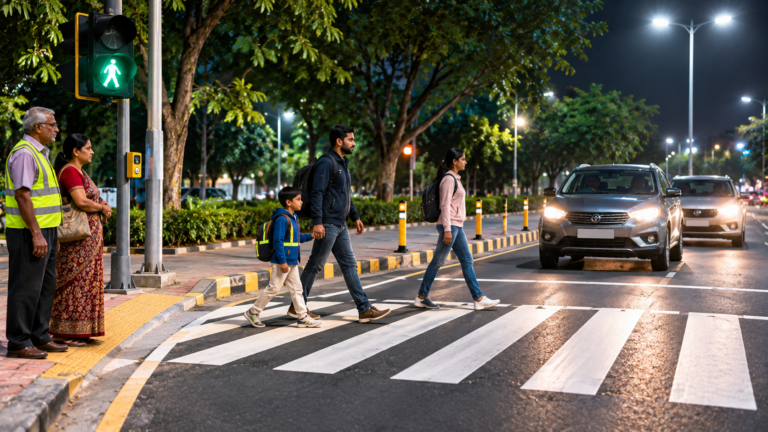
Use footpaths and designated crossings where available. Stay away from the corners and turning path of large vehicles at junctions. In darkness or bad weather, use bright or reflective clothing and lights where appropriate. Never assume a driver has noticed you.
7. Drivers must adjust mirrors and check more than once
Before moving, changing lanes, turning or reversing, check all mirrors and any fitted cameras. Adjust mirrors before the journey, keep them clean and use a slow, deliberate scan. Mirrors and cameras reduce blind areas but do not remove every visibility gap.
8. Use a safe stop-and-check routine
When visibility around the vehicle is uncertain, stop in a safe place. For reversing or tight manoeuvres, use a trained spotter when available, agree on clear signals and stop immediately if the spotter disappears from view. Never guess that the path is clear.
Do’s: habits that protect lives
- Do keep a safe distance from the front, sides and rear of heavy vehicles.
- Do wait behind a truck or bus when it is preparing to turn.
- Do pass only where legal and safe, and do not linger beside the vehicle.
- Do give a heavy vehicle room to brake, merge and complete a turn.
- Do use pedestrian crossings and stay clear of reversing areas.
- Do check mirrors, cameras and the surroundings before moving a bus or truck.
- Do use a trained spotter for difficult reversing manoeuvres when available.
- Do report damaged mirrors, cameras, alarms or other safety equipment.
Don’ts: dangerous mistakes to avoid
- Don’t ride in the narrow space beside a truck or bus.
- Don’t overtake a large vehicle that is signalling or positioning for a turn.
- Don’t cut closely in front of a heavy vehicle.
- Don’t tailgate or sit directly behind a reversing vehicle.
- Don’t stand close to the front or rear of a bus while it is moving.
- Don’t assume mirrors or cameras show every person and object.
- Don’t reverse when the path is unclear or the spotter’s signal is lost.
- Don’t pressure a driver to move until the surrounding area is safe.
Benefits of understanding blind spots
- Fewer visibility-related conflicts: road users are less likely to remain where a driver may not see them.
- Safer turns and lane changes: more space gives drivers time to manoeuvre carefully.
- Better protection for pedestrians and riders: staying clear of front, rear and side blind zones reduces exposure to danger.
- Less vehicle damage and downtime: careful low-speed manoeuvres can prevent avoidable contact and repair costs.
- Stronger fleet safety culture: mirror checks, spotter procedures and defect reporting make safe operation repeatable.
What transport operators should do
Fleet owners and depot teams should include blind-spot awareness in driver induction and refresher training. Check that mirrors are fitted, adjusted and intact; verify reversing alarms and cameras where fitted; and make sure drivers practise safe turning and reversing procedures. A damaged mirror or camera should be reported and repaired—not ignored.
In a 12 February 2026 release, India’s Ministry of Road Transport and Highways described future requirements for Blind Spot Information Systems and Moving Off Information Systems on specified heavy-vehicle categories, with effective dates beginning in 2027 and 2028. These technologies can support awareness, but they do not replace careful observation and safe procedures.
Remember this before you pass a truck or bus
If you cannot be certain the driver has seen you, do not stay there. Give the vehicle space and choose the safer position.
A truck driver, a bus passenger, a motorcyclist and a pedestrian all deserve to reach home safely. Blind spots are a shared-road risk, and preventing a conflict is easier than recovering from one.
DRIVE SAFE. STAY SAFE.
@SafeRoadLife
Sources and further reading
- Haryana Transport Department: Road Safety Manual – Sharing the Road and Blind Spots
- Ministry of Housing and Urban Affairs: Drivers Handbook – Know Your Blind Spots
- Press Information Bureau / Ministry of Road Transport and Highways: Mandatory Safety Devices for Heavy Commercial Vehicles, 12 February 2026
- US Federal Motor Carrier Safety Administration: Tips for Passenger Vehicle Drivers
- US Federal Motor Carrier Safety Administration: Tips for Truck and Bus Drivers
Related SafeRoadLife reading: Driver Fatigue: 9 Warning Signs Every Highway Driver Must Never Ignore · Mumbai–Pune Expressway New Rules and Speed Limits
About the Author